


Big Tech bosses are changing their tune on AI and jobs.
A year ago, the heads of the biggest tech companies warned that AI would wipe out millions of jobs. Dario Amodei talked about half of unskilled positions disappearing within a few years. Sam Altman predicted labor market upheavals unlike anything we've seen in a long time. The market mood was apocalyptic, and most investors started acting accordingly.
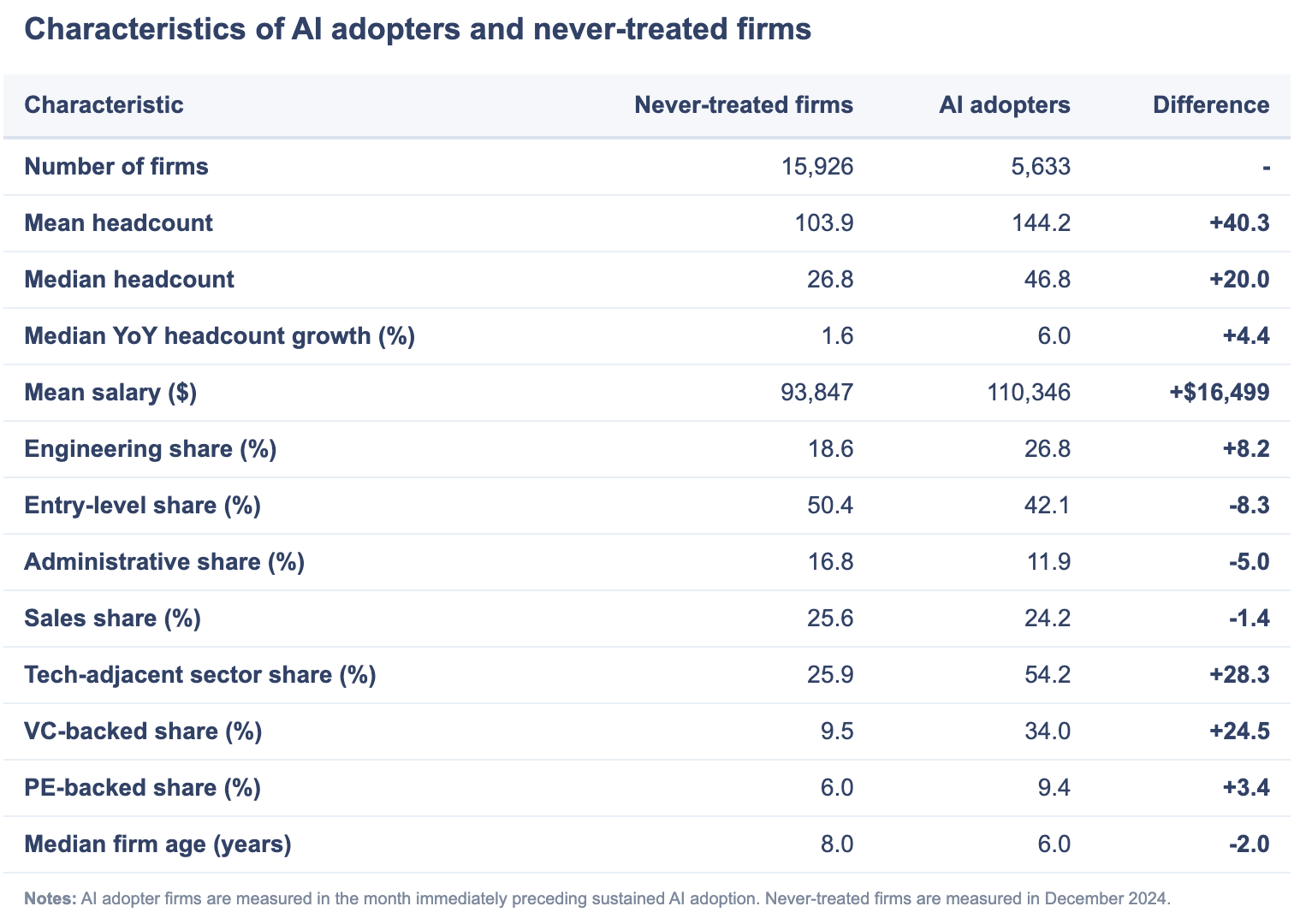
Characteristics of firms adopting AI versus those that aren't
Over the last month, though, we've been hearing something different from the same people. Altman suddenly says that companies investing the most in AI are also hiring the most. Amodei admits their estimates of social and economic impacts were "pretty off." Zuckerberg claims that if AI boosts productivity faster than it replaces people, the result should be more, not less, work.
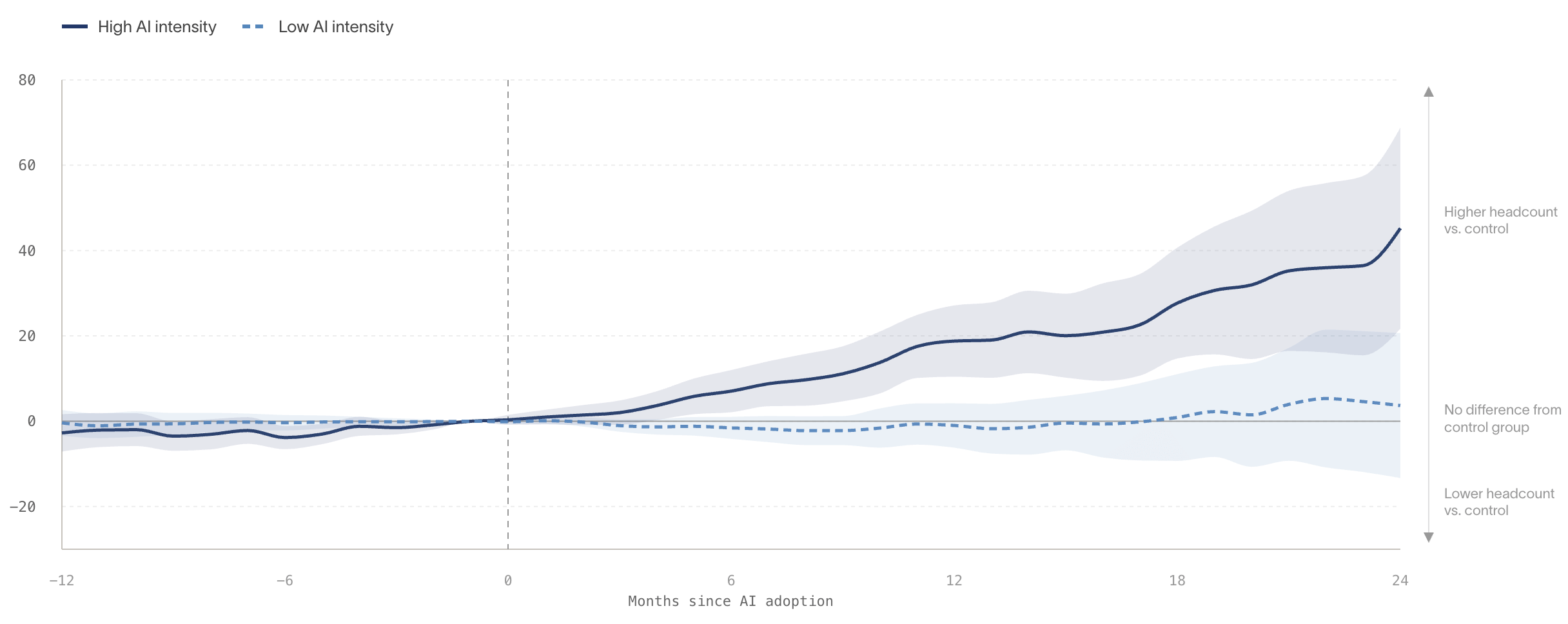
AI adopters are hiring; the rest are stagnating.
The question that occurred to me and has been nagging at me – is the hiring surge just a PR spin, or are the public and clients starting to get fed up with AI? Or has reality turned out differently than people imagined a year ago?
ATMs were supposed to kill bank tellers
I recently read in a book about what happened in the 70s and 80s when banks began deploying ATMs on a massive scale. Economists and journalists wrote practically the same things we hear about AI today – the end of bank tellers is near. A machine that can dispense cash and accept deposits would surely replace the person behind the counter.
But the exact opposite happened. The number of bank tellers in the US kept growing for decades after ATMs were introduced. ATMs lowered the cost of running a branch, so banks opened new branches faster than before, and tellers moved from counting banknotes to selling mortgages, investment products, and advising. Automation eliminated one narrow activity but opened the door to a broader role that earned the bank more money.
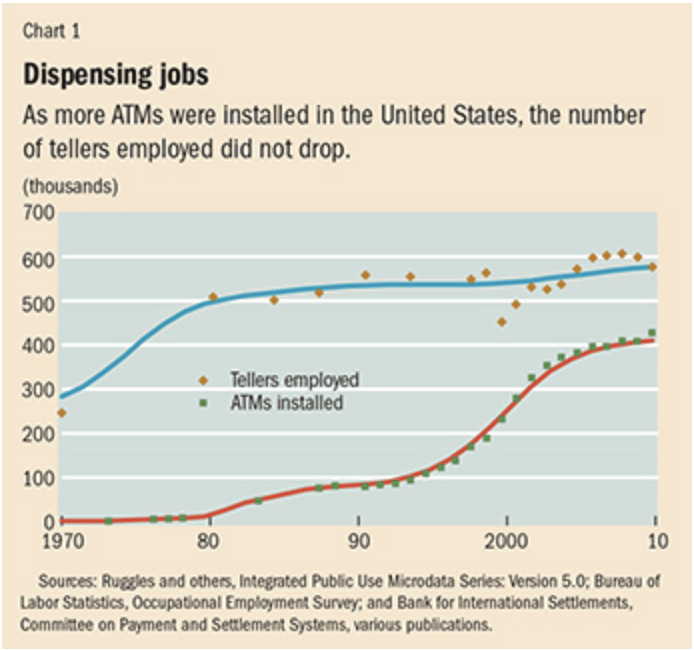
Growth of bank employees and ATMs after ATM introduction
It's not that automation never affects employment. It's that the effect tends to be different from what we see in moments of fear, and it's worth measuring with hindsight, not during the hype.
What's actually changed over the past year
An EY-Parthenon survey among CEOs shows that the share of company heads expecting significant workforce reductions due to AI investments fell from about 46% in January 2025 to 20% this May. That's a drop of more than half in a year and a half – and it's not one company; it's a whole sample of leadership across industries.
A study by fintech Ramp and analytics firm Revelio Labs found that companies with the highest AI investments increased employment about 10% faster than comparable firms that hadn’t yet deployed AI. That's exactly the opposite signal you'd expect if AI were primarily replacing people.
Of course, it's not uniform. Meta $META laid off 8,000 people in May and is shifting money into AI infrastructure. Amazon $AMZN reduced headcount by 16,000 positions over the past year, though the company says it's more about streamlining corporate culture than AI directly. Ford $F warned last year that AI could replace half of white-collar workers in the US, yet this year it hired hundreds of engineers because work quality dropped after automation, and more human experts were needed to operate and oversee AI tools.
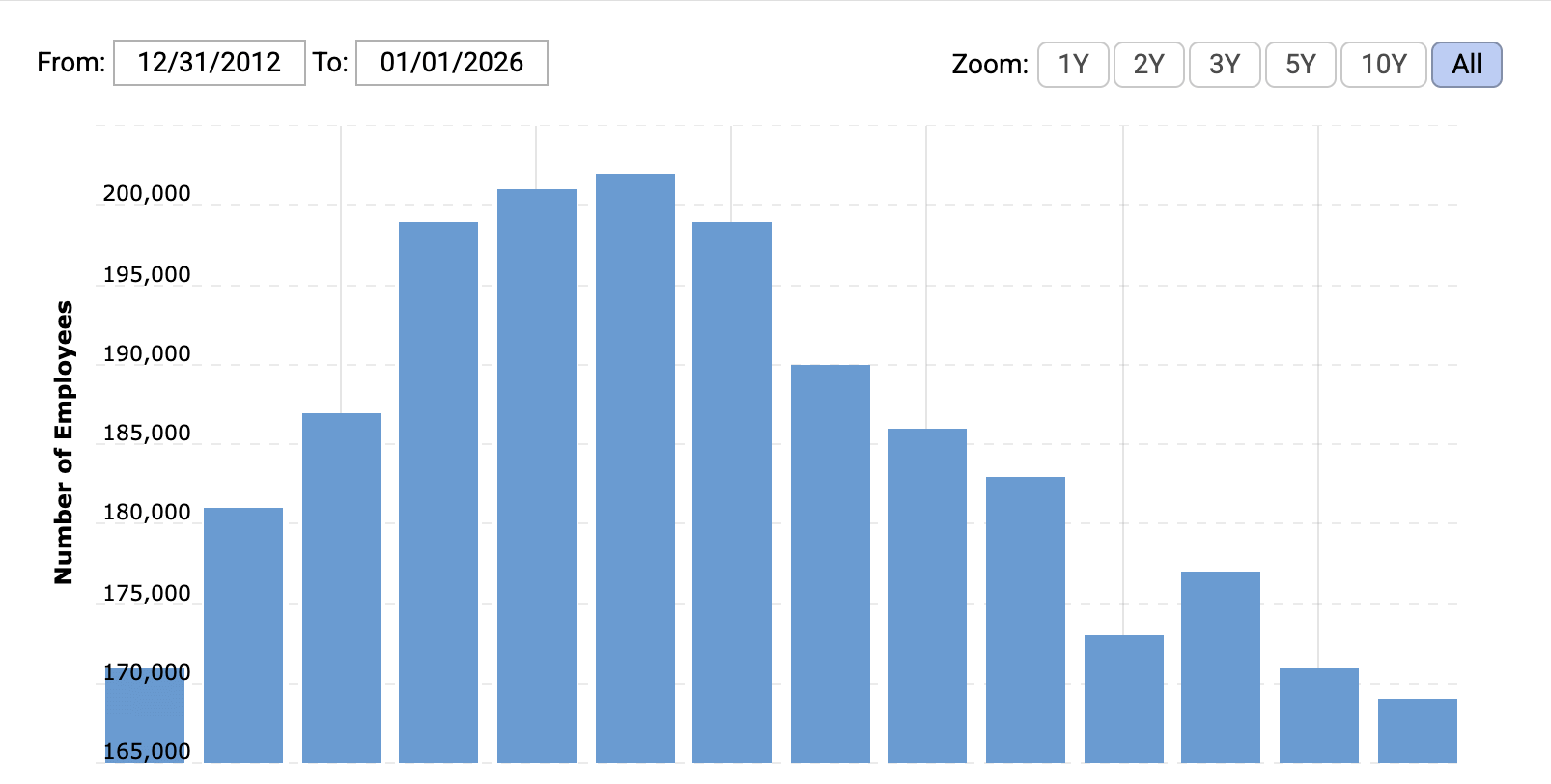
Ford $F employee growth chart
AI often first replaces a narrow, repetitive task, and then the company realizes it needs more people with deeper expertise to oversee the output and work with the tool meaningfully. Just like with ATMs.
There's also an interesting perspective from MIT economist David Autor, who points to a rather mundane explanation – the labor market simply isn't collapsing as fast as company leaders expected, and it would be bad business to keep claiming that your own product will destroy the economy. In other words: some of this optimism might be a correction of overblown marketing, not a discovery of new truth.
Why I lean toward the more optimistic version
I'm not the type to believe everything a CEO says at a conference – those people have an interest in selling their product and shifting their tone to what sounds good right now. But with this turnaround, a purely cynical explanation doesn't sit right with me because it's backed by real numbers, not just quotes.
The drop from 46% to 20% among CEOs expecting mass layoffs, plus the fact that companies investing the most in AI are actually increasing employment – these are data points that CEOs didn't make up for better PR, because they were collected by independent analysts. And the history of automation gives me reason to expect a similar pattern now: AI eliminates specific tasks, not entire professions, and the freed-up capital and time flow elsewhere.
What also keeps me up at night is the asymmetry between sectors. In companies where AI is deployed on narrow, well-defined tasks (coding, support, basic data analysis), I see real productivity increases and, in parallel, hiring of people who can operate those tools. In companies where AI is used as an excuse for cuts (and I'd venture that Amazon and Meta partly fall into this category), I see straightforward cost reduction merely wrapped in an AI narrative because it sounds better to investors than "we're cutting because we overexpanded."
For me, the clear conclusion is: betting on companies where AI truly enhances people's performance rather than replacing them is a more sustainable investment thesis than betting on companies that use AI as a pretext to slim down corporate expenses. The first group grows with the economy; the second only temporarily improves margins.
