Apple bets on domestic chips | Future Intelligence #17

The past week was dominated by this idea: tech companies increasingly want to control their own chip supply chain, whether for business or political reasons. On Wednesday, Apple announced a record 30-billion-dollar deal with Broadcom to manufacture chips directly in the US, while Meta simultaneously unveiled its own AI chip and a plan to double computing capacity, and even China's DeepSeek is quietly trying to shed its dependence on Nvidia. Let's take a look at what the future holds.
Bulios Black: Future Intelligence is an exclusive analytical report published once a week and available only to Bulios Black members. To get permanent access to this newsletter, receive it automatically every weekend morning, and read the entire analytical section, including specific scenarios and market implications, you need to become part of Bulios Black.
Apple builds America from silicon
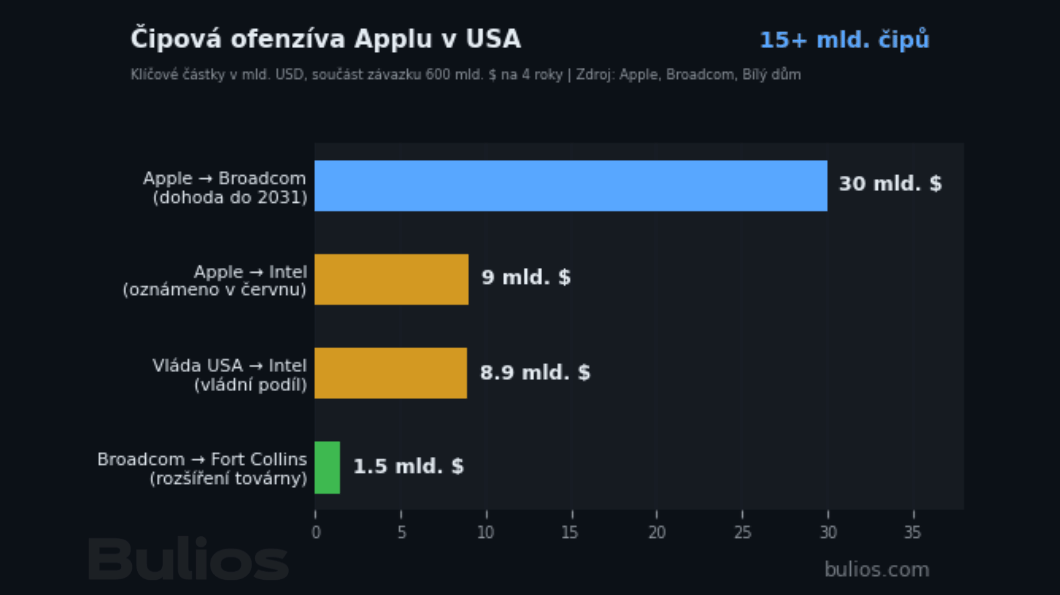
On Wednesday, Apple announced its biggest step yet toward domesticating its supply chain: a multi-year deal with Broadcom worth over 30 billion dollars to design and manufacture chips directly in the US.
What happened
According to a joint statement from both companies, the deal will lead to the production of more than 15 billion chips on US soil and includes both custom ASIC-type chips and key wireless components, specifically FBAR radio-frequency filters that manage how the iPhone divides signal between 5G, Wi-Fi, GPS, and Bluetooth. The contract runs until 2031 and builds on a collaboration that has lasted since the launch of the iPhone 3GS in 2009. Because of the deal, Broadcom is investing 1.5 billion dollars to upgrade and expand its manufacturing plant in Fort Collins, Colorado.
Apple CEO Tim Cook accompanied the statement by thanking President Trump and his administration for supporting the project and called the components made in Fort Collins "essential" to the performance and connectivity customers expect from Apple. Broadcom CEO Hock Tan praised the deal as an impetus to further expand the company's US manufacturing capacity.
This is part of Apple's American Manufacturing Program, which the company launched last year with a commitment to invest a total of 600 billion dollars in the US economy over four years. The Broadcom deal follows a June report that Apple had signed a separate 9-billion-dollar contract with Intel to buy American chips, into which the US government itself invested 8.9 billion dollars.
Why it matters
The motivation is twofold, both business and political. Apple has long faced pressure to diversify its supply chain away from Taiwanese manufacturers, which currently make processors for iPhones, iPads, and Macs, and at the same time is trying to mitigate the impact of tariffs, which according to Cook cost the company billions of dollars per quarter. Cook told the Wall Street Journal in June that price increases on products due to rising costs for memory and storage chips are "inevitable" and that the situation has become "unsustainable." That is precisely why the company is deliberately building an image of growing domestic investments as a counterbalance to any further tariffs.
For Broadcom, the deal has another dimension: it assuages investor fears that Apple might switch to its own wireless chip design and abandon Broadcom as a key supplier. Apple today accounts for roughly 20% of Broadcom's annual revenue, so locking in this collaboration until 2031 gives the company unusually high visibility into future revenue.
What it means for investors
The market reacted asymmetrically. Broadcom shares strengthened by about 4% on Wednesday, while Apple remained virtually unchanged, or rather slightly weakened by 0.5%. The explanation is simple: the deal gives Broadcom certainty, whereas for Apple it means an increase in long-term costs, albeit with the promise of lower exposure to tariffs and supply disruptions.
For Broadcom, this means a stable, well-visible revenue stream from one of its biggest customers for the next five years, which is exactly what analysts who rate the stock mostly as a "strong buy" with an average price target around 524 dollars appreciated. For Apple, it's another brick in the wall of its defensive strategy against tariffs and, at the same time, a way to secure supplies at a time when the company is also dealing with memory shortages and preparing to expand AI features across its products.
The timing is also interesting from a corporate leadership perspective. Tim Cook is stepping down as CEO on September 1 and handing the reins to John Ternus, the current head of hardware engineering. Thanks to the deal with Broadcom, Ternus won't have to renegotiate one of the company's most critical supply contracts in his first year on the job.
Risks
Apple did not provide any specific timeline for when the new capacity in Fort Collins will come online, making it difficult to estimate how quickly the investment will translate into lower costs or reduced tariff risk. At the same time, this does not solve the truly pressing problem, which is expensive memory and storage chips, whose prices have roughly quintupled since last August, according to Cook. FBAR filters and wireless chips from the Broadcom deal are not the category of components forcing Apple to raise the prices of Mac, iPad, and other devices by 17 to 25 percent, and the Apple TV by as much as 54 percent.
Moreover, the deal came in the middle of a week marked by renewed fighting between the US and Iran, which briefly increased volatility in tech stocks before the market calmed down again. Apple shares, according to InvestingPro analysis, are trading above their estimated fair value, so even positive news like this has limited room to move the stock price upward.
What to watch next
Apple's third fiscal quarter results, to be released on July 30, will show how much rising memory costs and potential tariff relief are affecting margins before the new Broadcom capacity even comes online. It will also be interesting to see whether Apple announces similar deals for domestic chip production with other suppliers and how quickly the 600-billion-dollar commitment translates into actually opened US operations, not just announced contracts.