Feed Community

Hi investors, I went through a report from Goldman Sachs Research that closes out 2025 and the percentage weight of tech stocks in the overall US market
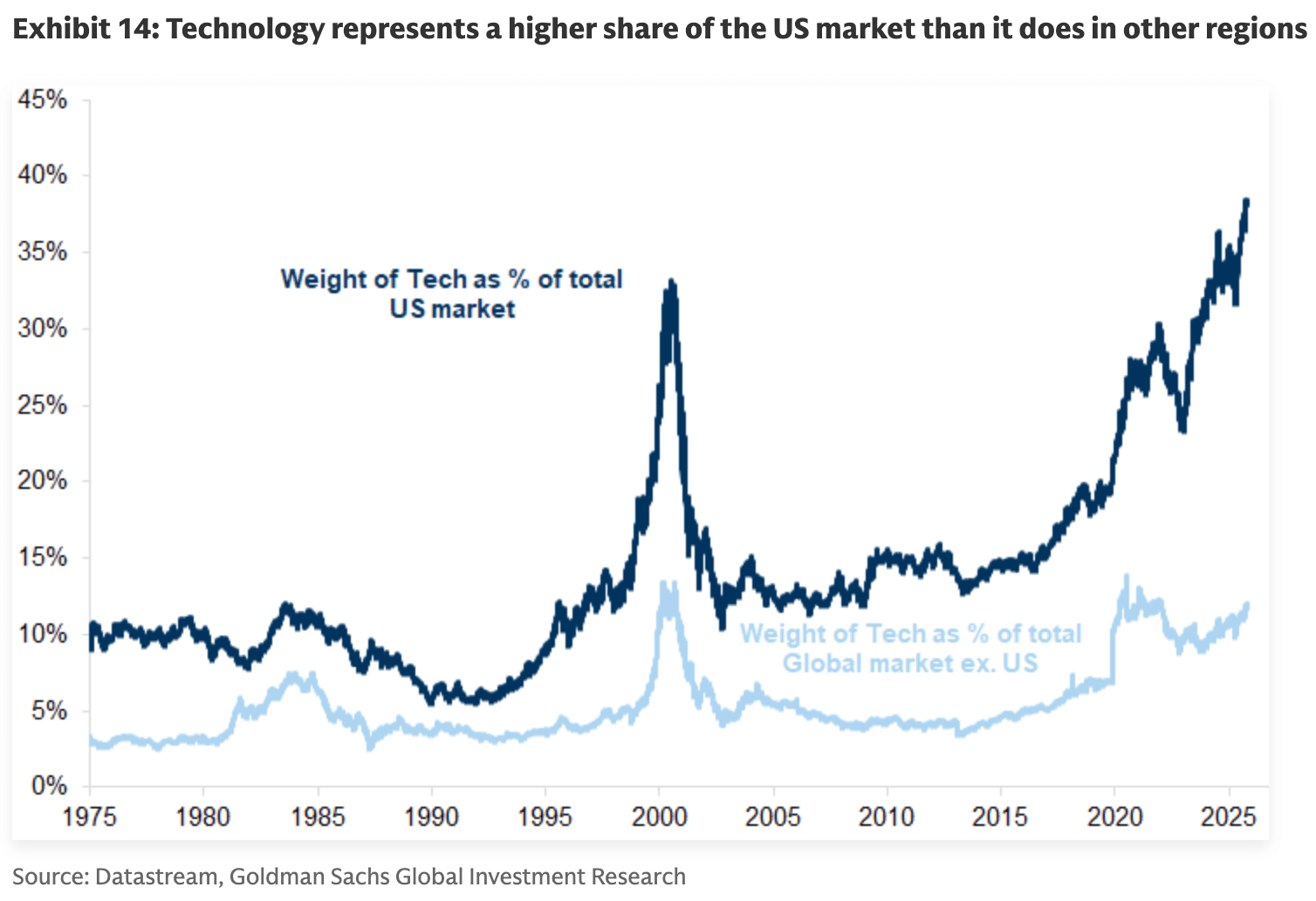
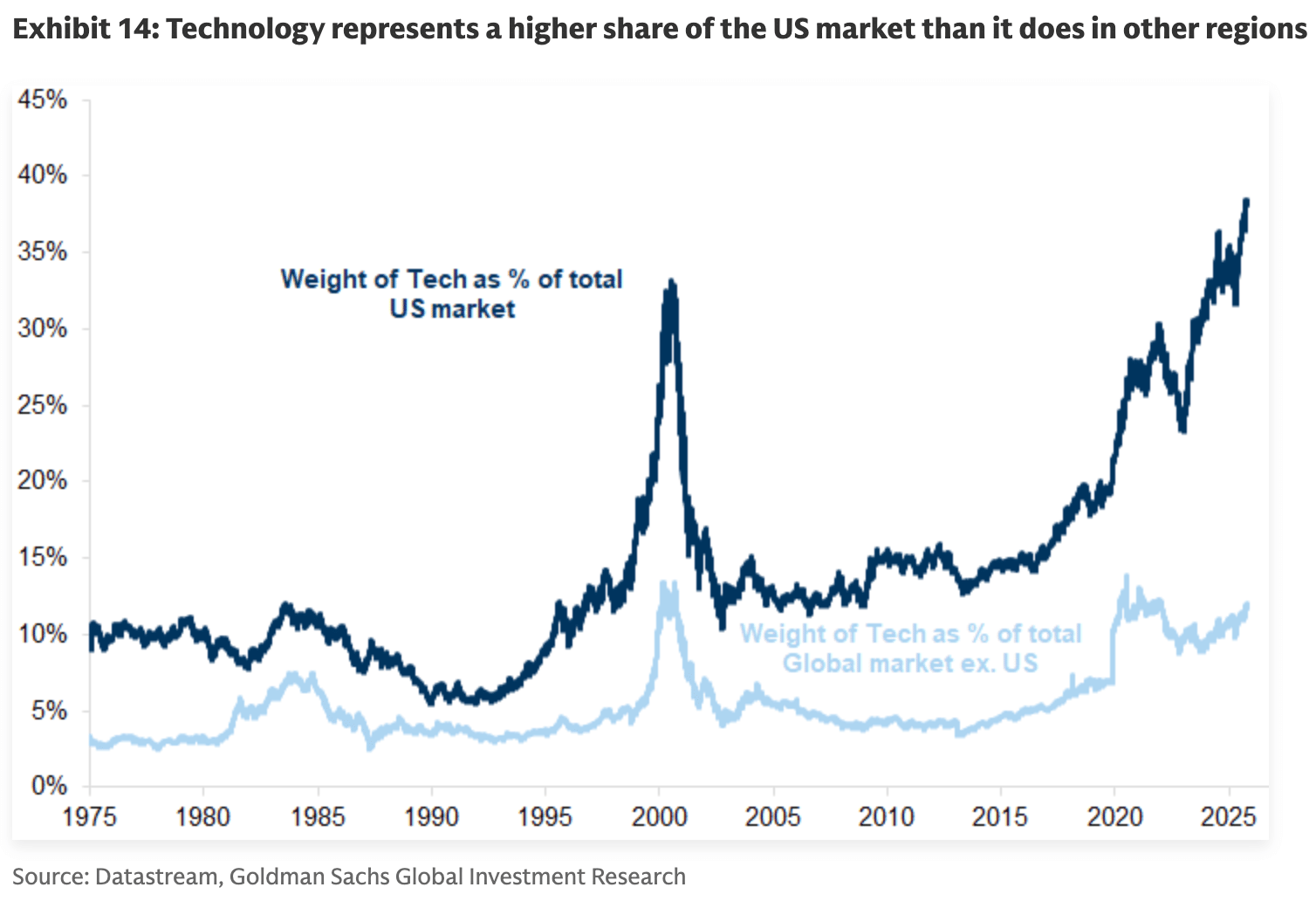
Tech now weighs 49% of the entire S&P 500. It has never been this bloated in history.

For comparison – at the peak of the Dot-Com bubble in 2000, it was 40%. So we’re now 9 points higher than when the whole thing later crashed by tens of percent.

And tech today by itself weighs more than finance, cyclical firms, and defensive stocks combined. The entire rest of the market against one sector.

During the 2008 financial crisis, tech made up just 19%.

I don’t know if this is a bubble or simply a new reality where a few firms pull the entire index. But the market has never looked this lopsided before.

What’s interesting, though, is that by another metric it’s not so clear-cut.

Goldman also looks at the PEG ratio – P/E divided by three-year earnings growth. It shows whether a sector is expensive even considering how fast it’s growing.
Tech now stands at 1.7. At the peak of the Dot-Com bubble it was almost 5.0, in 2015 over 4.5.

So even with the record 49% weight, tech isn’t as overblown by this metric as before, it’s simply growing fast enough to “earn” that price.

The question remains the same: bubble, or new reality? Only now we know the numbers aren’t as clear-cut as they seem at first glance.

TK

I agree that this time the growth is underpinned by profits and high margins. Of course, you need to look at who’s “feeding” it all and that one fine day, investment in data center construction simply won’t total $800 billion per year.

So for me, I don’t see a bubble, but at the same time I believe that in a few years the hyperscalers’ capex will be lower, and that will affect the business of other companies tied to it as well.

I also don’t expect the tech ratio to drop to 10–15%, but if what I described above happens, the ratio will just fall. But I wouldn’t venture to guess whether by a few percent or maybe even toward 30%.

VN

When I occasionally read those bearish opinions that still claim LLMs have no serious use yet, it seems to me that we're really only at the beginning. The vast majority of the CAPEX so far has been used for training/improving models and it's transitioning to inference, which will continue to scale for many more years. If I consider the other much-discussed scenario that hyperscalers are artificially extending hardware depreciation, then those data centers will need to be fitted with a new generation of chips and increased memory every few years.

From what I've seen of some bank estimates up to 2030, there's no sign of any slowdown, quite the opposite (cumulative estimate around 6-8 billion).

VN

Data can be interpreted in many ways. During the dotcom era, that representation was primarily driven by prices that were not backed by profits. Twenty-five years later, it seems quite logical to me that the global economy is supported by technological progress in the IT sector, and I am not at all surprised by the size of its representation—especially when it is backed by high-margin profits. If anyone really expects the tech share to ever return to something like 10–15%, then let them outline a scenario here, because nothing comes to my mind at all.

We use essential cookies to run the website and optional analytics cookies to measure usage. See our Privacy Policy.