


Johnson & Johnson said goodbye to Kenvue, and now the exchange is saying goodbye too. What awaits shareholders ahead of the Kimberly-Clark merger

The consumer giant spun off from Johnson & Johnson is going through its toughest period since becoming independent. The stock has mostly lost value since its IPO in 2023, organic revenue growth turned negative for the first time in 2025, and lawsuits over Tylenol and talc continue to weigh on cash flow despite the indemnity promise from the former parent company. Amid all this, a takeover bid from competitor Kimberly-Clark arrives, valuing the company at $48.7 billion and carrying a premium of over 46 percent. Shareholders of both companies overwhelmingly approved it in January 2026, but closing still awaits foreign regulators. What does this combination mean for the future value of the stock and is it even worth buying today when the company is set to cease independent existence in a few months?
Key points
Kenvue was spun off from Johnson & Johnson via IPO in May 2023, with the parent initially retaining 89.6% of shares, but through a swap offer and sale it reduced its stake to zero by May 2024.
Kimberly-Clark offered $48.7 billion for Kenvue in November 2025, i.e., $21.01 per share and a 46% premium, which shareholders of both companies approved in January 2026.
Full-year 2025 revenue fell organically by 2.2%, the first decline since the IPO, but the fourth quarter brought a turnaround with 4.2% growth and the start of 2026 continued with a 0.7% gain.
The quarterly dividend of $0.2075 yields 4.3 to 4.4%, but the payout ratio against accounting earnings is almost 100% and the company additionally carries debt of about $8.6 billion.
Over 90,000 lawsuits involve talc, and in July 2026 a court reinstated more than 500 Tylenol and autism lawsuits. Moreover, in Chicago a jury assigned Kenvue 70% liability.
Kenvue shares $KVUE fell from the 2023 IPO to a low around $14, and the company that was supposed to become a stable dividend successor to Johnson & Johnson is now dealing with something completely different. In November 2025, Kimberly-Clark $KMB came with an acquisition offer of $48.7 billion, i.e., $21.01 per share in a mix of cash and its own stock.
Shareholders of both companies overwhelmingly approved it in January 2026, and the deal closing now mostly awaits foreign regulators. What was behind this slump, how is Kenvue actually doing as a standalone company, and is it still worth buying the stock today when the company is about to cease to exist in a few months?
Spinoff from Johnson & Johnson: why was Kenvue created?
From division to standalone company
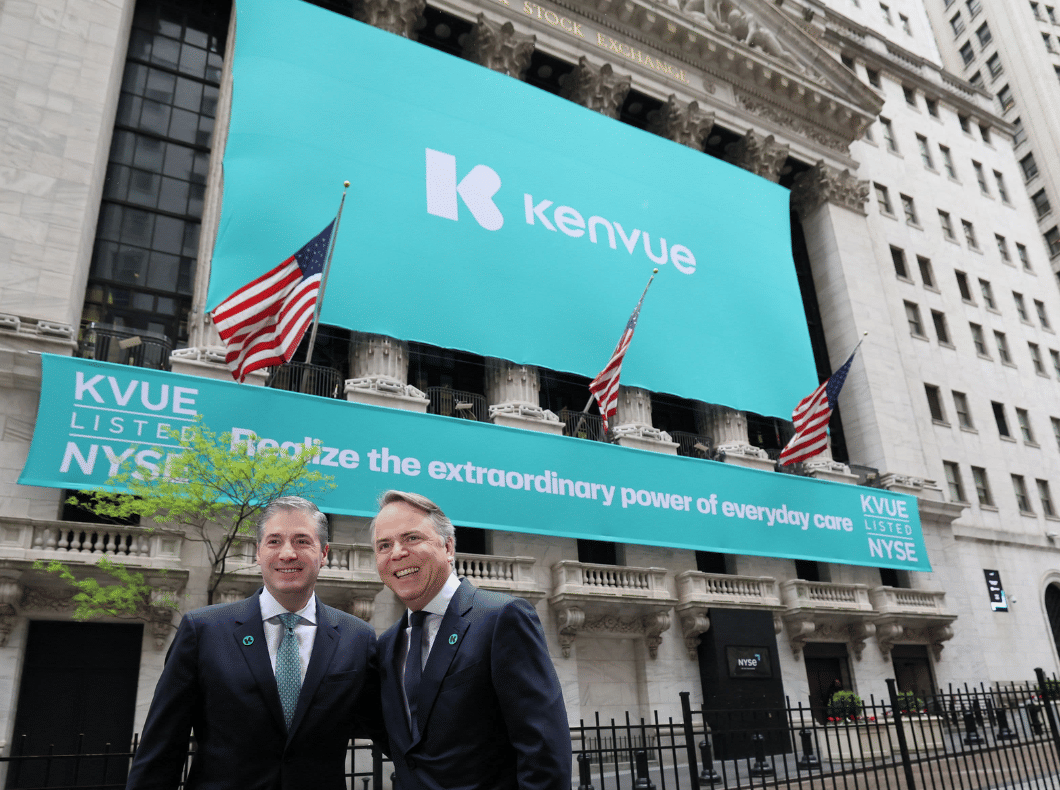
Kenvue entered the New York Stock Exchange under the ticker $KVUE and the separation process from Johnson & Johnson took place in several steps:
May 2023: IPO on the New York Stock Exchange, J&J kept approximately 89.6 percent of shares and sold the rest as part of the listing.
July 2023: J&J launched a swap offer, where shareholders could exchange a portion of their $JNJ shares for $KVUE shares, typically at a discount, which was a tax-efficient way for them to exit J&J.
May 2024: the process was completed and J&J ceased to own any stake in Kenvue.
Today, they are two entirely independent companies with no cross-ownership ties.
Why J&J wanted to get rid of Consumer Health
The official rationale spoke of simplifying the structure and focusing J&J on pharmaceuticals and medical devices. These are segments with higher margins and higher growth potential than the classic consumer segment with bandages, ointments, and over-the-counter drugs. The Consumer Health division had long been growing at only single-digit percentages annually and its margins were lower than the rest of J&J. The separation thus allowed the market to value both businesses separately, without the slower consumer part diluting the multiples assigned to the pharmaceutical business.
Who benefited from the separation
In hindsight, the main benefit of the separation went to J&J shareholders who remained in the parent company. J&J maintained higher growth and valuation after the separation and increased its dividend year after year. Kenvue shares, on the other hand, mostly lost value rather than rising since the IPO, and the company came under pressure fairly soon after its creation due to legal risks and weaker revenue growth. It wasn't until the Kimberly-Clark offer in autumn 2025, at a premium of over 46 percent to the then share price, that Kenvue shareholders got a chance to realize value they otherwise would have had to wait many years for, had the company remained standalone.
Can Kenvue function without J&J?
New infrastructure, new costs
After the IPO, J&J and Kenvue entered into so-called transition services agreements, under which both companies provided mutual services for a transitional period of about 24 months in areas like IT, accounting, or human resources. Similarly, transition manufacturing agreements covered production and supply of certain products, with terms ranging from three months to five years. Kenvue therefore had to build its own corporate support structure, one it previously shared with the much larger J&J, which meant additional costs on top of regular operations.