


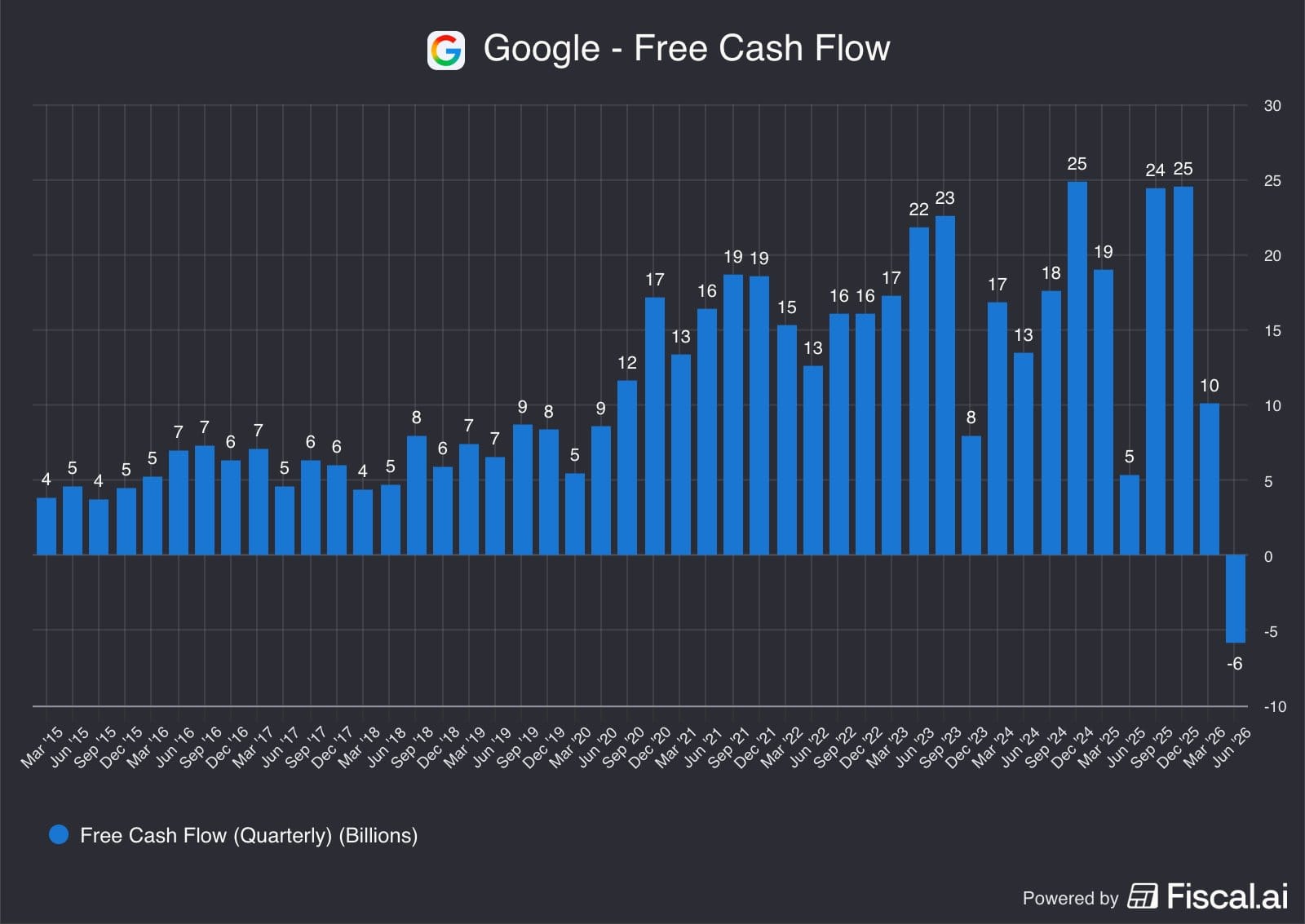
Google reported record quarterly results and burned cash for the first time in its history.
Alphabet $GOOG just released its Q2 2026 numbers, and one chart has been circulating across FinTwit. The company's free cash flow, which had grown steadily since 2015 (from a few billion to quarterly records around $24–25 billion), plunged into negative territory at -$5.9 billion. This is the first time in the company's history as a publicly traded entity.
Meanwhile, net income surged 298% year-on-year, yet nearly 90% of that increase has nothing to do with how the business is performing. And capital expenditures doubled year-on-year to $44.9 billion in a single quarter.
Let's break them down one by one, because together they paint a much clearer picture of what's happening at Alphabet (and across the AI sector) than the "negative cash flow" headline suggests.
Historical parallel with Amazon
We've seen this before. Amazon $AMZN poured tens of billions into data centers for AWS between 2010 and 2014, and for years investors saw virtually no immediate profit from it. Cash flow was under pressure, margins looked unimpressive, analysts wrote that Bezos was "burning cash aimlessly." AWS then became Amazon's most profitable segment and still drives the majority of the company's operating profit.
A similar pattern held for telecoms in the late 1990s, when companies built fiber optic networks before demand existed – but there was a crucial difference: demand never arrived in that volume, and the companies went bankrupt. That is exactly the risk you have to monitor in every capex supercycle – it's not about how much is being built, but whether there will be real demand for what gets built.
At Google, we now have a fairly clear answer to that question, and it's in the Google Cloud numbers.
Capex: doubled, and it will get worse (in a good way)
Alphabet's capital expenditures rose 100% year-on-year to $44.9 billion in this quarter alone. In the first half of 2026, the company has already spent $80.6 billion. Roughly 60% went to servers, 40% to data centers and network infrastructure.
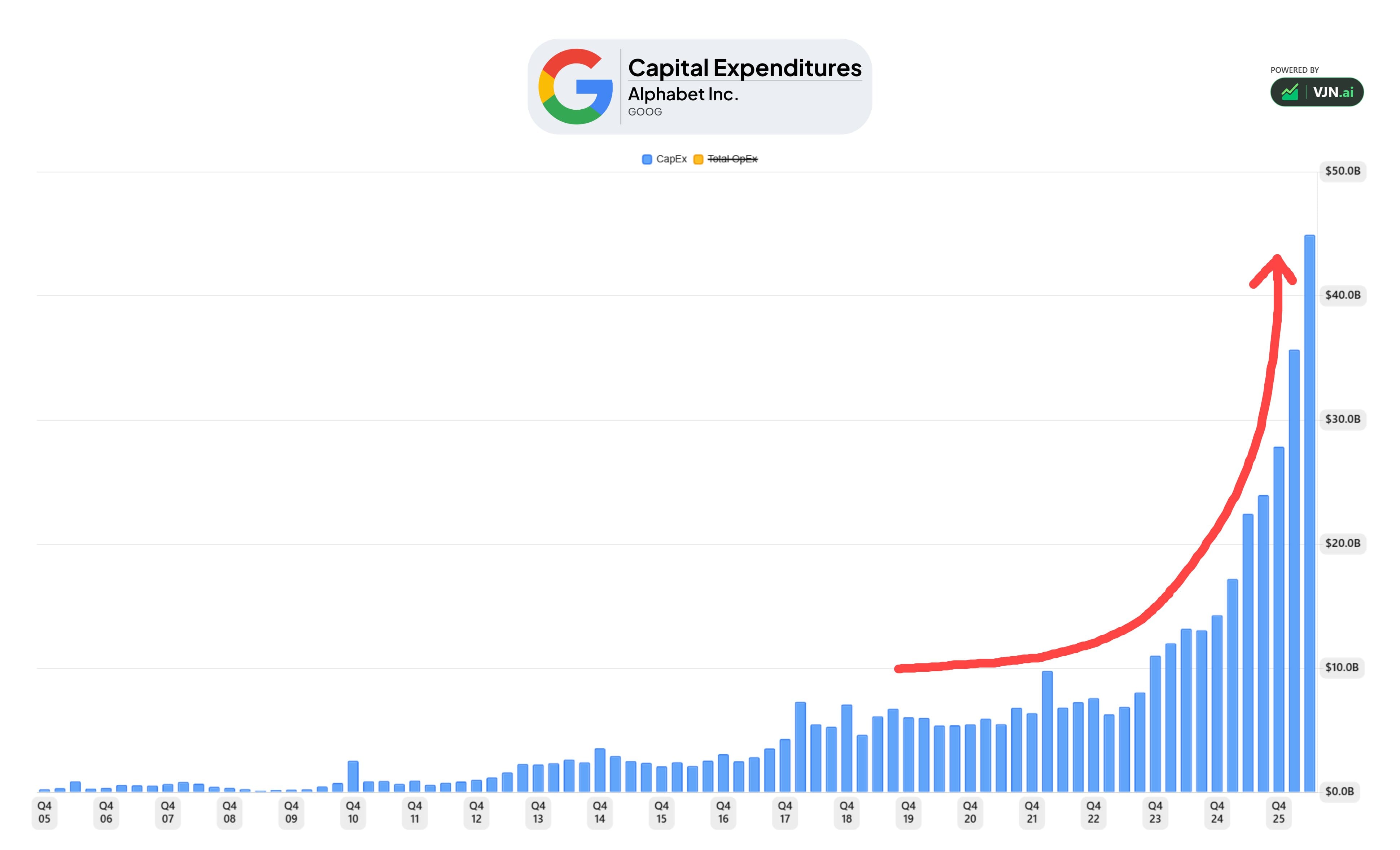
Moreover, management again raised its full-year 2026 outlook – from an original $180–190 billion to $195–205 billion. The reason is simple: demand for computing power is growing faster than the company can build its own capacity. Google is even temporarily borrowing computing capacity from third parties to meet demand before its own data centers come online – which management itself admits is putting near-term pressure on margins.
For 2027, Alphabet indicates that capex will grow "significantly" further, but hasn't given specific numbers yet. CFO Anat Ashkenazi stated plainly back in the spring that 2027 will be even more expensive than 2026.
Alphabet didn't announce any specific new investment acquisition (like a company buyout or a major new joint venture) during this quarter. What they announced is a clear signal: more money will go into their own infrastructure, not into new acquisitions. Sundar Pichai summarized it on the call by saying we are "in the very early stages of what looks like a secular shift" and that over the past year the company has become even more bullish about AI opportunities.
This is exactly the kind of capex that explains negative FCF – it's not a hole in the business, it's a company financing the construction of its own capacity from its own cash faster than it can generate it.
82% Cloud growth – the answer to "will it pay off?"
Here's the number that should interest anyone asking whether this capex makes sense: Google Cloud revenue grew 82% year-on-year to $24.8 billion. The backlog (contracted future orders) rose 63% year-on-year to a record $462 billion.
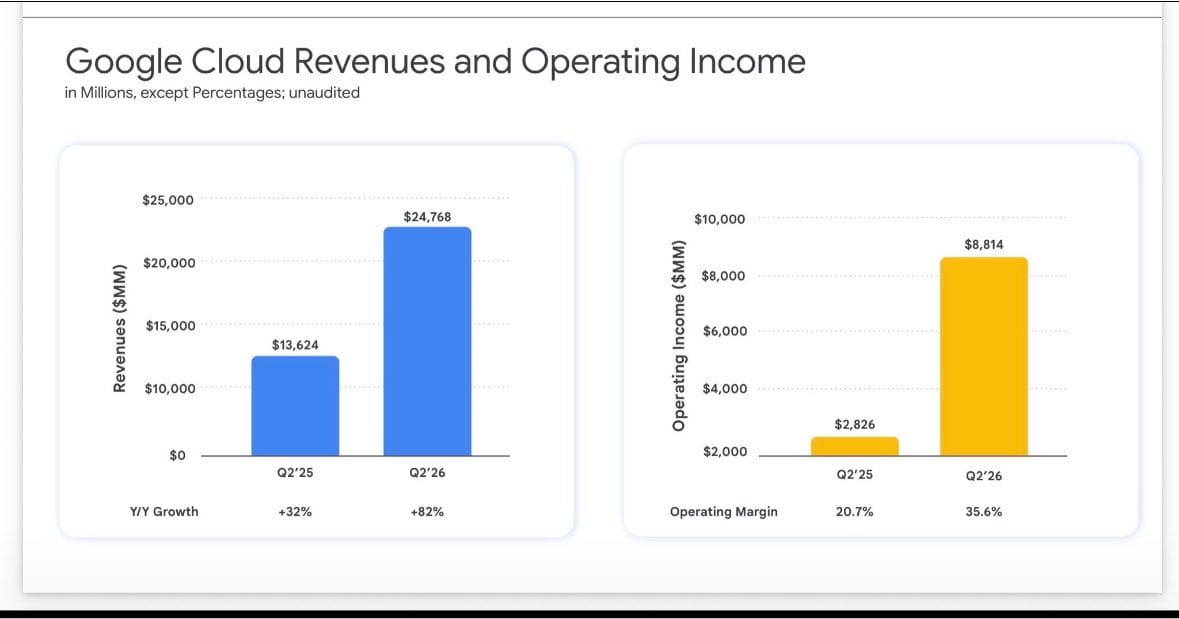
In other words – demand for the capacity Google is building is real and is paid for upfront in contracts. That's precisely the difference from the telecom overbuild of the 1990s that I mentioned earlier. The company isn't building into a void; it's building against a queue of customers waiting for that capacity.
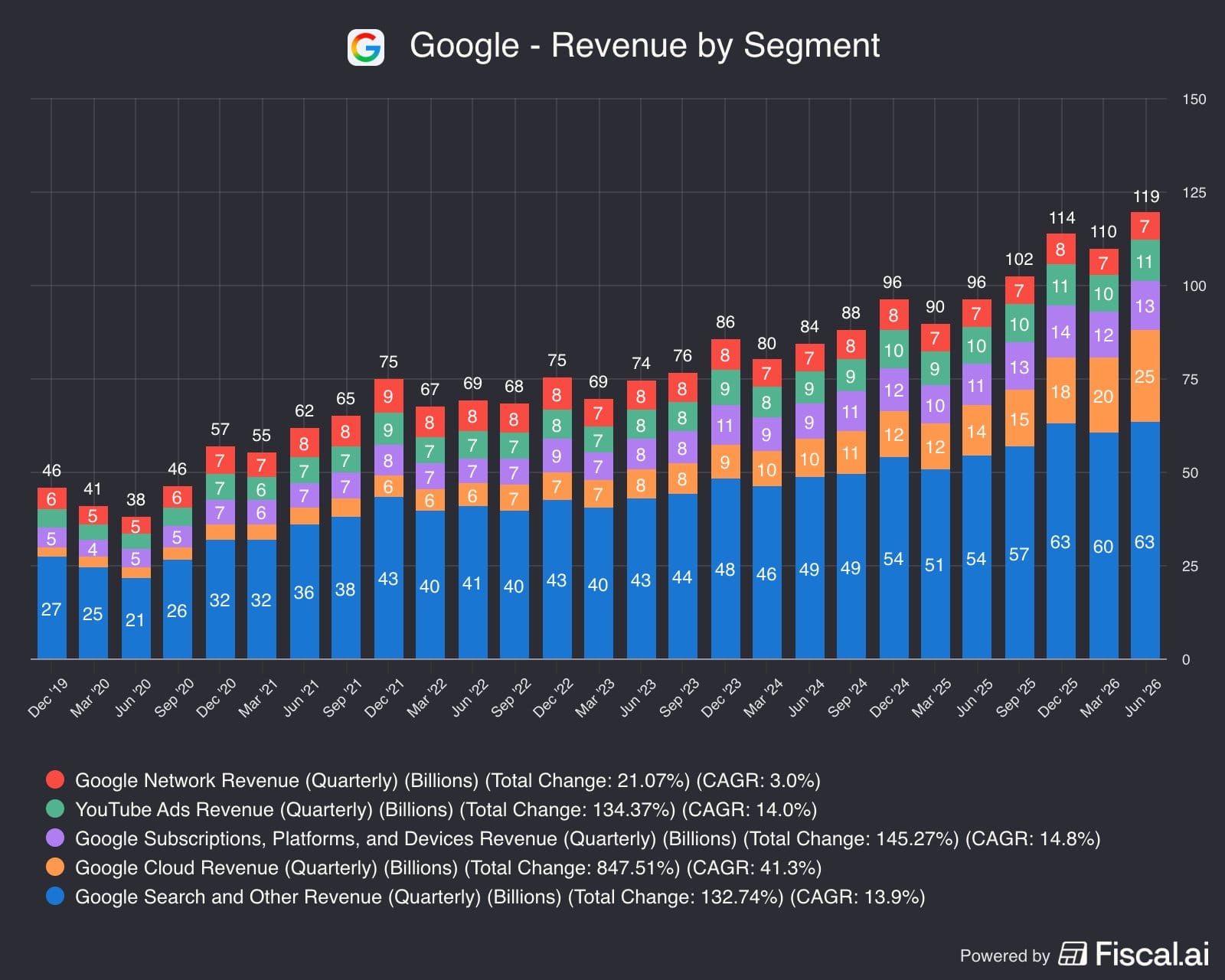
On top of that, Search grew 17% to $63.3 billion, YouTube ads rose 13%, the Gemini app has 950 million monthly active users, and the company's model APIs process 22 billion tokens per minute (up from 16+ billion last quarter). Operating profit increased 30% to $40.8 billion, with operating margin expanding to 34%. The core business is firing on all cylinders.
$98 billion in net income that isn't what it seems
Now to the other number around which most headlines revolve – that extreme jump in net income.
Of the $99.03 billion in "other income," the company acknowledges it comes from revaluing equity stakes in Anthropic and SpaceX. This revaluation boosted net income by $77.1 billion and EPS by $6.26 per share. Excluding this effect, earnings per share would be $2.85 – below analyst estimates ($2.95).
What specifically happened: Anthropic increased its valuation from $380 billion to $965 billion during the quarter after a $65 billion funding round. Alphabet holds a roughly 14% stake in Anthropic. Meanwhile, SpaceX went public in early June with a valuation of $1.77 trillion; a year earlier the company was privately valued at $400 billion. Google holds about a 6% stake in SpaceX.
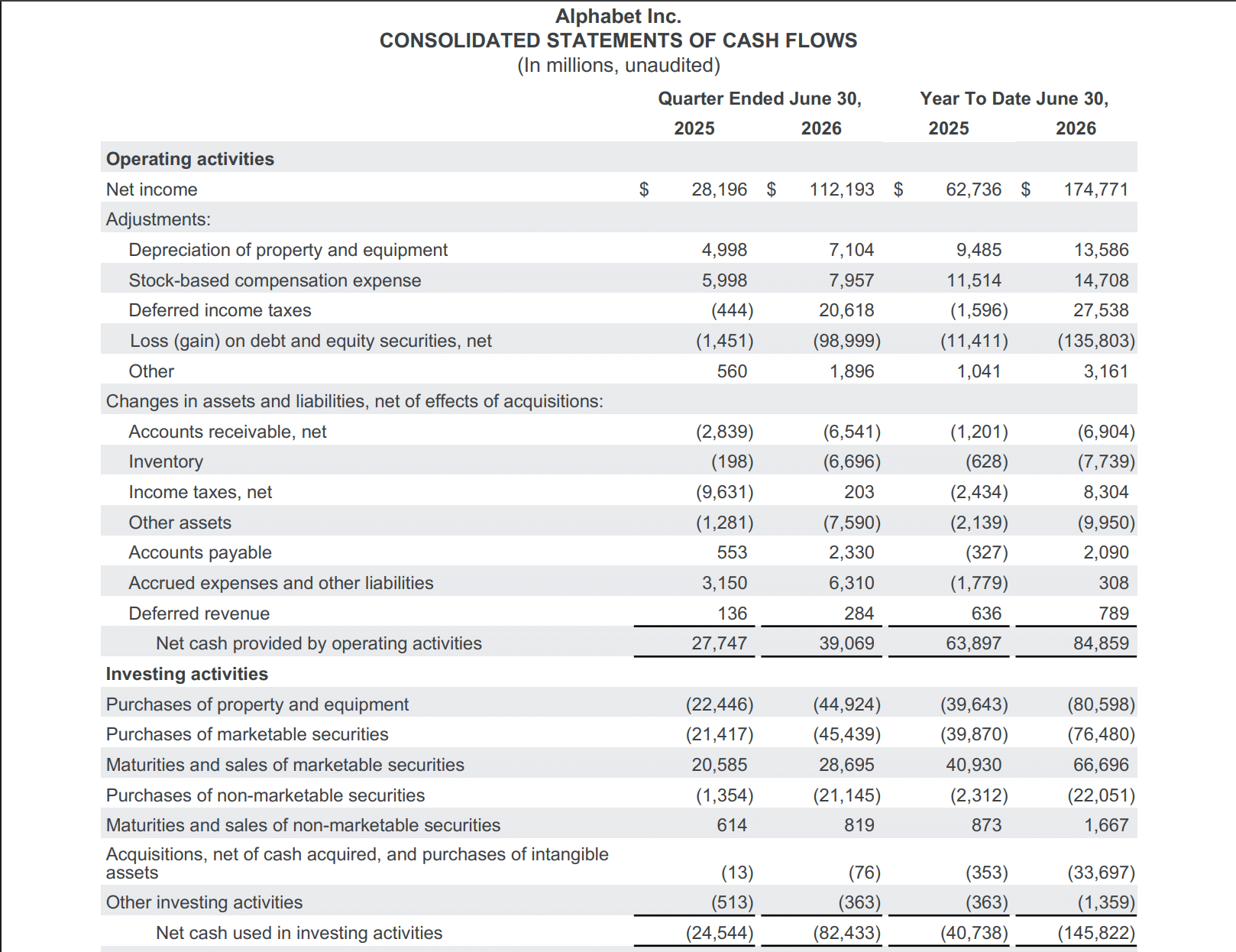
This is exactly the type of gain I would be cautious about with any company, and I'll explain why. It's not money the company earned by selling ads or cloud services. It's an accounting revaluation of minority stakes based on new market valuations. It's an unrealized gain – Alphabet hasn't sold those shares; accounting rules simply require it to revalue them at current market value, and that value soared.
The risk is straightforward: valuations of private AI companies are extremely volatile and largely built on sentiment and expectations of future profits, not on current hard numbers. What goes up by tens of percent in a quarter can just as quickly go down if sentiment toward AI turns or the next funding round prices the company lower. The company itself admits in the notes to its results that fluctuations in the value of these investments could significantly affect future results. For an investor, this means one thing: look at the numbers excluding this effect (adjusted EPS of $2.85), not the headline number of $9.11 per share, which is inflated by a one-time revaluation.
What to take away?
Negative cash flow by itself doesn't mean something is wrong with the business – at Google, it's the result of a massive investment in infrastructure for which there is demonstrable demand (82% Cloud growth, $462 billion backlog). Conversely, the part of the profit that looks most positive (nearly $100 billion from the revaluation of Anthropic and SpaceX) is also the least "real" and most dependent on how sentiment toward AI companies evolves in the coming quarters.
Anyone looking only at headline EPS of $9.11 or at the bogeyman of "negative FCF" gets a distorted picture in both directions. The sober number is adjusted EPS of $2.85 (slightly below estimates) and the fact that the company is betting tens of billions of dollars a year that demand for computing power will continue to grow faster than it can build capacity heading into 2027.


