
Until recently, it was a marginal sector, but today it is being fought over by governments, industrial giants and retail investors. In a matter of weeks, rare earth mining, a key element in modern technology, has become the focus of capital markets' attention. The market is reacting to geopolitical tensions with China, strategic moves by the US administration and a surprise announcement by mining colossus Cleveland-Cliffs, which has decided to enter this lucrative but risky business.
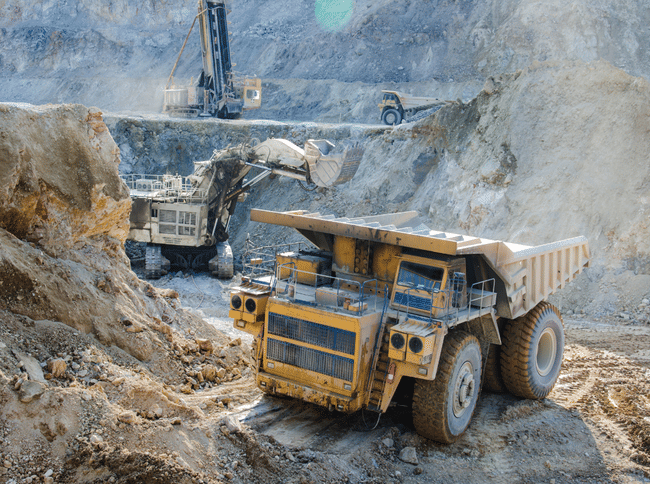
New raw materials plant
Rare earths - seventeen elements such as neodymium, dysprosium and terbium - are the building blocks of modern industry. Without them, Tesla's electric motors, Siemens' wind turbines, the lasers in iPhones and the Pentagon's radar systems would not work.
But for many years, the market for these materials has been virtually in the hands of China, which controls over 90% of the world's processing capacity. This means that any geopolitical upheaval or export restriction from Beijing has an immediate impact on global supply chains.
It is this vulnerability that has led Washington to take a dramatic U-turn. In recent months, the U.S. administration has unleashed a series of measures with a single objective: Ensure domestic self-sufficiency in strategic raw materials. President Donald Trump has signed several executive orders, the Department of Energy (DoE) has earmarked nearly a billion dollars to develop rare earth mining and processing, and the Pentagon announced direct investments in companies that can strengthen the defence industry.
Cleveland-Cliffs ignites a spark
In this atmosphere comes a surprise move by Cleveland-Cliffs $CLF - a traditional steel and iron ore producer. The company has announced that it intends to expand its operations specifically into rare earth mining. It has identified deposits in Michigan and Minnesota, where it plans to use existing infrastructure for new projects.
The market reacted immediately: CLF shares rose by more than 20%, becoming a symbol of the new raw materials trend.
However, the announcement had a deeper impact than the project itself would have accounted for. Cleveland-Cliffs sent a signal that rare earth mining is no longer the preserve of small speculative companies - established industry players are getting in on the action.with real capital and logistical backing.
When commodities behave like crypto
A wave of euphoria immediately swept the market. Yahoo Finance has described the current situation as a "crypto moment" - a period when a marginal asset suddenly becomes the subject of mass interest and explosive growth. Shares of smaller rare earth miners and project companies in the US and Australia shot up by 20-30% in a matter of days.
Investors are not just reacting to the prospect of future profits. In part, it's a bet on the big geopolitical story - the West's efforts to break free from Chinese dominance and create a new, diversified supply chain. In these situations, capital behaves much as it did during the cryptocurrency rush: media, social networks and retail create a strong demand wave that drives prices higher, often before real results are seen.
Politics, industry and security all rolled into one equation
Unlike classic speculative bubbles, the current boom has real underpinnings.
- The energy transition requires massive volumes of magnetic materials and battery components.
- Defence depends on supplies for navigation systems, drones and radar technology.
- Green policy forces governments to ensure 'clean' supplies with a lower environmental footprint.
The combination of these three pressures - economic, strategic and environmental - makes rare earth mining one of the most sensitive sectors in the next decade.
At the same time, the US has signed a new agreement with Australia to cooperate on the mining and processing of critical minerals, strengthening an alternative alliance to China. This confirms that this is not a short-term trend - it is a long-term industrial strategythat has direct implications for stock markets.
The implications for investors
For retail investors, the rare earth sector represents both an opportunity and a trap.
The potential is clear: Global demand for critical minerals could double by 2030, according to the International Energy Agency. Combined with government support and industry subsidies, this creates a strong structural backdrop for growth.
On the other hand, however, mining projects take years to move from the announcement phase to actual production. Share prices can thus be extremely volatile in the interim. Investors should carefully differentiate between companies that already have exploration data, permits and technology partners, and those that are just reacting to a wave of interest.
How to navigate the sector
Those who want to follow a topic in depth should use screening and stock analysis tools.
At Bulios one can compare the valuations of miners, analyse the margins and capital expenditure of companies and find candidates that actually benefit from government programmes.
More sophisticated investors can consider a thematic approach - a combination of direct stocks (e.g. Cleveland-Cliffs $CLF, Energy Fuels $UUU, MP Materials $MP) and ETFs focused on critical commodities. The long-term horizon is key: rare earth mining won't become the new bitcoin, but it could become the infrastructure backbone of the modern economy.
Conclusion
The boom around rare earth mining is not just another fad. It is a strategic transformationthat brings together industrial policy, geopolitics and investment speculation. The U.S. government is openly supporting domestic production, Cleveland-Cliffs is bringing credibility and capital to the sector, and investors - from institutional to retail - are trying to be there before the next phase of growth begins.
Rare earths are today what oil was in the 1970s: a commodity that could define the power relations and investment trends of the next decade.