
Artificial intelligence is redefining the structure of the global economy — and AMD wants to be at its very core. At its Financial Analyst Day in New York, CEO Lisa Su unveiled an ambitious roadmap to boost data center revenue by 60% within the next three to five years, from $16 billion in 2025 to more than $25 billion. The message was clear: AMD intends to take meaningful market share from Nvidia’s long-standing dominance.
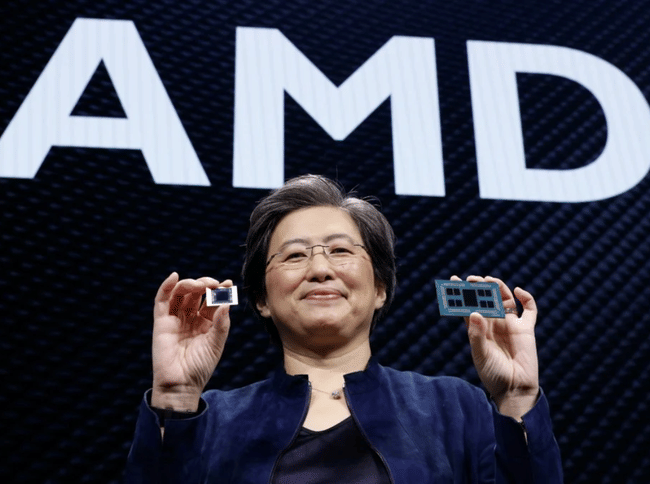
Su projects the total addressable market for AI data centers will reach a staggering $1 trillion within five years, spanning GPUs, CPUs, networking, memory, and the software stacks that power “AI factories of the future.” With its expanding lineup — from CPUs and GPUs to rack-scale Helios systems and integrated AI software — AMD is positioning itself not just as a chipmaker, but as an infrastructure company for the next industrial revolution.
New strategy: chips, partners and AI factories
AMD $AMD is building its expansion on several pillars:
- The powerful MI450 and MI500 accelerators - next-generation chips for AI and HPC that will power projects by hyperscalers, AI-native companies and sovereign states building their own infrastructure.
- Big contracts - In recent months, AMD has announced shipments for OpenAI (6 GW of computing power) and Oracle (Both projects will ramp up in 2026.
- Server share growth - The company expects to acquire within three years More than 50% share of server market revenues, up from the current 40%.
- Growth beyond AI - In the client chip segment (PC, gaming), the company expects more than 10% growth and plans to take over the part of the market that Intel (INTC) is losing.
CFO Jean Hu also predicts that AMD's total sales will grow by 35% to around $46 billion by 2030, with datacenters remaining the main growth driver. Gross margins are expected to remain in the range of 55-58 % and operating margins above 35%.
Lisa Su: "AI is a unique moment, we must not be short-sighted"
In response to questions about funding AI projects, Su dismissed doubts about whether companies like OpenAI can pay for massive GPU deployments. "This is a unique moment in the history of AI. Those who look only a few quarters ahead will not understand the scale of the opportunity. If AI usage grows as we expect, funding will not be a problem," she said.
According to Su, AMD is at a stage where it is moving from the role of "technology challenger" to a position of an infrastructure playerthat can offer a complete AI stack - from chips to system solutions. In doing so, the company is targeting Long-term partnerships with hyperscalers such as Microsoft, Amazon Web Services or Google Cloud.
Nvidia stays on the throne, but AMD accelerates
Nvidia $NVDA continues to dominate the majority of the AI market - with a market capitalization of $4.7 trillion and a dominant share of GPU sales. AMD is smaller (approximately $396 billion), but its growth is significantly faster:
- Shares AMD up 111 % YTD.
- Shares of Nvidia have appreciated by 40% YTD.
Lisa Su is betting on a combination of technical leadership in the CPU segment, diversification of the customer portfolio and capacity expansion. If the company manages to stabilize supply and the launch of the MI500 series is delayed, AMD can get to double-digit share in AI datacenters by 2028.
Risks and opportunities for investors
📊 Risks:
- The market is extremely capital intensive and the return on investment may take longer than investors expect.
- Increasing competitive pressure - Nvidia, Intel, Broadcom, Qualcomm and state AI projects.
- Dependence on TSMC's manufacturing capabilities and associated geopolitical vulnerabilities.
🚀 Opportunities:
- Growing global demand for AI computing power.
- Expansion into sovereign and national AI projects.
- Opportunity to gain strategic position in the ecosystem of "AI factories".
New competition for datacenters
While Nvidia continues to profile itself as a leader in high-end accelerators, AMD is targeting the broader datacenter ecosystem. Lisa Su in New York concluded her presentation with a simple message:
"We have all the pieces of the puzzle to build AI factories. And that's our goal - at every layer of the stack, from chip to system."
It's a statement that confirms that AMD has long been "the other" company behind Nvidia. It's a company that wants to be the foundation of a new era of computing infrastructure - one that will power the trillion-dollar datacenter market and AI economy of 2030.