
Japan is accelerating its attempt to reclaim a strategic position in the global semiconductor race, and Micron has emerged as the central pillar of this push. According to reporting from Nikkei, the company plans to invest 1.5 trillion yen ($9.6 billion) into a new manufacturing plant in Hiroshima, designed to become one of the most important global hubs for producing high-bandwidth memory (HBM). These chips have become critical infrastructure for AI models, hyperscale data centers and accelerator platforms, making Micron’s expansion a direct response to the rapid global escalation in AI compute demand.
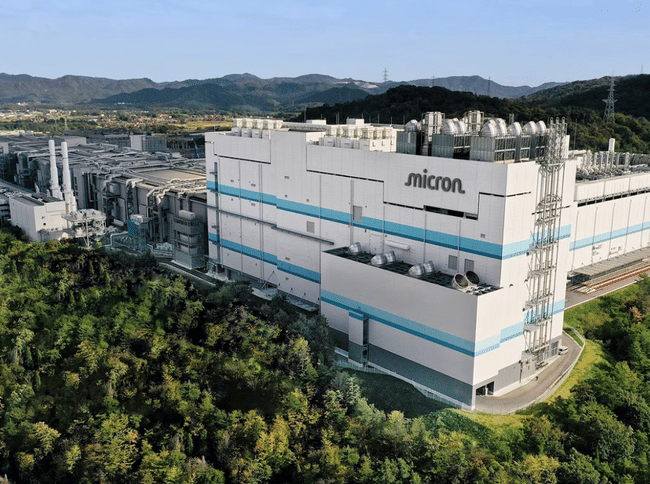
Construction is expected to begin as early as May next year, using Micron’s existing Hiroshima site as the foundation for the new facility. The first HBM shipments are projected for 2028 — aligning precisely with the next major build-out cycle in global data centers and next-generation memory architectures. Japan’s Ministry of Industry is prepared to contribute up to 500 billion yen in subsidies, underscoring the government’s determination to re-establish the country as a major semiconductor power after decades of decline.
Japan wants chip sovereignty back
Japan's chip industry once dominated the world, but the last two decades have brought a gradual loss of influence. That's why the government is now investing tens of billions of dollars in projects to attract global players and return the country to strategic control of advanced technology manufacturing. This strategy includes:
- Subsidies to foreign companies, including Micron and TSMC $TSM
- joint projects with IBM aimed at producing advanced logic chips
- support for the domestic firm Rapiduswhich aims to develop 2nm manufacturing by 2027-2028
Micron's $MUfactory thus becomes not only an investment in the local economy, but also a key element of national security - a reliable source of HBM chips is now as crucial to tech superpowers as energy supply.
HBM as a cornerstone of the AI boom
Demand for HBM memory is growing explosively. Every modern AI accelerator - from Nvidia to AMD - uses HBM as the main source of high data throughput, without which today's models would not be able to train or function.
Increasing production capacity is therefore one of the most critical tasks for the entire AI sector. Micron has accelerated its HBM product development in the last two years and wants to move closer to the market leader, SK hynix $HY9H.F, which controls more than 50% of the segment.
The new Hiroshima plant is intended to provide Micron with:
- Diversification outside Taiwan
- a more stable supply chain
- greater competitiveness against SK hynix and Samsung
- a strategic position in Asiawhere the majority of HBM component production is located
Geopolitical dimension: less dependence on Taiwan
Tensions between the US and China, as well as concerns about possible destabilisation in the Taiwan Strait, is leading chip companies to shift some production to other regions. Japan is becoming a preferred destination due to its stable political environment, strong industrial infrastructure and generous incentives.
Micron is thus following a "friend-shoring" strategy where production is shifted to partner countries. This:
- reduces geopolitical risk
- protects long-term memory supplies for US AI chipmakers
- strengthens the US-Japan technology security link
Competition: Micron vs. SK hynix vs. Samsung
While SK hynix dominates the entire segment, both Samsung and Micron are aggressively trying to increase investment. In fact, HBM is becoming a strategic product where not only price matters, but more importantly:
- energy efficiency
- data throughput
- reliability under heavy load
With Hiroshima, Micron wants to accelerate the adoption of its next generation of HBM chips and expand in a market where demand often outstrips supply.
- Don't overlook: Micron Technology beats expectations in 4Q FY25!
What this means for Japan
If the investment comes to fruition as planned, it will be one of the largest foreign technology projects in the country's modern history. Benefits:
- Thousands of new jobsboth direct and indirect,
- strengthening the regional economy in Hiroshima,
- technology transfer and know-how enhancement,
- Japan's strategic position in the global chip competition.
HBM may become a segment in which Japan will gain global relevance before conventional logic chips.