
What began as a seemingly straightforward transaction has evolved into a multi-front conflict. The fight over Warner Bros. Discovery now blends litigation risk, proxy threats, political pressure, and a fundamental debate over how traditional media assets should be valued in a streaming-first world.
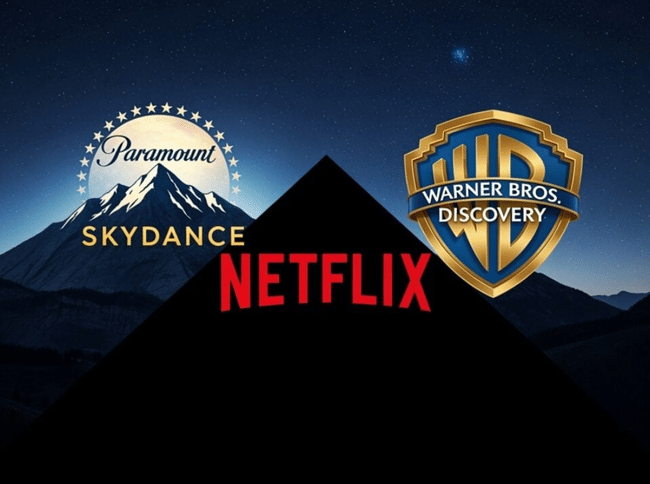
Paramount’s decision to take the dispute to the Delaware Chancery Court raises the stakes further. While the lawsuit does not halt a deal outright, it challenges the decision-making process at the board level. For investors, the focus shifts from who wins the asset to how governance, timing, and legal leverage reshape the final economics of any outcome.
The crux of the dispute is not price, but structure and control
At first blush, it may appear that the issue is simply the difference between $27.75 and $30 per share. In reality, the conflict is much deeper. Netflix's $NFLX bid combines cash and stock while separating cable assets, including CNN, into a new entity, Discovery Global. This means that $WBD shareholders will have to trust that the value of these "residual" assets will materialize over time.
Paramount, on the other hand, is betting on simplicity: cash, full control, no splintering of the company. From an investment perspective, this is a classic clash of two philosophies:
Netflix maximizes the strategic value of content and minimizes operational complexity.
Paramount argues that the market is systematically undervaluing traditional media assets and that WBD's current management cannot or will not defend that value.
This is where the scope for litigation arises - not over whether management has the right to select Netflix, but whether it provided sufficient information to shareholders in doing so.
Why the lawsuit is just one piece of a larger strategy
Going to court is more of a tool than a goal. David Ellison openly talks about the possibility of a proxy fight, i.e., trying to replace the entire WBD board. This is an extreme but effective mechanism if enough institutional investors can be convinced that the current board is not acting in their best interests.
Importantly, Paramount is using this pressure to extend the timeline of the transaction. Moreover, each month increases the probability:
that Netflix will be forced to upgrade the offer
that regulatory or political complications will arise
or that some shareholders may prefer the certainty of a cash offer
From a negotiating perspective, this is a rational, albeit risky, strategy.
The political dimension as an unexpected factor
The situation is further complicated by the fact that the US President has publicly commented on media mergers and implied personal oversight of approvals. This increases uncertainty, especially for Netflix, whose global dominance and cultural influence have become a political issue.
For investors, it means one thing: the likelihood of scenarios is beginning to expand. What a year ago would have been a purely financial decision now involves regulatory, geopolitical and reputational risk.
What could follow?
From a capital markets perspective, the situation can be simplistically divided into three realistic scenarios:
1) Netflix completes the transaction unchanged
This scenario favors stability but limits the short-term upside of WBD stock. The market would likely overvalue Netflix only slightly, while the value of Discovery Global would remain uncertain.
2) Paramount gets a better deal
Either a higher price or concessions on structure. This is the most positive option for WBD shareholders, but also the most burdensome for Paramount in terms of debt and integration.
3) Prolonged stalemate
The riskiest option. Delays, litigation and uncertainty could put pressure on both WBD and Paramount shares, while Netflix would remain relatively on the sidelines.
What investors should take away from this
This story is no longer about who has the "better offer." It's about a fight for time, control and narrative in which even a seemingly minor event - a court decision, a political statement or a change in attitude by large institutional investors - can make the difference.
For investors:
WBD is a speculative title with an asymmetric risk-return profile
Netflix has a strategic advantage but also a growing political risk
Paramount is playing a high stakes game that could deliver either a transformational win or a painful retreat
And that's why this deal has become one of the most interesting media fights of recent years - not just for viewers, but especially for the capital markets.