
Interactive Brokers entered the final quarter of 2025 in an environment that plays directly to its strengths. Elevated interest rates, persistent market volatility, and steady client inflows continue to favor brokers with global reach, low costs, and a scalable technology platform.
The fourth-quarter results did not rely on one-off surprises. Instead, they highlighted something more durable: exceptional operating leverage, near-record margins, and sustained growth in core activity metrics. For investors, the key takeaway is not the quarter itself, but how resilient the model appears across different market regimes.
How was the last quarter?
In Q4 2025, Interactive Brokers $IBKR reported diluted earnings per share of $0.63 and $0.65, respectively , on an adjusted basis, a significant improvement over last year's period when adjusted EPS was $0.51. Net revenues were $1.64 billion and $1.67 billion, respectively, on an adjusted basis, representing year-over-year growth of roughly 18-20%.
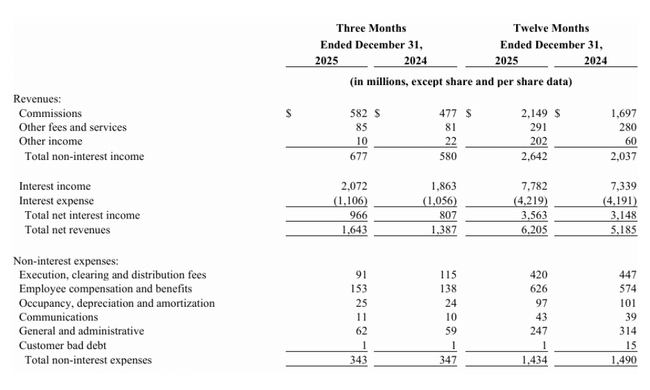
In terms of revenue structure, net interest income remains the key driver, up 20% year-on-year to US$966 million. This growth was driven by higher client lending, rising client credit balances and strong securities lending activity. Commissions from trading grew even more strongly, up 22% to USD 582 million, with trading volumes up 27% in options, 22% in futures and 16% in equities.
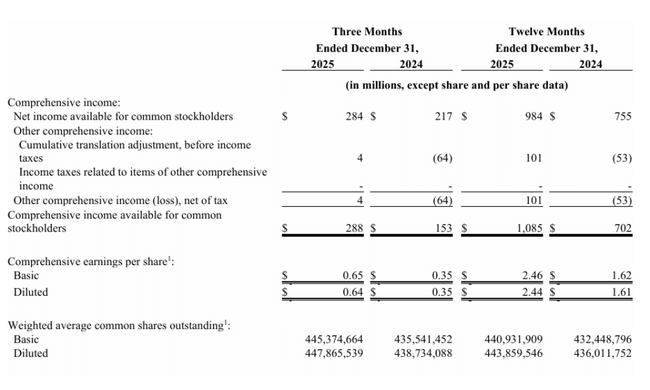
The positive picture is illustrated by the extremely high pre-tax margin of 79%, which further improved from 75-76% a year ago. Interactive Brokers thus reaffirmed that it is one of the most profitable financial institutions in the world in terms of operational efficiency.
Management commentary
In particular, management highlighted the continued growth of the client base and the amount of capital under management. The number of client accounts grew 32% year-on-year to 4.4 million, while client assets reached nearly US$780 billion, up 37%. Management said this was clear evidence of the firm's long-term market share gains across regions and investor types, from retail to institutional clients.
It was also highlighted that the business model is well prepared for both periods of heightened volatility and any gradual rate cuts, as growth in volumes and client numbers remains a key long-term factor.
Outlook
Although the company does not traditionally provide detailed quarterly guidance, it is clear from management commentary and the structure of the results that 2026 is starting from a very strong base. Interest rates will be a key theme - a potential decline in interest rates could slow interest income growth in the short term, but the firm has natural protection against this risk in the form of rising trading volumes and continued inflows of new clients.
Management also stresses that even if rates normalise, Interactive Brokers will remain highly profitable due to its low costs, high automation and global scale.
Long-term results
Looking at the long-term development, it is evident that Interactive Brokers has undergone an extremely strong transformation over the past four years. Revenues have grown from approximately $4.2 billion in 2022 to $9.3 billion in 2024, reflecting the extreme growth in business activity during a period of high volatility and rapid rate increases. 2025 is confusing at first glance in the financial statements due to the significant decline in reported revenues, but this is primarily due to changes in reporting methodology and the structure of other revenue items.
More important is the evolution of profitability. Net profit grew from USD 380 million in 2022 to USD 755 million in 2024 and jumped to USD 3.37 billion in 2025, a more than fourfold year-on-year growth. Earnings per share increased from $0.95 to $2.23 over the same period, despite a gradual increase in the number of shares outstanding.
The company's operating leverage is also extremely strong. Operating expenses have grown only very slowly, while revenue and profit have responded strongly to volume growth. This is why Interactive Brokers is able to maintain margins over the long term that are virtually unrivalled within the financial sector.
News
Significant news for the quarter is the continued growth of the client base and record daily average trades (DARTs), which reached 4.04 million per day. At the same time, the firm continues to invest in technology infrastructure and automation, allowing it to manage growth without significant cost increases.
The announcement of a quarterly dividend of $0.08 per share is also a positive signal for long-term investors, confirming management's confidence in the sustainability of cash flow.
Shareholder structure
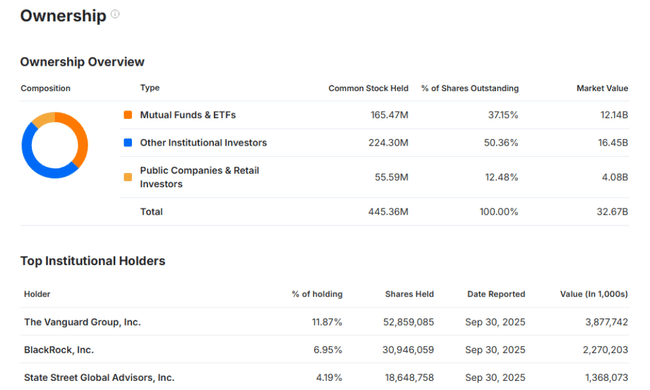
Interactive Brokers' shareholder structure is strongly institutional, with over 87% of shares held by institutional investors and funds. Long-term capital managers such as Vanguard, BlackRock and State Street play a dominant role, reflecting the perception of the company as a quality long-term asset rather than a speculative title. Also interesting is the relatively low proportion of retail investors, which typically contributes to the stock's lower volatility during market fluctuations.
Analysts' expectations
Analysts view Interactive Brokers as one of the best managed companies in the financial sector. The consensus consensus is that even with falling rates, the firm will remain able to generate above-average earnings growth due to structural growth in its client base and trading volumes. The key theme remains sensitivity to the macro environment, not the quality of the business itself.