
Airbnb closed 2025 in stronger shape than many expected. The fourth quarter marked the fastest growth in gross booking value in more than two years, accompanied by double-digit revenue expansion and robust cash generation. The company now enters 2026 combining accelerating demand, high margins and a clear ambition to sustain momentum.
Context, however, matters. Year-over-year comparisons are becoming tougher, regulatory pressure on short-term rentals is increasing in several major cities, and competition within online travel remains intense. Against that backdrop, a roughly 30% EBITDA margin, nearly 40% free cash flow margin for the year and renewed booking growth form the backbone of the investment case. The question is not about demand resilience, but about how durable this margin structure remains as growth scales.
How was the last quarter?
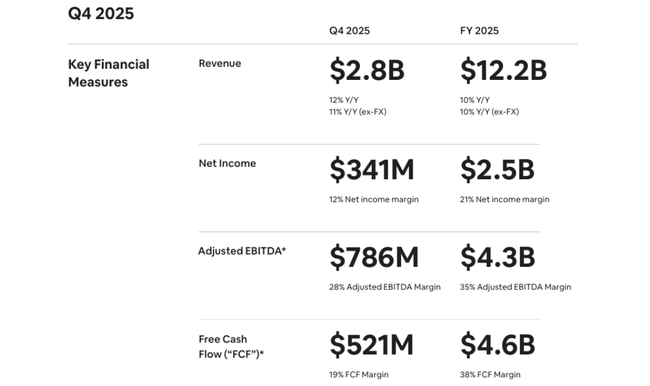
The fourth quarter of 2025 was the strongest in terms of momentum in two years. Revenues reached $2.8 billion, up 12% year-over-year (11% excluding the impact of foreign exchange rates). The company beat the high end of its guidance.
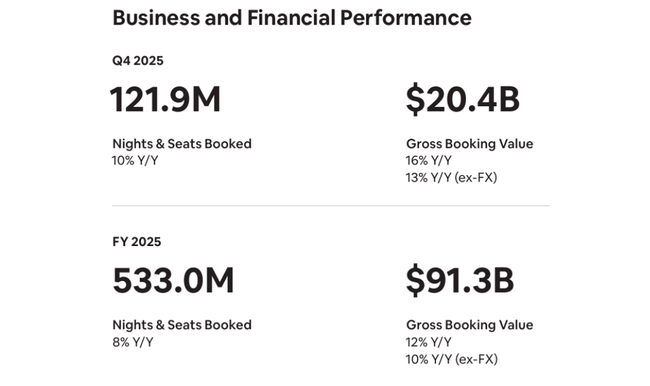
Gross Booking Value (GBV) rose 16% to USD 20.4 billion, or 13% excluding FX. This is the fastest growth rate in more than two years and a clear signal of accelerating demand compared to previous quarters. The number of nights and seats booked reached 121.9 million, up 10% year-on-year and a sequential acceleration from Q3.
Average rate per night (ADR) reached USD 168, +6% y-o-y (3% ex-FX). Growth was driven by both price appreciation and a favourable mix. This means that Airbnb is not only growing in volume, but also in quality of revenue.
Profitability remained very strong:
Net profit: USD 341 million
Net margin: 12%
Adjusted EBITDA: USD 786 million
EBITDA margin: 28%
Free cash flow: $521 million
FCF margin: 19%
Airbnb $ABNB thus reaffirmed its ability to generate strong cash flow even with investments in product, AI and expansion.
Management commentary

Management highlighted that Q4 was the result of improvements to the core product - better search, more flexible payments, adjusted cancellation terms and greater local relevance in expansion countries.
CEO Brian Chesky openly communicated that 2026 is set to be an acceleration year. The company wants to further improve the user experience, expand its service offerings (including hotel pilots) and massively integrate AI into search and customer support. The goal is to increase conversion and reduce customer service costs.
Outlook
Q1 2026
Airbnb expects:
Revenue of $2.59-2.63 billion
Year-on-year growth of 14-16% (including approx. 3 p.p. FX upside)
GBV growth in the low double-digit percentages
High single-digit bookings growth
Stable EBITDA margin year-over-year
Full year 2026
The company expects:
Acceleration of revenue growth into the low double digits at a minimum
Stable Adjusted EBITDA margin
Continued strong cash generation
In other words, management does not expect a slowdown, but rather a further acceleration in growth.
Long-term results
A look at the last four years shows a significant transformation of the company. In 2021, revenues reached $5.99 billion. A year later, they rose to $8.40 billion, in 2023 to $9.92 billion and in 2024 to $11.10 billion. Airbnb has thus almost doubled the size of its business in three years.
Gross profit rose from $4.84 billion in 2021 to $9.22 billion in 2024. Operating profit increased from $429 million to $2.55 billion. Adjusted operating profit before depreciation and amortization increased from $276 million in 2021 to $2.62 billion in 2024. This shows a significant improvement in operating leverage, with revenue growth delivering above-average profit growth.
Net income has moved from a modest loss in 2021 to strong profitability. 2023 was particularly strong, with net profit reaching $4.79 billion, while 2024 brought in $2.65 billion. Despite normalization, the company remains steadily profitable and generates strong free cash flow.
The gradual reduction in the number of shares outstanding is also a significant factor, supporting earnings per share growth. The combination of revenue growth, improving operating efficiencies and strong cash flow is creating a more stable financial profile than in the post-pandemic period.
News
Airbnb significantly expanded its offerings beyond traditional short-term rentals during the year. The Airbnb Services and Airbnb Experiences project is gaining momentum, and nearly half of experience bookings in the fourth quarter were not tied to accommodation bookings, suggesting the emergence of a separate demand segment.
The company has also begun piloting with boutique and independent hotels in select cities where the supply of apartments is limited by regulation. The goal is to expand the addressable market, capture some of the demand that would otherwise go to traditional hotel platforms, and increase the frequency of return users.
The integration of artificial intelligence remains a major strategic priority. AI customer support already works in multiple languages and regions, significantly reducing the time to resolve requests. In the future, Airbnb wants to use AI in search as well, so that users can describe what they are looking for in natural language and get a more personalized offer.
Shareholder structure
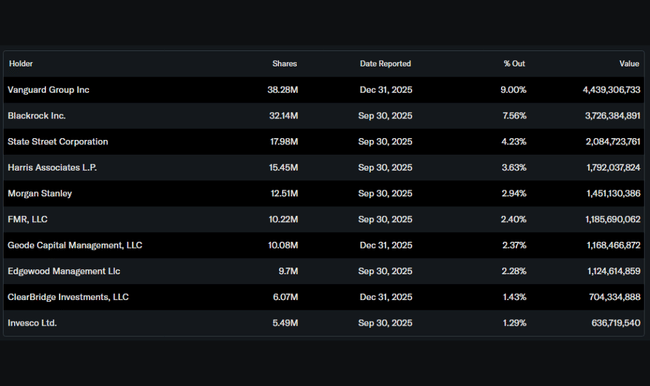
Airbnb has a strong institutional base. Approximately 85 percent of shares are held by institutional investors, while insiders hold roughly one and a half percent. The largest stakes are held by Vanguard, BlackRock, and State Street, all long-term global asset managers. Such high institutional participation typically means a greater emphasis on capital discipline, return on capital and steady growth in profitability.
Analyst expectations
Analysts will primarily be looking at the sustainability of double-digit bookings growth in 2026 and the firm's ability to maintain high margins while continuing to invest in product and technology. Regulation of short-term rentals in major cities and its impact on supply is also a key theme.
The market expects Airbnb to be able to maintain a growth rate above ten percent even in a slowing global economy. If the company manages to confirm acceleration in the first half of 2026 while maintaining an EBITDA margin of around 35 percent on an annualised basis, this could boost investor confidence in its long-term growth trajectory.