GameStop wants to gobble up eBay for $56 billion. Ryan Cohen's big bet, or a suicidal all-in?

GameStop shocked the market by proposing to buy eBay for about $55-56 billion in cash and stock - even though it is itself about four times smaller by market capitalization.
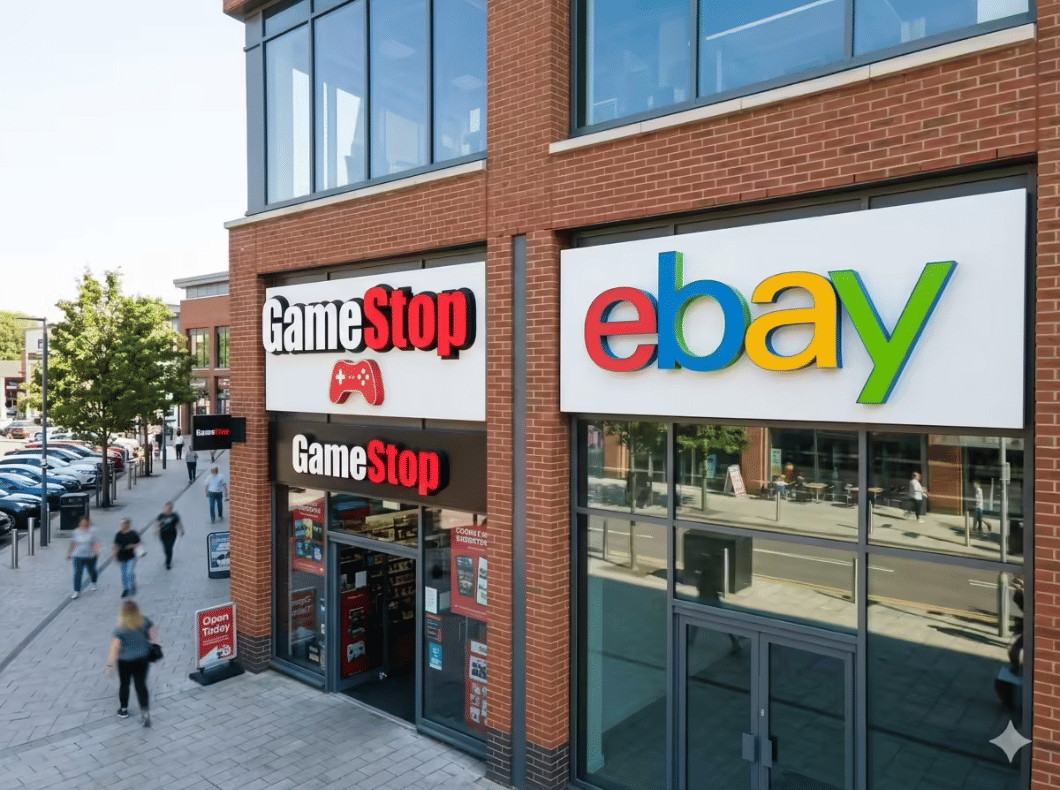
This is an extremely ambitious attempt to flip GameStop from a memestock and fringe retailer to a major player in global e-commerce, but at the cost of massive debt, shareholder dilution and huge integration risk.
What an eBay bid looks like
GameStop $GME is proposing $EBAY per share in cash and stock to eBay shareholders, for a total of roughly $55.5-56 billion, a roughly 20% premium to the last closing price before the announcement. The offer is unsolicited, has not been formally rejected or accepted by eBay's board, and is merely "evaluating strategic alternatives," according to the statement.
GameStop had already built up a roughly 5% economic stake in eBay beforehand, through a combination of stock and derivatives, to show "skin in the game". The market reacted typically: eBay jumped but traded below the offer price, while GameStop weakened - investors clearly believed more in the value of the premium for eBay than in GME's ability to finance the deal safely.
Where will GameStop get the tens of billions
The cash part: virtually the entire cash cushion + new debt
Half of the consideration is expected to be cash, approximately $27-28 billion. According to the latest results, GameStop has about $9 billion in liquid assets (cash + short-term investments) and net debt at a conservative level.
In order to pay the cash component, it plans to:
use most of its current cash and marketable securities
raise debt through new loans and bonds - the company says it has a "highly confident" commitment from TD Securities for up to $20 billion in acquisition financing
The result would be a company with significantly higher net debt and leverage than GME shareholders were used to - a cash-rich memestock would become a high-yield debt-laden e-commerce conglomerate.
The stock part: massive dilution of GME's current shareholders
The other half of the consideration would come in GameStop stock, at roughly the same par value. With GME's market cap around $11 billion, it's clear that the company will have to issue new shares in multiples of the current free float if the equity component is to reach ~$28 billion.
Ryan Cohen openly says that "GameStop may issue additional shares" to make the deal happen. For existing shareholders, that means:
Dramatic share dilution.
a significant increase in exposure to eBay's business
Dependence on the market to maintain GME's high valuation just as the company itself is pushing the price down with the proposed deal
What this will do to GameStop's balance sheet
If the deal goes through, the combined entity would be an order of magnitude 5-6x larger in terms of enterprise value, but:
it would carry significantly higher debt and interest costs
would have a substantial portion of its assets in goodwill and other intangible items (a typical result of large M&A)
would lose the comfortable cash cushion that now protects GME in a worse retail cycle
On the positive side, the company would gain a business with a higher proportion of fee-based revenue, less reliance on inventory and working capital, and a global marketplace with tens of millions of active users. The negative is that the balance sheet would become much more sensitive to interest rate movements, e-commerce sentiment and competition from Amazon and other platforms.
Strategic logic: why eBay
From Ryan Cohen's perspective, eBay makes sense on three levels:
Instant scale in e-commerce: instead of building its own marketplace, GME is buying a ready-made global platform with infrastructure, branding and user base.
Synergies and the eBay "fix": GameStop claims in its materials that it can find about $2 billion in annual savings in eBay over 12 months, which would lift eBay's EPS from roughly $4.3 to $7.8, according to their model. That's an extremely aggressive assumption, but it serves to justify the $125 per share premium.
Using a "meme currency": GME stock has historically high valuations due to the retail community and volatility. Cohen is clearly trying to use them as an acquisition currency to buy a larger, more stable cash-flow generator.
If synergies really arrived in such volume, it could create great value over the long term - but achieving them requires hard cost cutting, complex integration and flawless execution in a brutally competitive environment.
What GameStop stands to gain and what it risks
Potential benefits:
Access to a giant global marketplace and diversification beyond the narrow gaming retail segment
Higher FCF potential due to eBay's fee-based model
Opportunity to transform GME from a memestock into a "serious" e-commerce holding company if the integration works
Key risks:
Financial: debt leverage spike, downgrade risk, higher rate and cycle sensitivity
Integration: GameStop is a small company with limited mega-M&A experience. A merger with eBay would be orders of magnitude more complex than anything it has ever done
Equity: massive dilution, reliance on memestock valuation when sentiment can turn quickly, and the risk that the retail community that has held GME will not want to hold a debt-laden conglomerate
Are there other bidders on eBay?
So far, there are no publicly announced alternative bidders for eBay that have made a competing bid. Reuters and the WSJ mention that if eBay's board rejects GameStop's offer, Cohen is prepared to go into a proxy fistfight and approach shareholders directly - but that in itself may attract the attention of other players.
Large strategic giants like Amazon would likely run into regulatory limits in both the U.S. and the E.U. More realistically, it would make sense for a large PE fund or consortium, or another mid-sized e-commerce player, to step in as a white knight. But until someone like that officially steps forward, only GameStop remains on the table - and eBay's board has to consider whether the risk of a GME deal is offset by a $125 premium.