
Shares in the Danish pharmaceutical giant have plunged more than 65% from their highs. Meanwhile, a P/E below 11 stands in stark contrast to the robust results - sales of over DKK 309 billion, margins of over 41% and a new tablet-based obesity drug that could change the whole equation.
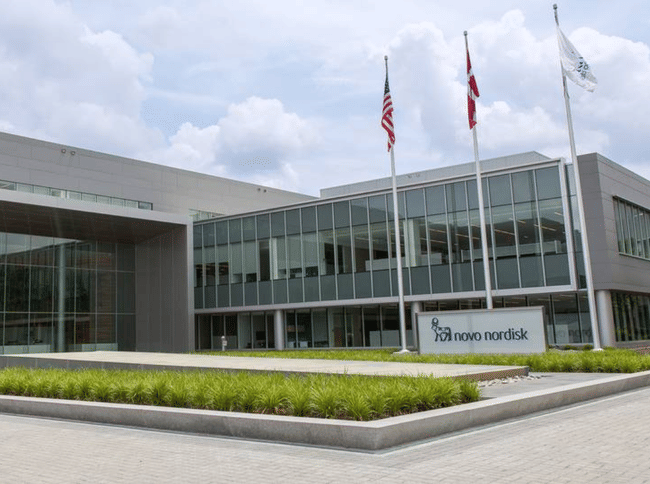
How a market star became a controversial stock
As recently as June 2024, Novo Nordisk $NVO shares were trading at an all-time high of over $137. Today, they're trading around $43 - roughly a third of their value then. For investors who entered at the top, it's a painful lesson. For those watching the situation from afar, a different question arises: is this valuation a reflection of real problems or of exaggerated market pessimism?
The company reported sales of DKK 309.1 billion for 2025, up 6% year-on-year, net profit of DKK 102.4 billion and an operating margin of over 41%. These are numbers that most pharmaceutical companies would have signed up to even in golden times.
And yet the stock trades at a P/E of just 10.3 - more than 57% below the healthcare sector average and well below the company's own 10-year average of 26.
Wegovy vs. Zepbound
The key to understanding the sell-off is one weakness: the growing competition from Eli Lilly's $LLY and its Zepbound product. The latter shows 5% to 7% greater weight loss than Wegovy's semaglutide in clinical trials. In the US market, Lilly has managed to build a dominant position, according to available analyses, from virtually no starting point two years ago.
Meanwhile, Wegovy continues to grow: for the full year 2024, its sales reached DKK 65.1 billion, up 56% year-on-year. But even these figures have not been enough to allay investor fears about what comes next.
In early 2026, Novo Nordisk came up with an answer: a tablet form of Wegova. And so far, it looks promising. In the first quarter of 2026, the company exceeded analysts' expectations, with sales up 32% at constant exchange rates to DKK 96.8 billion. Injectable Wegovy was up 12% to DKK 18.2 billion, while tablets generated over DKK 2.26 billion in the first quarter alone, at the very start of sales. In addition, CEO Mike Doustdar reported that around 80% of users of the tablet form are people who have never taken GLP-1 drugs before - so the tablets are not competing with the injection, but expanding the overall market.
"Weg's tablet formulation appeals to patients who are afraid of needles or cannot self-inject. It's not a substitution, it's a new segment of demand."
Mike Doustdar, Novo Nordisk CEO, CNBC, May 2026
https://www.youtube.com/embed/Ujq3kSsZeeg?rel=1
Ozempic in decline, but stronger companies are surviving this too
While Wegovy is growing, diabetes blockbuster Ozempic saw its Q1 2026 sales fall 8% YoY. However, it still beat analysts' estimates. Ozempic remains the only GLP-1 drug approved to slow the progression of chronic kidney disease in diabetics - a niche indication that gives it staying power even as new competition arrives.
Still, the company maintains a strong market position: with a 33.7% share of the global diabetes treatment market (unchanged over the past twelve months), 26 million patients on insulin products and distribution in 170 countries, it is not a player that is easily replaceable.
Key financials for 2025:
Revenue: DKK 309.1 billion (up 6%)
Net profit: DKK 102.4 billion (+1%)
Operating margin: 41.3% (operating profit DKK 127.7 billion)
Wegovy: DKK 79.1 billion (+21%)
Ozempic: DKK 127.1 billion (+6%)
Free cash flow: DKK 28,3 billion
Pipeline as insurance: CagriSema and semaglutide in higher dose
Novo Nordisk has played two cards in the next round of the battle with Eli Lilly. The experimental CagriSema - a combination of semaglutide and cagrilintide - achieved a weight loss of 22.7% in 68 weeks in the REDEFINE 1 clinical trial. A higher dose of semaglutide 7.2 mg then led to a 20.7% reduction in another study. Both figures are close to the results of Lilly's tirzepatide, which has so far been clinically more effective.
If CagriSema makes it through more advanced phases of testing and wins regulatory approval, the company could restore technological parity - or even an advantage. In addition, UK regulator NICE recommended Wegova in April 2026 to reduce cardiovascular risk, opening the way for wider reimbursement from the health system.
Three risks that the market is not forgiving
The pessimistic outlook for Novo Nordisk is not just based on Eli Lilly. There are real threats that cannot be overlooked.
Starting in 2027, the U.S. government will begin directly negotiating the prices of the company's three key products - Ozempic, Rybelsas and Wegova - under the Medicare program. According to estimates, this could reduce US market revenues for the affected products by 15% to 25%.
The Donald Trump administration is working on a so-called Most Favored Nation pricing policy that would mandate pharmaceutical companies to offer American patients the lowest prices applicable anywhere in the world. For Novo Nordisk, whose highest sales come from the US, this would be a severe hit to margins.
Potential tariffs of up to 250% on pharmaceutical imports would dramatically change the cost structure of companies dependent on global production chains.
The combination of these factors explains why the company issued guidance for 2026 anticipating a decline in adjusted sales of 4% to 12%. Even so, management upgraded this forecast slightly in May 2026, from the previously announced -5% to -13%.
What does the valuation say: undervaluation or warning?
A consensus of 23 Wall Street analysts rates NVO as a Hold with an average target price of $65.56 - at the current price of around $43, that's a potential upside of over 50%.
The valuation alone is compelling: P/E of around 11, dividend yield of 3.77%, forward P/E of 13.3 versus fair value estimates of around 25.
Historically, the company has never been this cheap - it last posted similar levels during the global financial crisis in 2008.
Three scenarios for where the stock could be in two years:
Optimistic (CagriSema gets approval, tablets strengthen globally): P/E return to 20, growth potential +50%.
Realistic (gradual loss of Weg's share but stable diabetes division): P/E around 15-17, potential +33%
Pessimistic (Lilly dominance over 70% of market, full impact of Medicare + tariffs): P/E below 8, downside potential -20%
The market is valuing the company closer to the pessimistic scenario at the moment - even though the fundamentals are significantly better than the valuation suggests.
Is this an opportunity for patient investors, or a signal that the market knows something the numbers haven't yet picked up? That's for each of us to answer for ourselves.