3 market-leading, high-quality consumer stocks with up to 6% dividend yield

The year 2026 has returned to defensive consumer stocks the attention they completely lost for a moment in the AI era. But not every title from the 'staples' sector offers the same business quality. The following three businesses are among the firms with the highest return on invested capital and strongest cash generation in their sector on the New York Stock Exchange. Yet each of them is grappling with its own challenges. What they have in common, aside from other traits, is that they all trade on the NYSE.

Key points
Defensive rotations tend not to last. The sector is leading the market this year, but within it the dispersion of quality is enormous, and a high dividend yield alone says nothing about business quality.
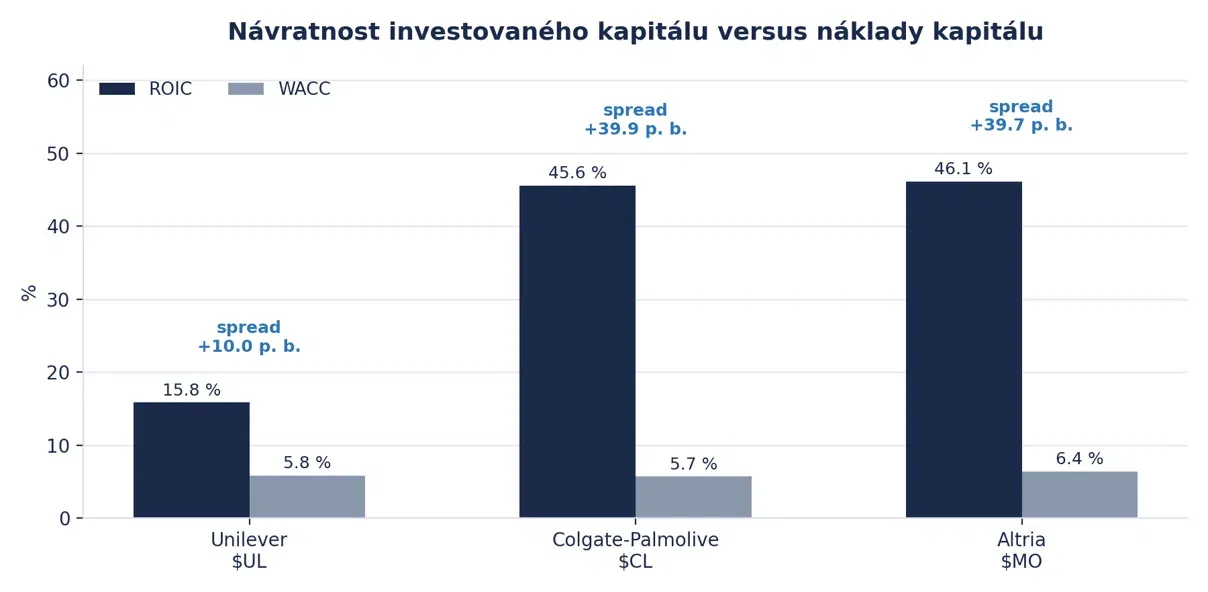
What matters is the spread of ROIC over WACC, not the dividend. For two of the three titles it exceeds 39 percentage points; for the third it is 10. That is the only number that long term separates a quality business from a bond proxy.
Multiples are useless in this sector this year. Restructurings, spin-offs, and one-off items are pushing P/Es in both directions. The gap between the trailing and forward value reaches twelve points for one title.
Volume growth versus price growth is what the market cares about. A company that grows units sold is gaining market share. A company that grows only by price is exhausting consumers' willingness to pay.
The market reshuffled priorities in 2026. After two years when capital flowed almost exclusively into AI infrastructure and tech megacaps, interest in defensive sectors has risen markedly since the start of this year. Consumer staples, alongside energy, rank among the strongest market segments, against a backdrop of geopolitical tensions, higher fuel prices, and more cautious consumers. Sector ETFs such as $XLP have recorded one of the best starts to a year in the entire past decade.
A rotation into defensives, however, says nothing in itself about the quality of individual companies. The consumer goods sector is internally very diverse. Alongside companies with real pricing power and high returns on capital, there are many firms that are growing only through inflation and whose margins are narrowing over time. It is therefore crucial to distinguish what is truly a quality business and what is merely a high-yielding bond proxy.
In this context, we regard quality as a combination of three things: return on invested capital significantly above the cost of capital, high conversion of profit into free cash flow, and the ability to return capital to shareholders without having to increase debt. The three NYSE titles we focus on today meet these criteria, but each in a different way and with a different risk profile.
Common features:
• Beta below 0.5 for all three titles, meaning significantly lower volatility than the broad market
• ROIC above 15% with a weighted cost of capital below 6.5%
• FCF margin above 14% and dividends fully covered by operating cash flow
• Repeat-purchase categories that are relatively insensitive to the economic cycle
Basic overview
Metric | Unilever $UL | Colgate-Palmolive $CL | Altria $MO |
Share price | USD 62.96 | USD 93.27 | USD 68.35 |
Market cap | USD 135.7 bn | USD 74.4 bn | USD 114.1 bn |
Enterprise value | USD 168.6 bn | USD 80.8 bn | USD 136.3 bn |
Revenue (TTM) | USD 57.8 bn | USD 21.1 bn | USD 20.4 bn |
Beta (5Y) | 0.45 | 0.33 | 0.50 |
52-week price change | −7.97% | +10.24% | +8.23% |
Analyst consensus | Buy | Buy | Hold |
Average target price | USD 73.63 | USD 98.95 | USD 70.64 |
But dividends, great results, and buybacks are not everything. Will these companies stand up to our analysis and demonstrate their true intrinsic value?