Warren Buffett's biggest buys defined stock markets. What is he buying now?

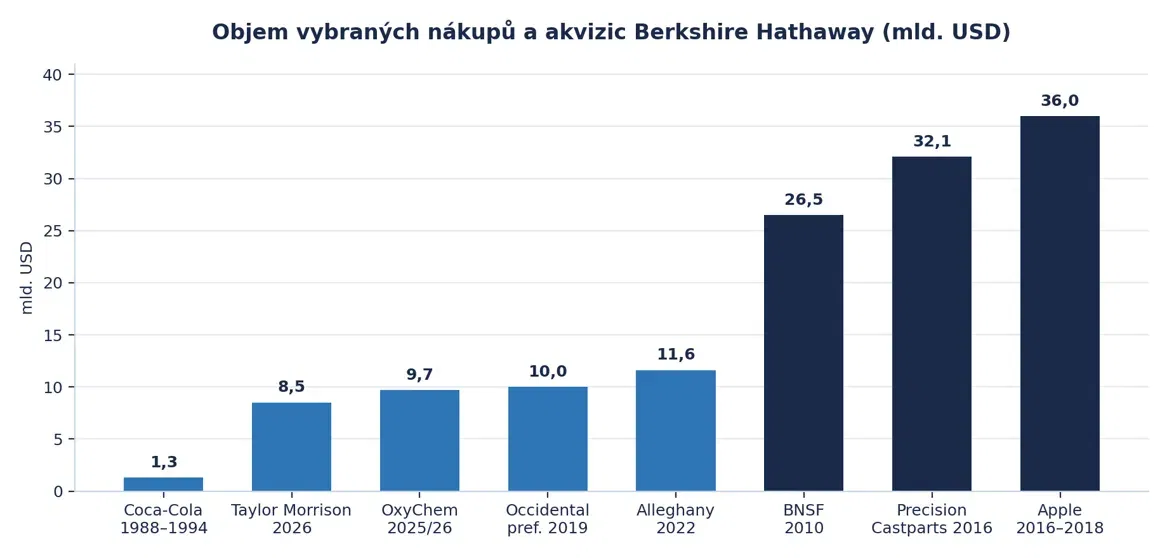
Berkshire Hathaway is built on several dozen purchases that left a deeper mark on market history than the entire portfolios of large funds. From American Express in 1964 through Coca-Cola, BNSF railway, and Apple to this year's entry into a tech giant that no one in the market expected. We looked at the deals that defined Buffett's style, and above all at what from their logic still holds in 2026 and what to use in a time when someone else is running Berkshire for the first time in six decades.
Key points
The most legendary purchase in the company's history was born in the middle of a scandal, when water was found in the tanks instead of an expensive commodity. The market saw the end of the business; he saw the difference between a damaged reputation and a damaged business.
One investment of $1.3 billion today sends Buffett $816 million every year in dividends alone. A yield of 65% per year relative to the original price, and not a single share has moved in it since 1994.
This year's largest acquisition took place near the bottom of the cycle, from a seller under debt pressure.
The entry into a tech giant that he had avoided for two decades is not a bet on AI hype. The company has $165 billion in operating cash flow and pays for its record AI investments itself.
The most expensive mistake was not in the purchase, but in the sale. He sold the most successful position in the company's history too early, and the stock has added 70% since then. Holding is harder than buying.
Warren Buffett has not been the CEO of Berkshire Hathaway $BRK-B since January 1, 2026. Greg Abel took over the role, and Buffett remained chairman of the board and the main voice on capital allocation. Still, this year brought several transactions that bear a clear old-school signature. Berkshire completed its largest acquisition since 2022, entered a technology company Buffett had avoided for two decades, and bought an entire homebuilder in the middle of the worst phase of the mortgage cycle.
For an investor trying to understand how long-term above-average returns actually come about, Buffett's big purchases are more interesting than his quotes. They show a concrete, recurring pattern. Berkshire almost never buys at the peak of enthusiasm. It buys at the moment when the counterparty needs to sell, whether because of debt, scandal, cyclical drop in demand, or because the market has stopped believing in that segment.
It is also important to distinguish between two different categories of transactions. The first are purchases of tradable stocks, which appear retrospectively in the quarterly 13F filings with the U.S. Securities and Exchange Commission. The second are whole-company acquisitions, when Berkshire buys the entire firm and delists it from the exchange. The second category plays a bigger role today, because the amount of cash in the conglomerate has reached a level that the stock market alone can no longer comfortably absorb.
As of June 30, 2026, Berkshire held roughly $365.5 billion in cash and short-term Treasury bills according to its own statement, a decline from the record $397.4 billion a quarter earlier. In the second quarter, the company became a net buyer of stocks for the first time in fourteen quarters, in a volume of about $20 billion, and repurchased its own shares for $4.5 billion, while in the first quarter it was only $235 million. The pace of capital allocation has thus visibly accelerated. Let's look at how Berkshire actually got to its current state.