


⚙️ APPLIED MATERIALS:
MACHINES WITHOUT WHICH AN AI CHIP CANNOT BE MADE
☕️ Good morning, investors and friends.
On Thursday, Applied Materials reported record results and guidance significantly above expectations. Yet the stock fell more than 5% after the market close. Before we discuss why, let's look at what this company actually makes and why it is one of the most important "pick-and-shovel" suppliers for AI infrastructure.
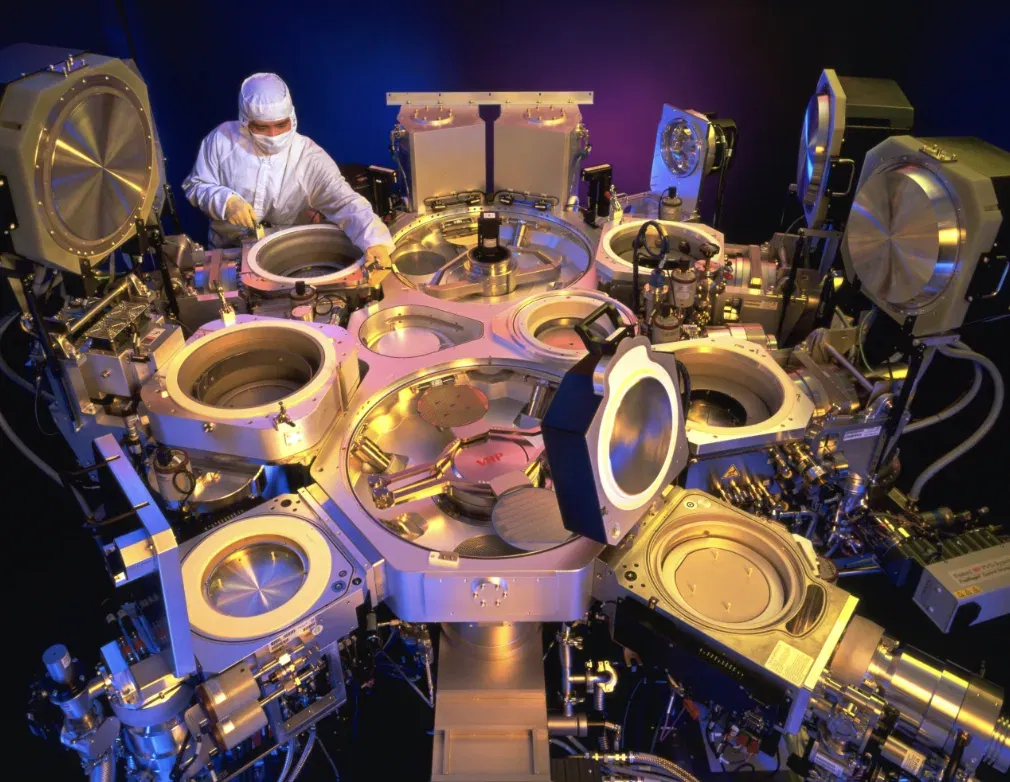
🔬 WHAT DOES APPLIED MATERIALS DO?
Applied Materials neither designs nor manufactures chips. It supplies factories with equipment that gradually transforms an ordinary silicon wafer into billions of transistors and their interconnects.
ASML uses lithography to project an extremely fine pattern onto the wafer. Applied Materials then helps turn that pattern into the actual chip structure:
• deposits material layers using PVD, CVD, and ALD, • etches away unneeded material, • implants ions and changes the electrical properties of silicon, • polishes surfaces using chemical-mechanical planarization, • measures dimensions and looks for microscopic defects, • creates copper interconnects and helps stack multiple chips on top of each other.
A single wafer therefore passes through similar equipment repeatedly. Interestingly, the Endura platform, used for metal layer deposition, has according to the company been involved in manufacturing the vast majority of chips made over the past 20 years.
🏰 WHAT IS ITS ADVANTAGE?
AMAT's strength is not in a single monopolistic machine, as is the case with ASML's EUV lithography, but in an exceptionally broad portfolio. It can combine deposition, etching, material modification, polishing, and inspection into one optimized manufacturing process.
Once a manufacturer approves the equipment and its precise process recipe for a new chip, switching suppliers would require new testing and could reduce yield. This creates high switching costs. At the same time, the growing installed base brings recurring revenue from service, spare parts, and software optimization.
🤖 HOW DOES AMAT MAKE MONEY FROM AI?
AI infrastructure needs three things: more powerful logic chips, more HBM memory, and advanced packaging.
For processors, AMAT is helping the transition to Gate-All-Around transistors, where several material layers must be deposited around extremely thin silicon channels with atomic-level precision.
HBM is made by stacking very thin DRAM layers. These are connected by vertical copper TSV interconnects. Applied supplies equipment for hole creation, insulation deposition, plating, polishing, and defect inspection. The new Producer Avila 2 also deposits balanced dielectric layers around TSVs that reduce warpage of thin memory chips and enable reliable stacking of 12, 16, and eventually more layers.
In advanced packaging, it connects GPUs, HBM, and other chiplets into a single system. The more performance is increased through vertical stacking instead of just shrinking transistors, the more manufacturing steps and opportunities arise for AMAT.
📊 RECORD QUARTERLY RESULTS
In fiscal Q3, which ended July 26, the company achieved:
• revenue of $9.12 billion, +25% year over year and above the $8.99 billion estimate,
• GAAP net income of $2.54 billion, +43%,
• adjusted EPS of $3.50, +41% and above the $3.40 estimate,
• adjusted gross margin of 50.4%, +1.5 percentage points year over year,
• adjusted operating margin of 34.0%, +3.3 points year over year.
GAAP EPS reached $3.17. The difference from the adjusted result was mainly due to an unrealized loss of $220 million on strategic investments.
Operating cash flow reached a record $3.04 billion and free cash flow $2.33 billion. The company returned $860 million to shareholders through dividends and buybacks.
🧩 WHERE DOES GROWTH COME FROM?
Semiconductor Systems increased revenue 27% to $7.04 billion and operating margin from 33.0% to 37.7%. Foundry, logic, and other applications accounted for 67% of segment revenue, DRAM 26%, and NAND 7%. The growing weight of DRAM shows the strength of HBM investments.
Applied Global Services increased revenue 22% to $1.78 billion and operating profit 34% to $536 million. The service business provides more stable revenue even when chipmakers reduce purchases of new equipment.
China accounted for 28% of total revenue compared with 35% a year ago. In dollars, revenue there declined slightly from $2.55 billion to $2.51 billion, while other regions grew faster.
🔭 GUIDANCE BEAT WALL STREET
For fiscal Q4, management expects:
• revenue of $10.25 ± $0.50 billion compared with consensus of $9.54 billion, • adjusted EPS of $4.02 ± $0.20 compared with the $3.69 estimate, • adjusted gross margin of approximately 50.4%.
DRAM, advanced foundry/logic processes, and advanced packaging are expected to grow fastest. Management raised expected packaging revenue growth this year from more than 50% to more than 70%.
CEO Gary Dickerson expects another strong year in 2027 as well. CFO Brice Hill said customers are providing longer visibility than ever before, and some discussions already extend to 2030. Applied therefore plans to double Semiconductor Systems manufacturing capacity by 2028 and is preparing space for further expansion.
📉 WHY DID THE STOCK FALL ANYWAY?
Results were strong and guidance beat consensus. The problem was not the business but expectations. The stock had more than doubled this year before results, and investors had set the bar extremely high after strong numbers from competitors Lam Research and KLA.
Risks also include 28% exposure to China, export restrictions, growth of local competitors, and dependence on investment cycles of a few large chipmakers. Capacity expansion also assumes today's high demand will last for several years.
👀 MY VIEW
ASML and Applied Materials complement each other rather than directly replacing each other. ASML dominates the key lithography step, while AMAT offers broader exposure to the growing number of materials, memory, and packaging steps.
More complex AI chips require not just smaller transistors. They need new materials, GAA architectures, HBM, copper vertical interconnects, perfectly flat surfaces, and more precise defect control. Each of these changes increases the amount of technology needed per chip.
The quarter confirmed not only strong demand but also the ability to turn it into higher margins and cash flow. Fundamentally, these were very high-quality results. The stock decline just reminds us that a great company and an attractive purchase price are not always the same thing.
🫵 I have already opened a small position here, and I would buy more below $500.
Thanks for reading and for your opinion in the comments. Of course, this is not investment advice. As always, my portfolio is public on eToro. 🙋♂️
