Feed Community
MS
Marek Skácel
@marekskacel · Aug 18

Does this stress anyone out at all?

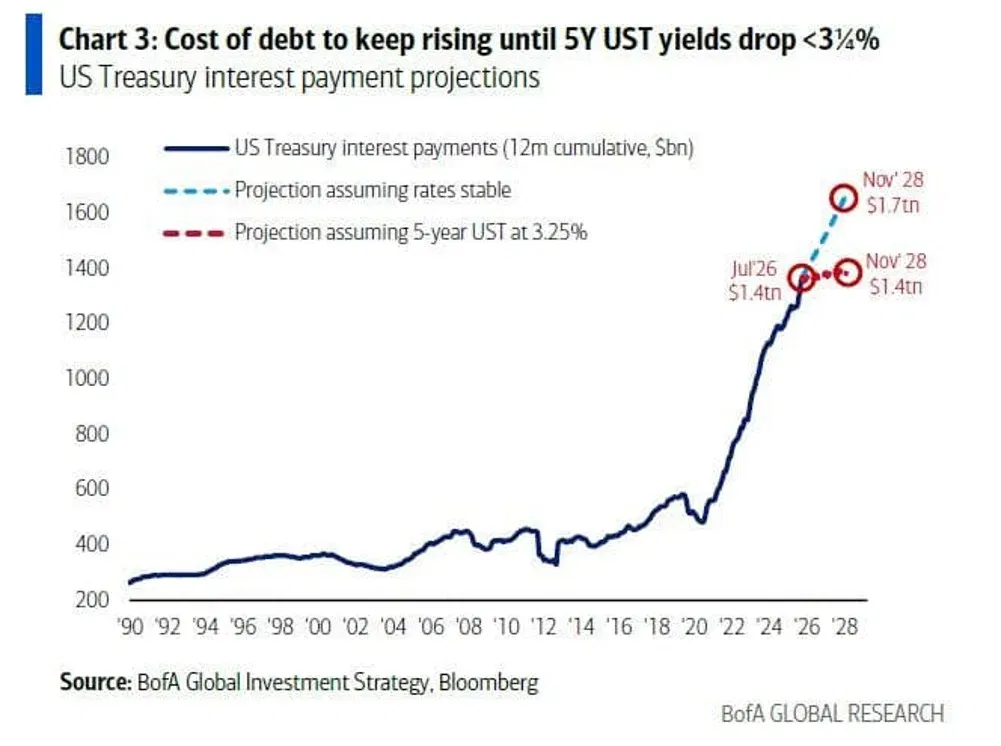
US interest costs tied to the national debt reached a record $1.4 trillion over the past 12 months.

Since 2020, the cost of servicing US public debt has nearly TRIPLED.

If interest rates remain stable, interest payments are expected to rise to $1.7 trillion by November 2028.

As a result, interest will for the first time exceed Social Security spending and become the largest government expenditure item.

US debt is spiraling out of control. (via The Kobeissi Letter)
A community member's personal view, not investment advice. Community Guidelines

MV

There is one very simple solution and it is supremely fair—one clever person, in fact, calculated that the amount of the US government debt is very precisely equal to the amount of tax breaks provided by the federal government, so to balance the debt all it takes is for those who were supposed to pay taxes to settle their obligations. Of course, it wouldn't be good for the economy, but something like that isn't likely to happen anyway :)

KJ

It's a problem that markets, and actually everyone, are currently half-ignoring. But it's nothing positive, and it really is a fairly significant threat. The current situation with still-high rates, inflation above the 2% target, rising bond yields, and accelerating debt is not good. But it doesn't look like anything in the approach is going to change. For several years, perhaps even decades, we can keep functioning in this cycle before something breaks. I don't know when or how it will come, but we're not going to get out of this so easily anymore.

DK

it's crazy, I keep telling myself that those rates are deadly for them but there's no escaping it, and what about the balance sheets of those banks and insurance companies that have piles of unrealized bond losses in their books, what will come of that one day, well as we all know big debts have always been wiped out in just a few ways in the past so we have something to look forward to, anyway what it will mean for shareholders I don't know either but probably anything can happen and as something almost inevitable I count on the dollar weakening

VN

2020 is an unfortunate comparison given the level of rates/interest on bonds

LA

As Tomáš writes, it's not my debt, but on the other hand it does create concerns for me. The chart shows growth since 2020—what has changed? ...

I don't know how to stop it; those at the top, the politicians, would have to want to start first. Enough is collected in taxes and other fees, but politics is generally a black hole for finances. (And I mean in general; I don't want to say now whether the USA or the Czech Republic is better.)

But no one wants to repay the debt—why would they, when they don't have to.

Do you have any idea how to get out of this without us shareholders feeling it?

TK

It's not my debt, so it doesn't stress me out, but I do have concerns about it. This is simply not normal and it could easily bring a lost decade for the S&P500 in the future, when annual returns will hover around 0.

Crypto and asset tokenization could save the US from catastrophe and a complete loss of the dollar as the world's reserve currency. They might buy a few more decades with that.

We use essential cookies to run the website and optional analytics cookies to measure usage. See our Privacy Policy.