


The broker I use every day has suddenly become the most hated stock on the exchange
Over the past 2.5 months, $ETOR has lost more than 60% of its value. From a high of $79.96, which the stock reached in June 2025, it has fallen to today's value of around $29. Yet in the second quarter of 2026, the company reported GAAP net income up 77% year over year.
I decided to take a closer look at this exact issue, let's walk through it together.
The context is macro, as the Fed has held rates in the 3.50-3.75% range for the fifth consecutive meeting, and the hawkish wing of the FOMC even voted for another hike. Add to that the tension around Iran and more expensive oil.
The result is simple - traders and investors have no appetite for risk, and it's most visible where money is withdrawn first, which is crypto. eToro is a company that until recently built a substantial part of its business on crypto trading.
But is that really fair?
A business that's not just "another broker"
eToro is built on CopyTrader – a patented technology where you copy the trades of successful traders on the platform with one click. That's a real network effect. The more people use the platform, the more performance data on traders exists, the more attractive the platform is to new users. Competition can't simply copy it, because it's not one feature, it's a network of people and data built over years.
The second pillar is the regulatory barrier. eToro has licenses in 75 countries – CySEC, FCA, ASIC and dozens of US state-level licenses. Getting those licenses took years and tens of millions of dollars in compliance costs, which significantly complicates entry for new firms.
The company is also trying to transform from a "trading app" to a financial superapp. eToro Money as a neobank, wealth management products – ISAs in the UK, pension savings in Australia, pension products in France in partnership with Generali. This year two acquisitions were added: TradeZero for $231 million (active US traders) and Zengo, a self-custody crypto wallet.
The numbers the market overlooked
This is the most important chart of the whole story – the company's turnaround from existential problems to solid profitability. In 2022, at the end of the previous crypto cycle, the company lost $215 million. In 2023, in the middle of crypto winter, it earned only $15.3 million – barely above zero. In 2024 came a massive turnaround: net income of $192.4 million, the key metric Net Contribution at $788 million. In 2025 profit rose to $215.7 million (+12% year over year), Net Contribution to $868 million, an increase of 10% over the previous year. Over the last twelve months to the second quarter of 2026, net income reached $238 million.
Here's a key note on methodology – and exactly what the market misunderstood in the last report. eToro reports GAAP "Total Revenue" in billions; for 2025 it was $13.8 billion. But that number is largely the gross flow of crypto trades, not the actual economic revenue of the company. The company itself therefore communicates Net Contribution as its key metric – and despite the headline "revenue decline" in the last quarter, it continued to grow.
In the second quarter of 2026 specifically: Net Contribution $229 million, up 9% year over year – that's a slowdown from the 26 to 28% pace the company maintained in the second half of 2025. GAAP net income of $53.48 million versus $30.19 million in the same quarter last year, an increase of 77.3%. Adjusted EBITDA reached $78.1 million. Adjusted earnings per share of $0.68 versus $0.56 last year. The company's CFO mentioned that results were driven by the strength of equity trading and CopyTrader activity, showing the resilience of the multi-asset platform. It's also visible in the segments – the contribution from capital markets (stocks, commodities, currencies) rose 25% to $142 million, while the crypto segment is weakening.
A textbook balance sheet
- Cash and short-term investments: $1.2 billion.
- Total debt: just $34 million.
- Debt-to-equity ratio: 0.02 – the company is practically debt-free.
- Current ratio of 3.41, which is an extreme liquidity cushion.
- Net cash is about one billion dollars, roughly $12.75 per share – that's almost 43% of today's market capitalization in net cash.
Capital efficiency is also solid: ROE 20.97%, ROIC 11.19%. Free cash flow over the last twelve months was $321.4 million. At a market cap around $2.35 billion, that gives an FCF yield of approximately 13.7% – a very high number that signals either undervaluation or that the market is pricing crypto risk correctly. That's exactly the question you have to answer for yourself.
Direct comparison with competitors
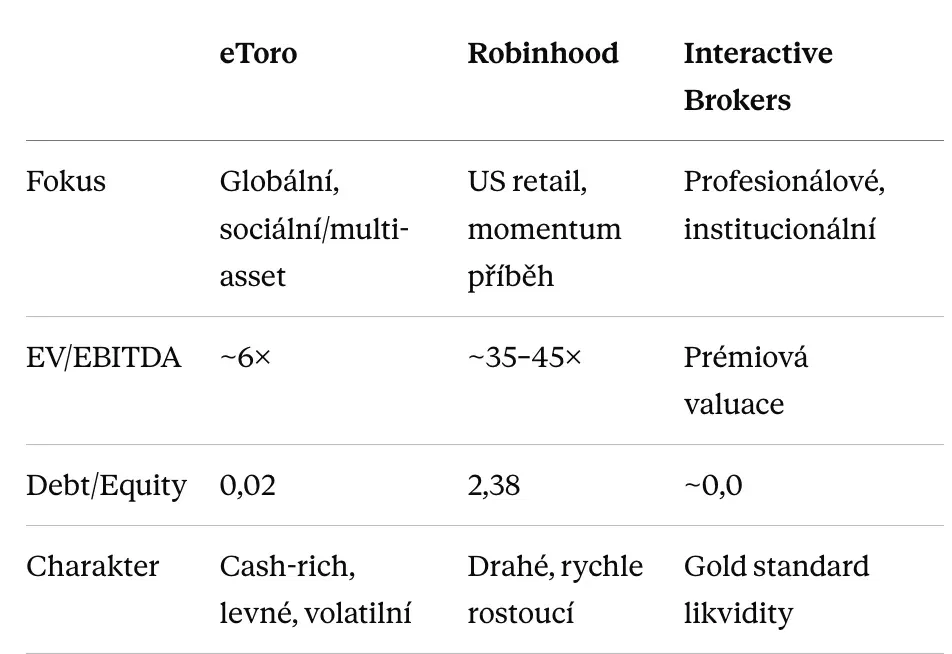
Robinhood trades at an EV/EBITDA of 35.76, which is 232% above its ten-year median. eToro at 6.17. The market gives Robinhood a massive growth premium and treats eToro like a commodity business in trouble. Both companies have network effects, both are growing, but one gets a multiple like a rising star and the other like a company being written off.
Red flags you must not overlook
The collapse in crypto activity is a fairly serious risk. In July 2026, the total number of crypto trades on the platform fell to 1.4 million, 73% less year over year. The average invested amount per transaction fell by half to $182. Assets under management in crypto fell 5% year over year to $18.5 billion. This is a real signal that retail demand for crypto on the platform is genuinely disappearing.
Share dilution is the second risk that needs to be watched every quarter. The number of shares outstanding grew 118% year over year. Part of it is the IPO structure with two classes of shares, but this year three acquisitions were added, partly paid in stock. February's increase in buybacks by $100 million eases the situation, but the net impact on share count needs to be monitored.
The third risk is concentration of power. Class B shares carry ten times the votes of ordinary shares and hold roughly 89% of all voting power in the company. As a minority shareholder you have practically no influence over strategic decisions, and three acquisitions in one year are exactly the type of decision where a minority voice might want to tap the brakes.
The fourth risk is a slowing growth engine. Net Contribution grew at a pace of 26 to 28 percent year over year in 2025; now it's 9%. It's not a collapse, but it's a clear slowdown exactly at the moment when the firm is stepping up its acquisition pace – a combination that requires flawless execution.
Valuation and three different investment scenarios
Model inputs: base free cash flow for 2026 at $300 million (conservatively against $321 million over the last year, due to crypto slowdown), net cash of $900 million after accounting for acquisition commitments, 79.53 million diluted shares, terminal growth 2 to 3%.
I set the discount rate in the range for risky small companies, 10.5 to 14%, due to volatility, a short public history and correlation with crypto.
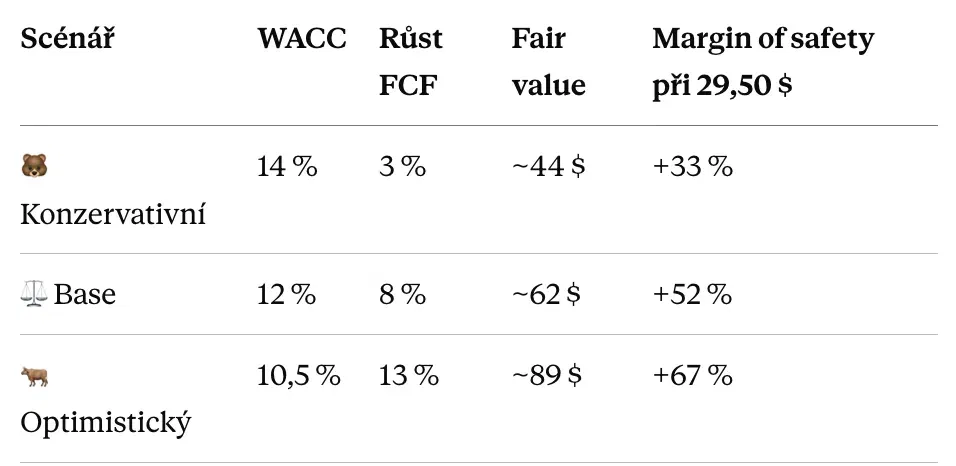
Even in the conservative scenario, where crypto winter continues and cash flow grows only 3% per year, the model shows a 33% margin of safety against the current price. That corresponds with the dispersion of price targets on Wall Street, from $35 to $53 depending on the bank. Even the most pessimistic price target implies a double-digit upside to today's price.
Sentiment vs. numbers
The stock was down roughly 29% over the last three months, then dropped another 14% in a single day to a close around $29, despite GAAP profit rising 77% year over year. That day, the S&P 500 added 0.2% and the Nasdaq 0.4%, so it wasn't a whole-market selloff. It was a purely company-specific reaction to the headline "revenue decline" and the collapse of crypto metrics.
It's a textbook example of how the market reacts to headlines, not economic substance. The headline said "revenue fell 24%". Yet the substance said "Net Contribution continued to grow, profit continued to grow". Add to that a 118% increase in shares outstanding and three acquisitions in one year, and we get perfect conditions for panic, even though the balance sheet remains solid.
My investment thesis
I have an eToro account and have been using it actively for years, so I take this somewhat personally. This drop doesn't make sense to me if I look at what the platform is actually doing today, not what it did in 2021. Back then crypto was the main draw; today it's a side product that is fading, and the company has weathered it with equity trading and CopyTrader.
I think the market is asking the wrong question. It asks "how much did the company earn from crypto" instead of asking "how well did the company manage the transition from crypto to a multi-asset platform". The answer to the second question is decent - profit grew 77% and capital markets 25%.
I take it as a speculative position, not a sure thing, and I'm watching it closely. Share dilution and the dual-class structure annoy me, and I will monitor them every quarter. I have my buy price set at $28, where I would enter the stock, because at that level I really like the risk-reward ratio.
