


Nvidia earned a record 96 billion dollars. Why is it suddenly borrowing money at a record pace?
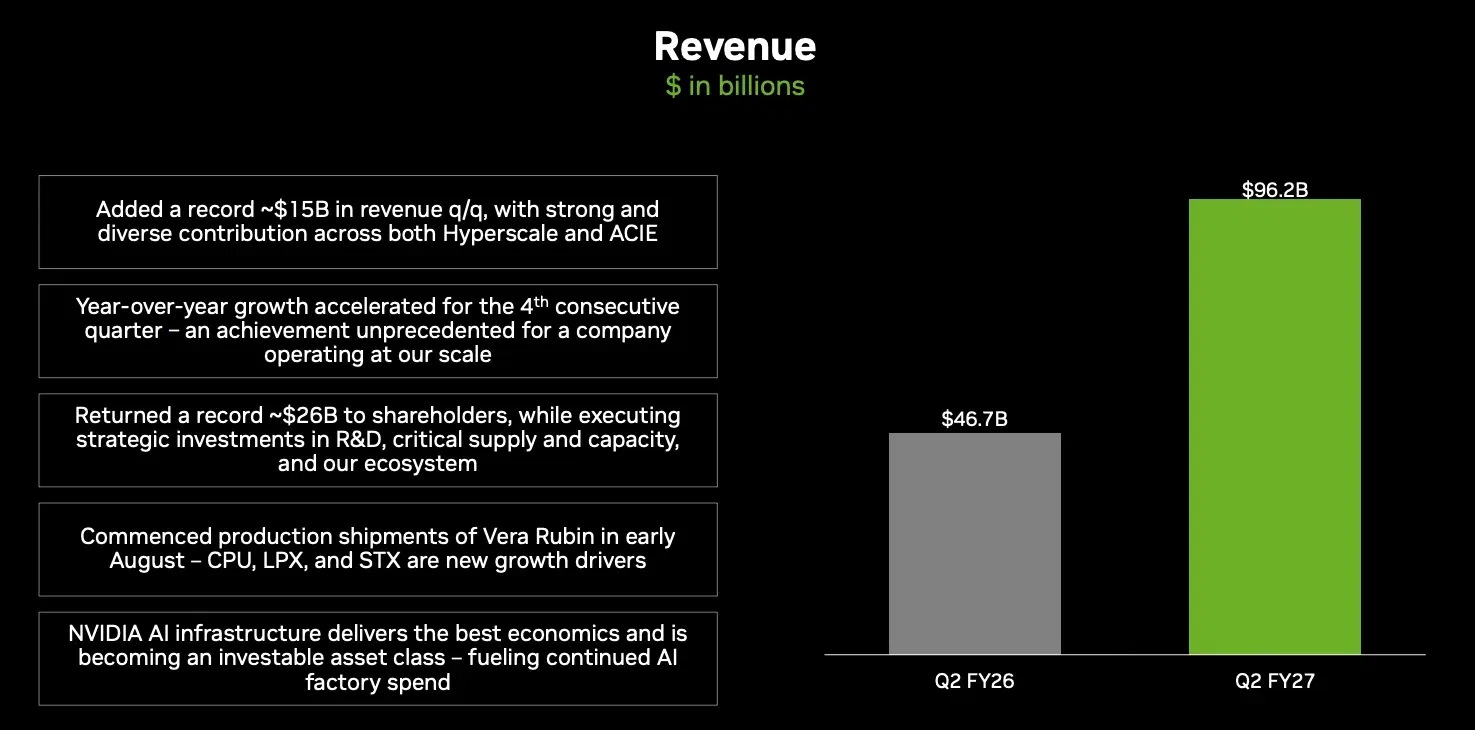
The world's largest company reported its quarterly results for the second quarter of fiscal year 2027 yesterday, and most numbers set new records - no company in the world has ever earned 96.2 billion dollars in revenue in three months.
The market is reacting with a 7.5% rise in the stock price, newspaper headlines compete in superlatives, and Jensen Huang talks about the "golden age of AI labs".
So I thoroughly read the report and listened to the earnings call, and I found 3 specific numbers that I believe say more about the health of the entire AI cycle than the record revenue itself:
1. Nvidia borrowed money for the first time in five years
2. Its margins are falling for the first time in a long time due to a component it does not control
3. The company itself is guiding for growth that half of Wall Street does not believe
Let's break it down!
Which numbers are really important?
The main numbers. Revenue of 96.2 billion dollars, up 106% year-over-year. Nvidia guided to 91 billion in May, so it exceeded the upper end of its own estimate by more than 5 billion. Net income of 59.7 billion dollars, up 126% year-over-year. Earnings per share reached 2.46 dollars.
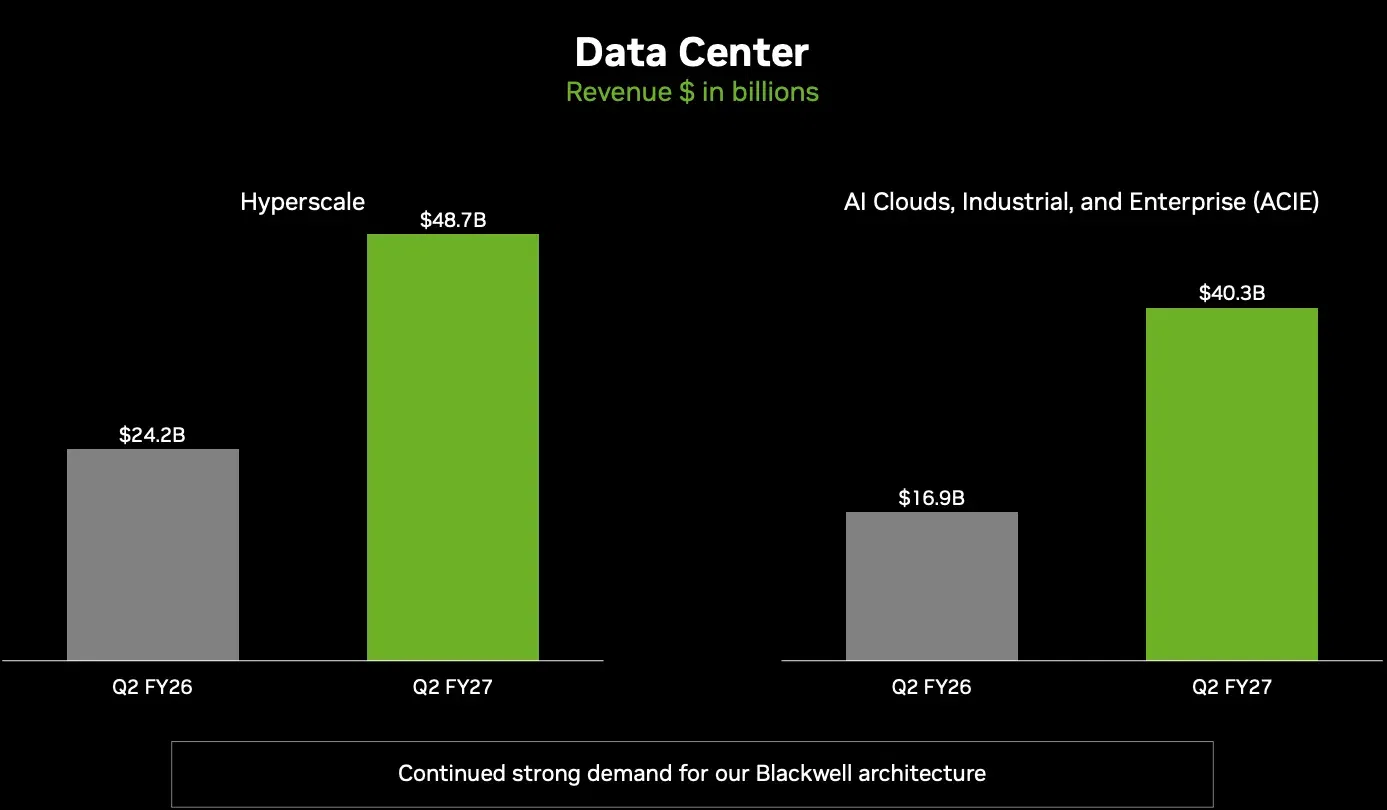
Data centers, but split differently than we are used to. The data center segment made 89 billion dollars, that is 93% of the whole company. But for the first time, Nvidia clearly split where that money comes from: "Hyperscale" brought in 48.7 billion dollars, +13% quarter-over-quarter. The second category, which Nvidia calls "ACIE", i.e. AI-native clouds, earned 40.3 billion dollars and grew 25% quarter-over-quarter, and even improved 138% year-over-year.
This is a number almost nobody mentions, and it is more important than it looks: demand for Nvidia is no longer relying only on the five big cloud companies. It is growing faster where governments, smaller specialized clouds, and companies outside Big Tech are buying. From a risk concentration perspective, this is a healthier mix than Nvidia had a year ago.
Margins and why they are suddenly falling. Gross margin of 75% this quarter, 2.5% higher than a year ago. That sounds great, but guidance for next quarter says 74%, and CFO Colette Kress described the memory market situation on the earnings call as "extreme pricing conditions".
According to her, margins will fall further, with Nvidia expected to bottom out in the fourth fiscal quarter at 71–72%, and it should get back to 72–73% only in the next fiscal year, when the "increased prices are reflected" in product selling prices.
In other words, the company that dictates prices to the entire AI industry is now itself paying more, because memory manufacturers dictate to it. Nvidia has enormous bargaining power over customers. Suddenly, it does not have as much bargaining power over its own suppliers of a key component as expected.
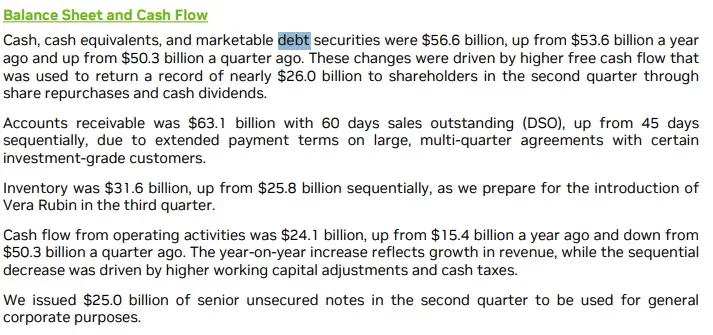
Debt that wasn't talked about much. In June 2026, Nvidia issued bonds for the first time in five years - 25 billion dollars in seven tranches with maturities from 2 to 30 years, with interest of 4.25 to 5.6%. It was the largest bond issuance in the company's history and investor demand exceeded supply.
The result is visible on the balance sheet: total debt jumped from 8.5 billion dollars to 33.4 billion. And this is a company that generated 21.3 billion dollars of free cash flow in the second quarter alone and sits on cash and marketable securities worth over 56 billion dollars, plus roughly 94 billion more in equity and non-equity investments.
The Chinese zero. Less than 1% of data center revenue this quarter came from customers in China. Guidance for next quarter assumes zero. Nvidia explicitly writes that it excludes any data center revenue from China due to geopolitical uncertainty. This is a market that was worth billions of dollars annually for Nvidia just two years ago, and the company has essentially written it off from its own forecast.
Rubin and other growth cards. The new Vera Rubin platform started shipping in early August, according to the company, and is expected to account for about 20% of data center revenue in the third quarter - that is an extremely fast ramp for a product that has been on the market for a few weeks. Amazon also committed to deploying another 2 million Nvidia GPUs by the second quarter of fiscal year 2029, providing demand visibility for almost three years ahead.
Guidance for the next fiscal year. Nvidia gave a specific number for fiscal year 2028 for the first time: revenue growth of around 70%. The analyst consensus before results was around 44–45%. Jensen Huang said on the call that real demand is "much higher" than what the company is guiding, and that the limit is not customer interest but supply chain capacity.
How do I evaluate the overall results and how will I react?
Regarding the debt, I would be cautious with a definitive judgment and I will intentionally present both sides. There is a version where it is a smart move: Nvidia borrows at 4.25–5.6%, while the company as a whole generates returns on capital much faster over the long term. It keeps cash free for acquisitions, buybacks, or anything else, instead of selling its own securities or cutting share repurchases. Apple did exactly this for the entire past decade - borrowed cheaply even with tens of billions in the bank, and it worked without a problem.
But then there is the other version: when a company at the peak of a cycle, with record profits, reaches for debt for the first time in years, it is also a signal that even it does not want (or cannot) finance the current pace of investment purely from its own cash. Both readings are legitimate at this moment. What I would watch going forward is what exactly the 25 billion will be used for, whether it goes into capacity, or mainly into further share buybacks.
The margin is the first crack for me in an otherwise bulletproof story. The entire narrative around Nvidia for the last two years was built on the company having absolute pricing power, able to dictate prices because demand endlessly exceeds supply. Now we see that this power has a ceiling when it hits its own supply chain. Memory manufacturers are not in a position to let Nvidia dictate terms; it is the other way around.
And I have healthy skepticism about the 70% guidance for next year. Every CEO in the world will say demand for their product is enormous, that is largely their job. The difference of 70% versus the consensus of 44–45% is huge, and the bigger the gap between what the company claims and what the market thinks, the greater the risk we bear if reality leans closer to the consensus.
Nvidia historically has a solid track record of meeting guidance, and I definitely don't want to take that away from it. But precisely because the margin now shows that Nvidia itself depends on suppliers who are putting it in a corner, I would be cautious about blindly believing a number that assumes a smooth ramp of Rubin, memory supplies, and geopolitics all at once. Guidance is only a scenario, not a promise.