


AI's limit isn't silicon, it's electricity | Future Intelligence #25

This week made clear that the limiting factor for AI infrastructure isn't chips, but electricity: Google secured 396 MW of geothermal capacity from Utah via Fervo Energy, while Amazon is pouring over $5.3 billion into its first AWS region in Saudi Arabia. Nvidia will pay $12.93 billion for Hugging Face, shifting the fight from hardware into the layer where models are distributed. And Microsoft will, for the first time in years, report Azure revenue in dollars—reporting is being reorganized around AI, because that's where the return on hundreds of billions of investment will be decided.
Future Intelligence is an exclusive analytical report published once a week and available only to Bulios Black members. Members receive it automatically every Sunday morning by email—in full, including specific scenarios and market implications. Permanent access to the report is available with Bulios Black membership.
Key points
Why electricity, not chip availability, is becoming the main ceiling for AI development
What the record 396-megawatt geothermal energy contract means for Google's energy plans
How Uber and Wayve opened London to robotaxis and what it means for the rest of Europe
Why Nvidia reached for Hugging Face and which layer of the whole model market is really at stake
Which AI-related stocks had a wild week and why Microsoft will disclose Azure revenue
Energy as the AI ceiling: Microsoft at 2.67 GW of gas, Google on geothermal
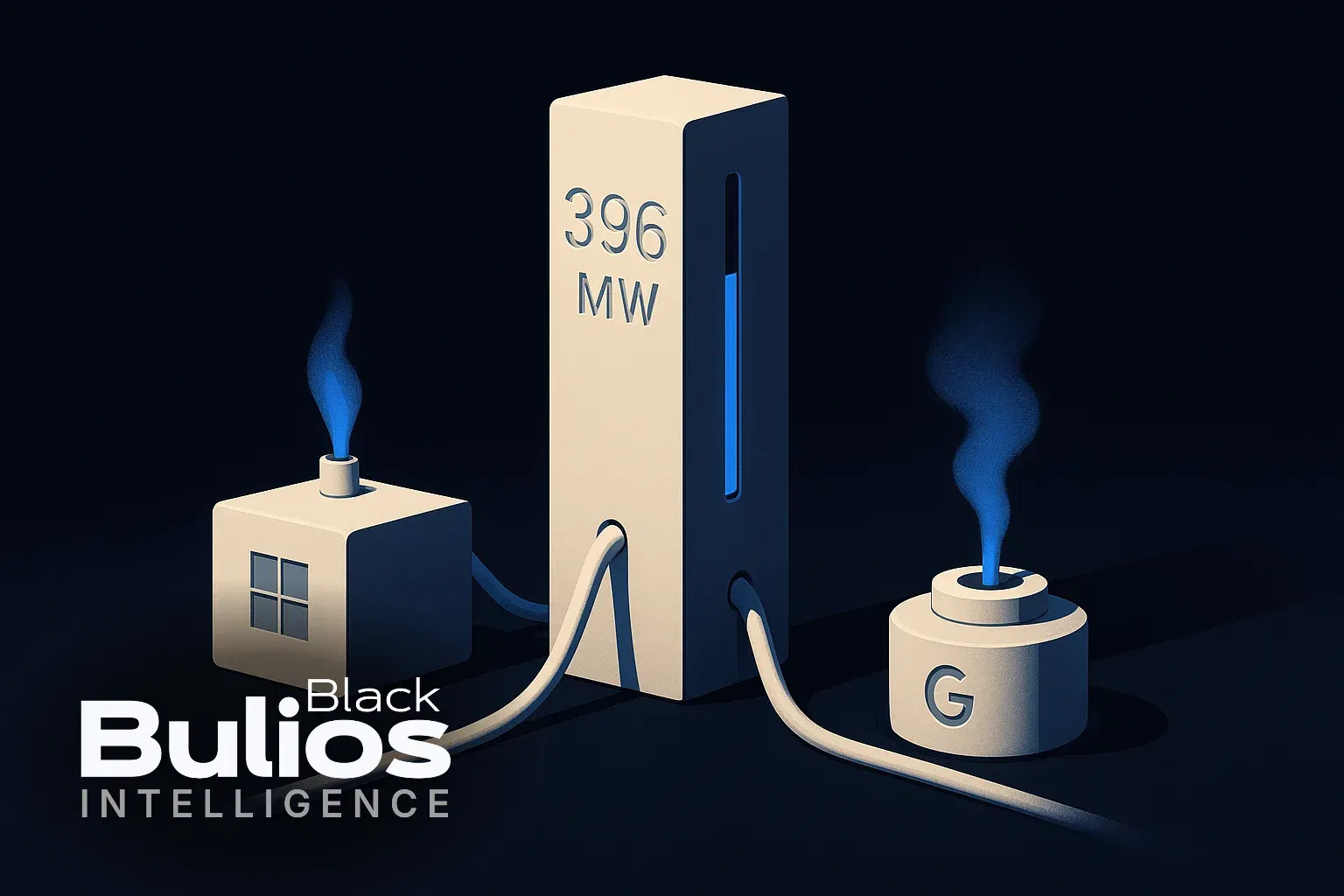
Within a single week, it became clear what currently limits AI infrastructure buildout: not chips, but electricity. Fervo Energy announced on September 1 a contract for 396 MW with Google from the Cape Station project in Beaver County, Utah—according to the company, the largest enhanced geothermal energy contract in history.
The other side of the coin is Microsoft. It signed a 20-year power purchase agreement with Chevron for electricity from a gas-fired plant in West Texas with a target capacity of about 2.67 GW. The Kilby project is being built by subsidiary Energy Forge One in partnership with investment firm Engine No. 1, and power is expected to flow from 2028.
The difference between 396 MW and 2.67 GW is not a detail. They are two different bets on how computing capacity will be powered by the end of the decade—and both mean hyperscalers are no longer just grid off-takers but are becoming co-investors in power generation.
Why a power plant is being built next to a data center
The key word in Chevron's press release is "co-located"—the plant sits right next to the data center and supplies power directly, bypassing the regional transmission system. This circumvents the industry's hardest bottleneck: the grid connection queue, where projects wait years for capacity and permits.
Kilby is to be built in a phased, modular way—capacity is added in blocks as demand grows. For Microsoft, that means not paying for 2.67 GW from day one; for Chevron, the final investment decision won't come until this year and risk is spread over time.
Fervo solves the same problem with different technology. Enhanced geothermal systems (EGS) use techniques from shale drilling—horizontal wells and fracturing—to create heat flow even where a natural geothermal reservoir is absent. The result is a carbon-free source that, unlike solar and wind, runs continuously.
Continuity is more important for a data center than price. Cape Station is scheduled to start in 2028, and Google has an option to increase offtake by about 600 MW, to nearly 1 GW by June 2030. Fervo's previous largest contract was 320 MW with Southern California Edison in 2024.
A new cost line on balance sheets
The economics of these contracts feed into capital expenditures. Alphabet plans up to $205 billion in capex this year, up from $91 billion in 2025—more than double. Sundar Pichai points to reach as the counterweight: AI Overviews in search reaches over 2.5 billion users monthly.
That these are real costs, not accounting theory, was shown by Microsoft elsewhere. Starting in November, it will limit cloud gaming hours in Xbox Game Pass—Ultimate subscribers paying $22.99 a month will get 15 hours—citing rising service operating costs. It is expected to affect 4% of subscribers.
Who profits from the bottleneck
Suppliers and acquirers are building on the capacity deficit. Vertiv is buying UtilityInnovation Group for $1.45 billion in cash, with contingent payments up to $1.15 billion tied to EBITDA targets—a total of up to $2.6 billion. The stated goal is to shorten the time it takes a data center to get power.
For $CVX, Kilby is an entry into a business with twenty years of contracted cash flow, a different profile from cyclical refining margins. For $MSFT and $GOOGL, it means pushing fixed commitments two decades ahead—and raises the question of whether compute demand will grow at the same pace as the contracted gigawatts.
The geography of expansion remains spread out: $AMZN confirmed an investment exceeding $5.3 billion in its first AWS region in Saudi Arabia with launch in December 2026, expanding the network to 40 regions. Capacity is moving to where energy is available sooner than in the US grid—a variable the market has so far underpriced.
Robotaxis in London: Uber and Wayve opened Europe to autonomous rides
Uber and UK-based Wayve launched the first autonomous taxi service in Europe this week in London—vehicles appeared on the streets of Westminster as early as Tuesday, September 1, and the service opened to the public on Thursday. It is ordered directly in the Uber app, and the driving technology is provided by Wayve. It is the first commercial robotaxi outside the US and Chinese markets available to ordinary passengers.