


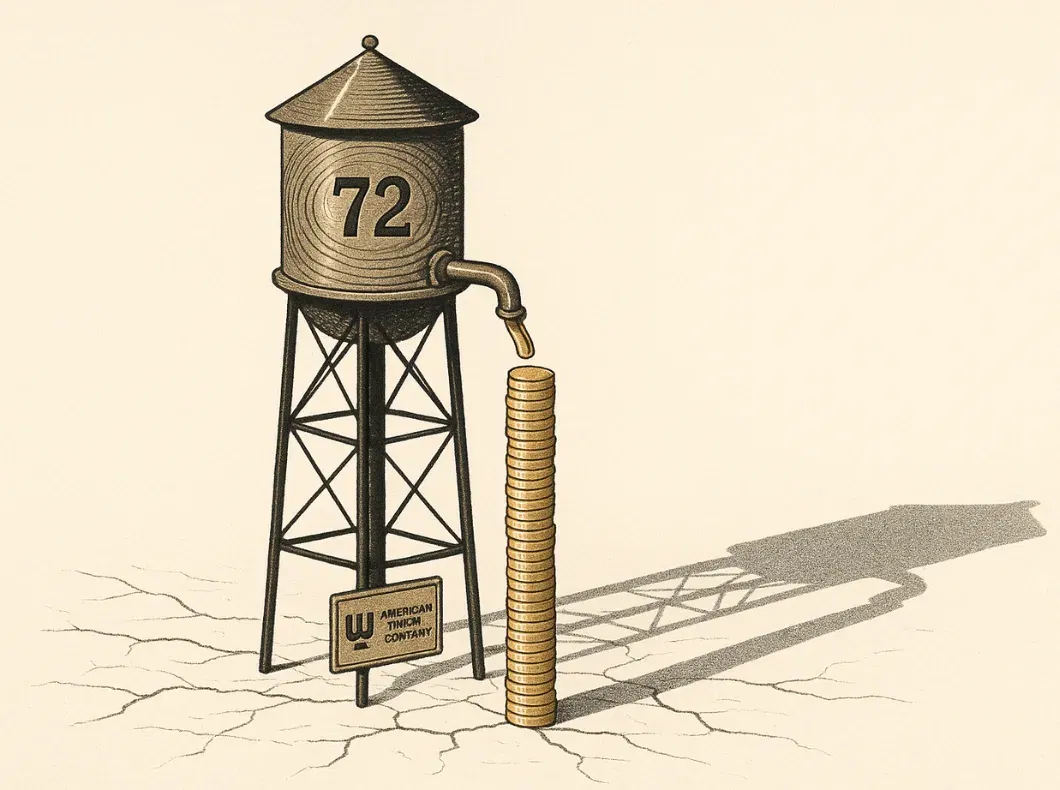
72 years of uninterrupted dividend growth. How this small water utility managed to survive everything?

Few companies on the New York Stock Exchange have paid a dividend continuously since before World War II even began. Yet that is exactly what a company that probably few ordinary investors have ever heard of has accomplished. Since 1931 it has not missed a single payment and since the mid-1950s it has increased it every single calendar year. In July 2026 it thus announced its 72nd consecutive year of growth and its 361st consecutive quarterly payment. No other publicly traded American company can boast of this number.
Key points
72 years and 361 quarters. The company has increased its dividend for longer than any other publicly traded American company, yet it is a stock with a market capitalization below $4 billion and minimal attention from the broader market.
Three businesses, one company. Regulated water, regulated electricity, and the operation of water systems on military bases work on completely different economic principles, and it is precisely their combination that explains the stability.
Free cash flow was negative in four of the last five years. The dividend, meanwhile, grew at a pace of over 8% annually.
The regulator is just changing the rules of the game. In 2026 the California commission reduced the allowed return for another utility by 0.25 percentage points.
Valuation divides analysts into two camps. One sees fair value around $71, the other 20% higher than where the stock trades today. Which of them has the stronger arguments, we will show with a simple model.
It seems like a paradox. A company with a market capitalization of around $3.5 billion, a fraction of giants like NextEra Energy $NEE or American Water Works $AWK, has survived the Great Depression, the Vietnam War, the oil crises, California earthquakes, the dot-com bubble, the 2008 financial crisis, and the COVID recession. It has also survived California regulators, which for a water utility is usually a tougher test than any macroeconomic crisis. And it keeps increasing its dividend at a pace that even technology companies might envy.
72 years of impressive history by itself proves nothing. What matters more is what specifically lies behind this streak, how the company earns its money, and whether the economics of its business are of sufficient quality for the streak to last another ten to twenty years. And also, whether investors are not paying too high a price for this history today.