


Who really profits from the rise of robots? 5 stocks from warehouses to operating rooms

More industrial robots were installed last year than even the federation that counts them worldwide expected. When the International Federation of Robotics published its last yearbook in September last year, it expected about 575,000 new installations for all of 2025. But preliminary data the federation presented this June show 621,000 units, up 15% year over year and the most in history. The United States alone returned to growth after two years of decline, with installations there rising 11% to 38,000 robots. Annual installations are expected to exceed 700,000 by 2028.
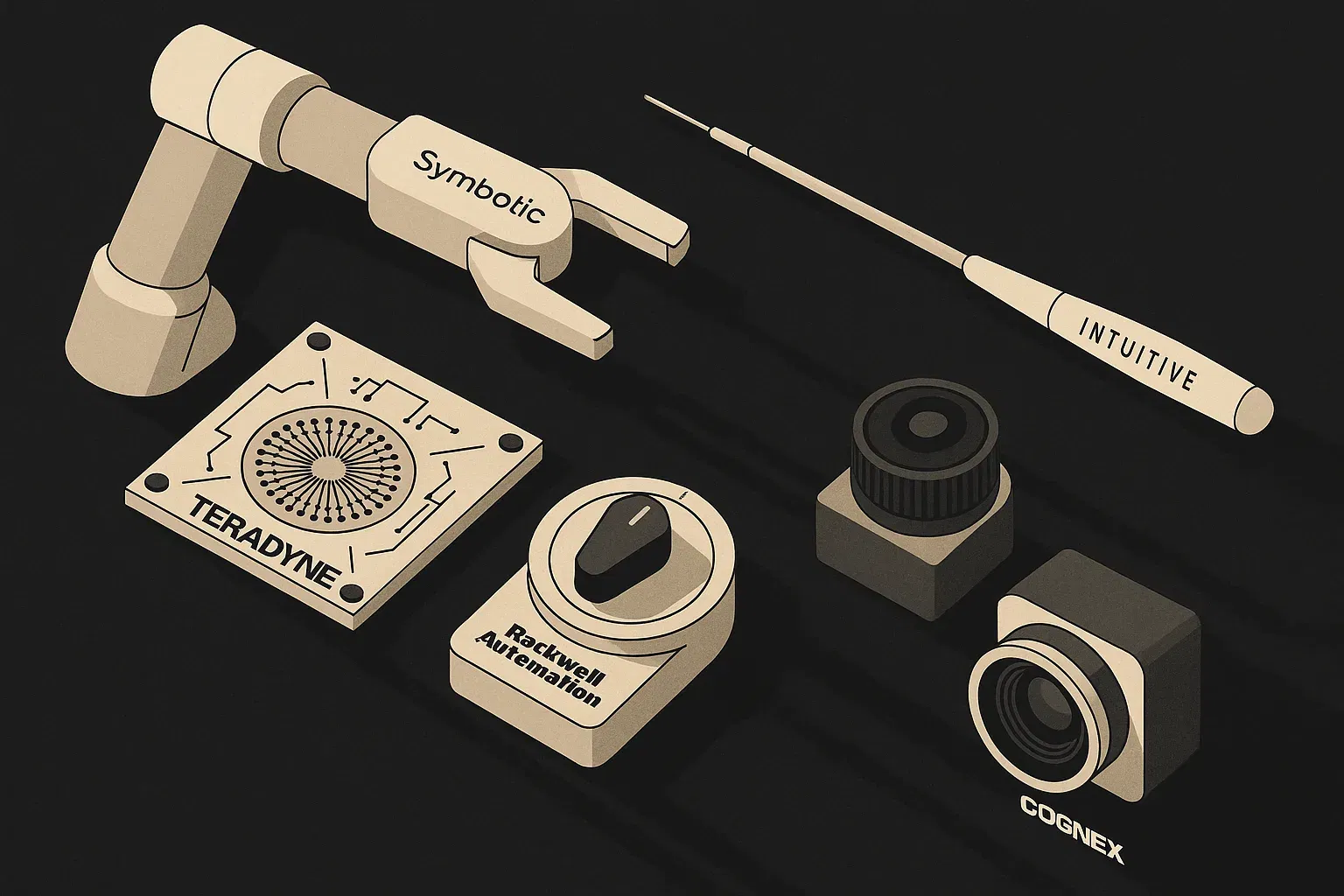
Key points
Symbotic has contracted work worth $22.5 billion and contracts that the customer cannot walk away from without penalty. Yet over 84% of its revenue is paid by a single customer.
Intuitive Surgical increased the number of procedures by 16% and the installed base by 12%. The stock is still 39% below its peak and fell even after a quarter in which the company did not disappoint.
Cognex increased revenue by 17%, while its operating expenses fell 3% year over year. Adjusted EBITDA jumped 81% and the margin has been rising for two straight years.
Teradyne's robotics revenue grew 33%. Yet its share of the company fell from 12% to 8%, and it's not because of weakness in robots.
Rockwell makes OTTO autonomous vehicles in its own plant in Milwaukee and its Software and Control segment is growing organically by 18%. The drivers are semiconductors, data centers and warehouse automation.
Artificial intelligence is accelerating this growth. Older machine vision systems had to be programmed for every situation separately, today's systems learn from examples, so automation pays off even where it didn't make sense before. Harder is picking a company that profits from it. At five American companies, robotics is already visible in revenue. But at each, next to the best number stands another that spoils it: a single customer, robotics as a fraction of the company, or a price that long ago priced in the growth.
Five companies, one trend and five completely different ways to profit from it
Robotics is sold today in five quite different forms: as distribution center automation, surgical systems, machine vision, robotic arms working without a cage next to people, and control of the entire production line. The warehouse, the operating room and the production line respond to completely different demand cycles, because hospital budgets behave differently than retail investments in warehouses. Comparing suppliers by how many times the word robotics appears in their results therefore leads nowhere. What makes sense is five questions.
Real exposure. How much of current revenue is actually related to robotics. The difference between a company for which it is the whole business and a company where it is less than a tenth changes the investment thesis from the ground up.
Where the growth is visible. Whether the trend is driving reported revenue, contracted orders, installed base or just usage volume. A signed order and recorded revenue are not the same thing, and at one of the companies the gap between them is huge.
Profitability. Whether the company just supplies robots or already makes money on them. Two of the five have gross margins around 70%, one stays below 25% and one still operates its robotics division at a loss.
What is already in the price. How much future growth the stock assumes. The more growth is in the price, the smaller a company misstep is enough to cause a drop in the share price.
Risk. Dependence on a single customer, cyclicality of customer capital expenditures, cheaper competition from China and the possibility that the technology shifts elsewhere.
For this five, it is not true that the lowest multiple means the best buy. One company is only now converting order volume into profit, a second stands on recurring revenue from instruments and service, and a third is a large diversified industrial company where robotics almost disappears in the numbers. The same P/E means something different for each. While one's revenue grows with every procedure performed, another's entire quarter depends on how many systems were handed over to customers. Decisive is who has taken robotics through revenue and margins all the way to recurring cash flow and who is still just collecting orders.