


These 5 companies are profiting from high interest rates

The Fed raised its benchmark rate by 25 basis points to a range of 3.75 to 4.00%. It is the first increase since July 2023, and the committee's new projections show that most members expect one more by the end of the year. For an ordinary company this means more expensive debt and a higher return hurdle demanded by investors. In part of the financial sector the opposite mechanism applies, and the higher rate flows straight into the revenue line of the income statement.
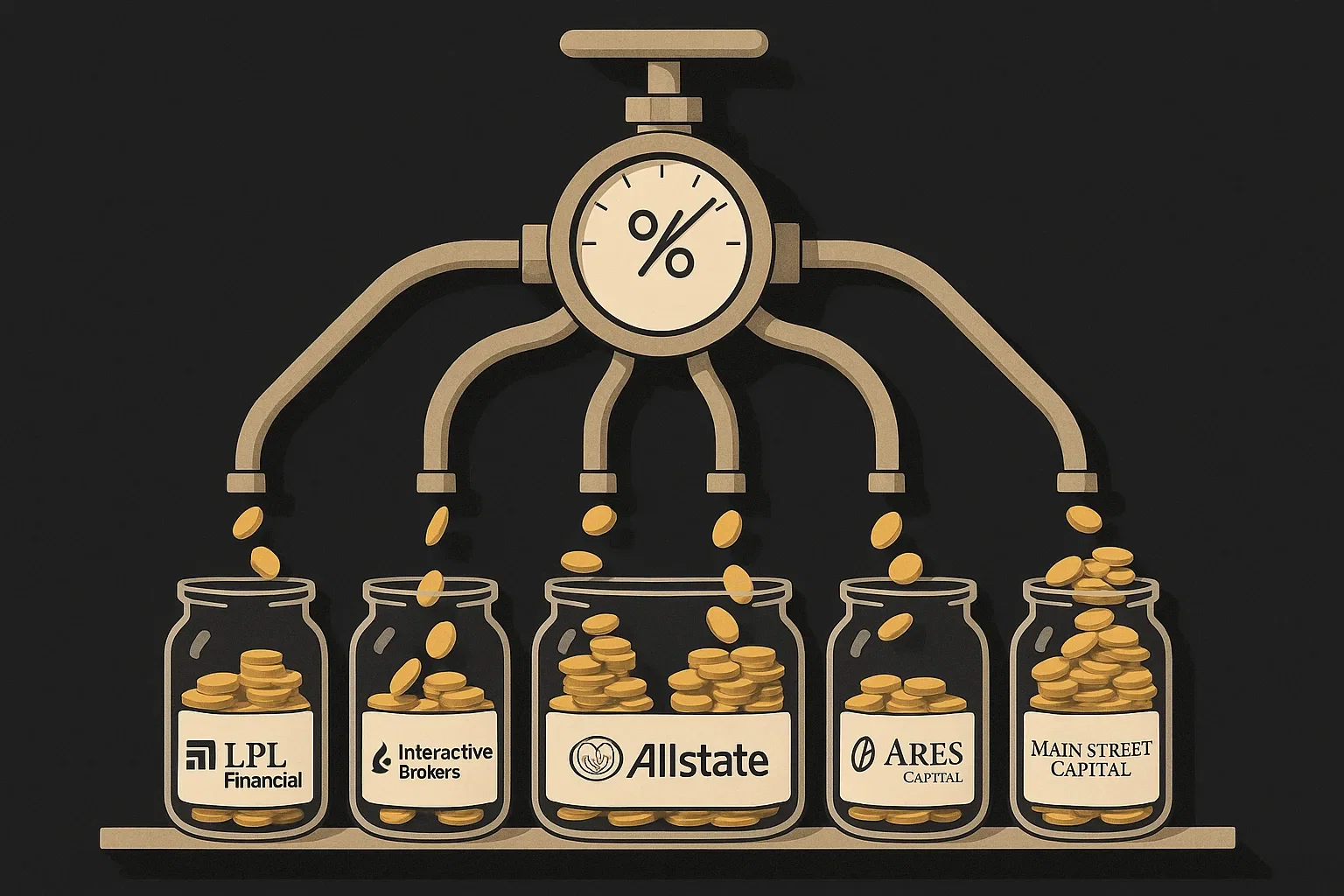
Key points
At LPL Financial about 60% of client cash has a fixed rate. The Fed increase therefore flows into less than half of balances, and the company deliberately keeps this ratio.
Interactive Brokers calculated that each 25 basis points adds $81 million of annual interest revenue. Its margin loans grew 67% year over year, while accounts grew only 34%, but these loans are the first to leave the balance sheet when the market falls.
Allstate manages an $87.8 billion portfolio, of which four fifths earn interest. Its investment income contribution to adjusted earnings per share rose from $7.00 in 2022 to $11.47, and unlike the rest of the five it will remain even after the Fed starts cutting rates again.
At Ares Capital non-accruals climbed to 2.4% of the portfolio and core earnings of $0.47 per share no longer cover the $0.48 quarterly dividend by itself. The fund has a cushion, but it can be exhausted.
Main Street Capital trades 67% above net asset value, while Ares Capital offers similar rate exposure practically at that value. The most transparent mechanism of the five is also the most expensive.
One of these companies collects over a billion dollars of net interest revenue per quarter, yet its margin from it fell year over year. Another holds $56.9 billion of client cash, whose share of client assets shrank from 2.6% to 2.2% over a year. A third publishes its own model, according to which exactly the step the Fed just took adds $5.2 million to its annual net investment income.
The previous twelve months played against them. Rates were cut three times since last September, and all five lost from their most profitable income statement line.
The decision came on September 16, 2026. It concerns five American financial companies: Interactive Brokers $IBKR, LPL Financial $LPLA, Allstate $ALL, Ares Capital $ARCC and Main Street Capital $MAIN. They share a single macro environment, but each turns the high rate into income through a different channel. And each has a different point where that advantage breaks.
One rate, three different paths to the income statement
Interactive Brokers reported second-quarter net interest revenue of $1.06 billion, up 23% from a year earlier. Almost all of that increase came from a larger balance sheet, not a better rate. Net interest margin fell to 1.93% from 2.07%, and margin loan yield to 4.10% from 4.67%. Main Street Capital described the same from the other side, blaming the decline in benchmark rates on floating-rate loans as the main brake on interest revenue. Cheaper money did not reduce volume for these companies, but the yield on each dollar. Only Allstate went against the current, and its net investment income rose 33.8% to $1.01 billion. The cause was not the Fed rate, but a larger portfolio and purchases of bonds that lock in higher yields for longer.
The channels through which the rate reaches the income statement are three, and each works differently.
Brokers. Interactive Brokers and LPL Financial earn on cash sitting in client accounts and on loans against securities. Their revenue is the difference between what they earn on the money and what they pay the client. The counterweight is obvious: the client can ask for more, or move the money elsewhere.
Insurer. Allstate collects premiums before paying claims, and in the meantime holds tens of billions in bonds. Higher rates reach it only through reinvestment, gradually, as older paper matures and the company replaces it with new. The effect is slow but lasting. In the short term, higher yields also reduce the market value of bonds already held.
BDC. Ares Capital and Main Street lend to mid-sized and smaller companies, mostly at floating rates tied to SOFR. That is the U.S. overnight reference rate secured by government bonds, which replaced LIBOR and closely tracks the Fed rate. Higher SOFR means a higher coupon once the loan rate resets according to contract. But the same rate also raises the borrower's interest bill.
The difference between the three channels is not academic. It determines how quickly the September increase appears in results, how long it stays there, and what happens when the cycle turns back down. For brokers it is a matter of weeks, and the effect disappears as quickly as it came. For BDCs it is a month to a quarter, depending on when the loan rate resets, but with a side effect on portfolio quality. For Allstate it is years, because the portfolio turns over gradually and the higher yield remains even after the Fed starts cutting rates.