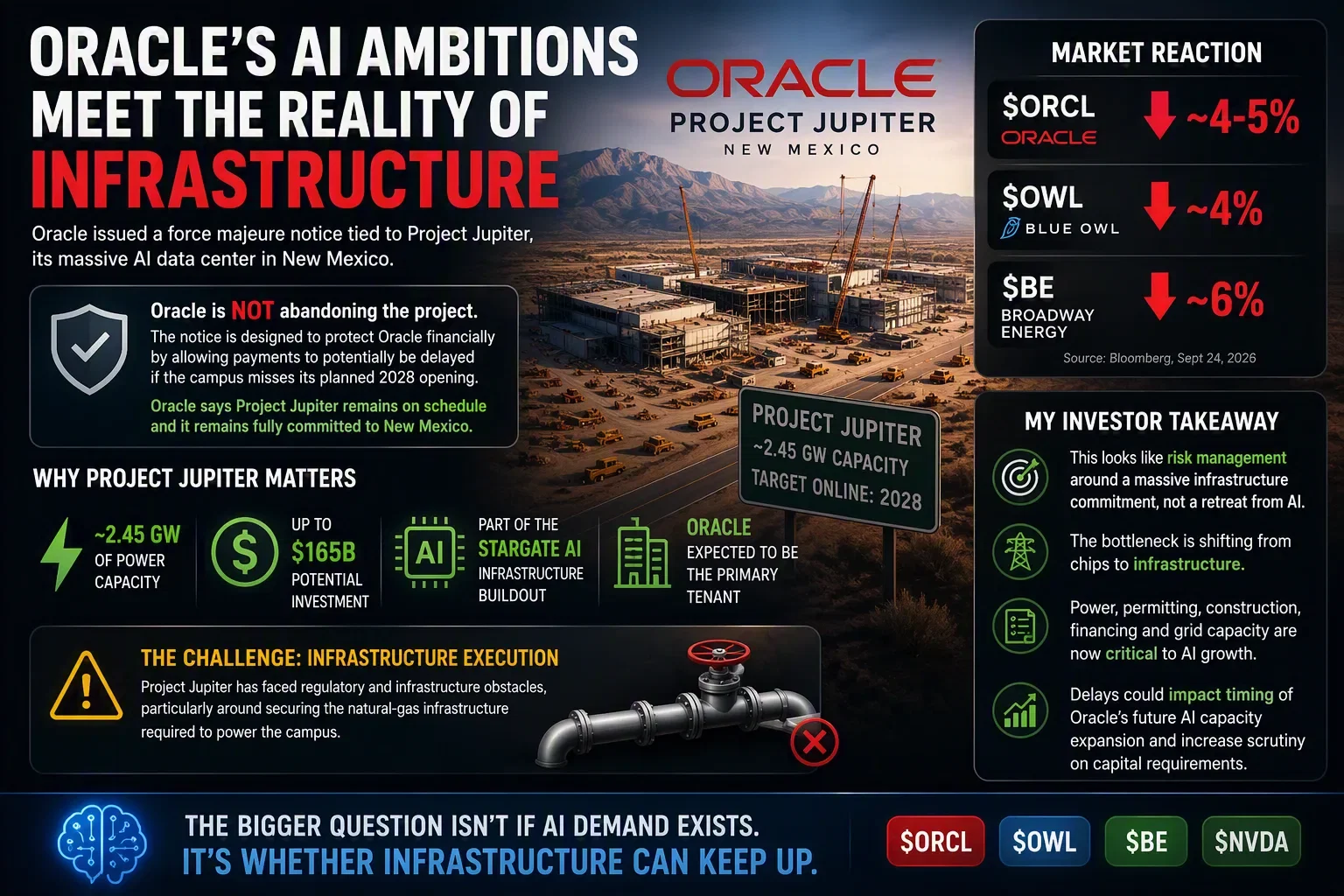
📉 Oracle’s AI Ambitions Meet the Reality of Infrastructure
$ORCL is under pressure today after reports that Oracle issued a force majeure notice tied to Project Jupiter, its massive AI data center development in New Mexico.
At first glance, that sounds alarming. But for investors, the details matter.
Oracle is not abandoning Project Jupiter. The notice is designed to protect Oracle financially by allowing payments to potentially be delayed if the campus fails to become operational as planned in 2028. Oracle maintains that the project remains on schedule and says it remains fully committed to New Mexico.
🏗️ Why does Project Jupiter matter?
The planned campus is enormous:
⚡ Around 2.45 GW of power capacity
💰 Potential investment of up to $165B
🤖 Part of the broader Stargate AI infrastructure buildout
🏢 Oracle is expected to be the primary tenant
The challenge isn't AI demand.
It's execution.
Project Jupiter has encountered regulatory and infrastructure obstacles, particularly around securing the natural-gas infrastructure required to support the campus.
And the market is clearly repricing that risk.
🔻 $ORCL fell roughly 4-5%
🔻 $OWL declined about 4%
🔻 $BE dropped around 6%
🎯 My investor takeaway
I don't see today's news as evidence that Oracle's AI strategy is falling apart.
Instead, it highlights something increasingly important for the entire AI investment thesis:
The bottleneck is shifting from chips to infrastructure.
The industry can order more $NVDA GPUs and sign enormous cloud contracts, but those commitments ultimately require:
⚡ Electricity
🏗️ Data centers
🔥 Reliable power generation
📜 Regulatory approvals
💰 Financing
🌐 Grid and networking infrastructure
Oracle's decision to invoke contractual protection looks like risk management around an exceptionally large infrastructure commitment, rather than a retreat from AI.
That distinction matters.
However, investors should still watch Project Jupiter closely. Delays could affect the timing of Oracle's future AI capacity expansion while increasing scrutiny around the enormous capital requirements behind the AI infrastructure boom.
For me, the key question isn't:
“Is AI demand slowing?”
It's:
“Can physical infrastructure be built quickly enough to keep up with AI demand?”
That may become one of the biggest investment themes of the next several years.
👀 And it could create opportunities far beyond the hyperscalers themselves.
$ORCL $OWL $BE $NVDA
#Oracle #ORCL #AI #ArtificialIntelligence #DataCenters #Stargate #CloudComputing #AIInfrastructure #Investing #Stocks #Technology #Energy