


Meta unveiled a new headset | Future Intelligence #28

Meta unveiled a compact headset for $1,299 and camera-free smart glasses on Wednesday - and with them a claim that its headset line is moving toward profitability. Two days later, Microsoft merged its consumer and work Copilot into one app, leaving the personal assistant field to OpenAI, Google, and Meta. Google is paying to increase the output of nuclear units in Georgia by about 96 MW because it needs electrons sooner than the first small reactor can be built. And Oracle sent a force majeure notice for a $165 billion campus - a signal that AI infrastructure construction is hitting its own deadlines.
Future Intelligence is an exclusive analytical report published once a week and available only to Bulios Black members. Members receive it automatically every Sunday morning by email - in full, including specific scenarios and market implications. Permanent access to the report is obtained through Bulios Black membership.
Key points
What Meta showed at Connect and why the $1,299 headset is aimed differently than before
Microsoft merges Copilot into one app and quietly exits the personal assistant battle
Why Google is paying to increase output of old nuclear units instead of waiting for small reactors
How Intel, AMD, and Meta earned double-digit weekly gains and what comes next
Oracle and force majeure at a data center, pressure on servicing ASML machines in China, and a stablecoin from SoFi
Meta Connect: $1,299 headset and camera-free glasses
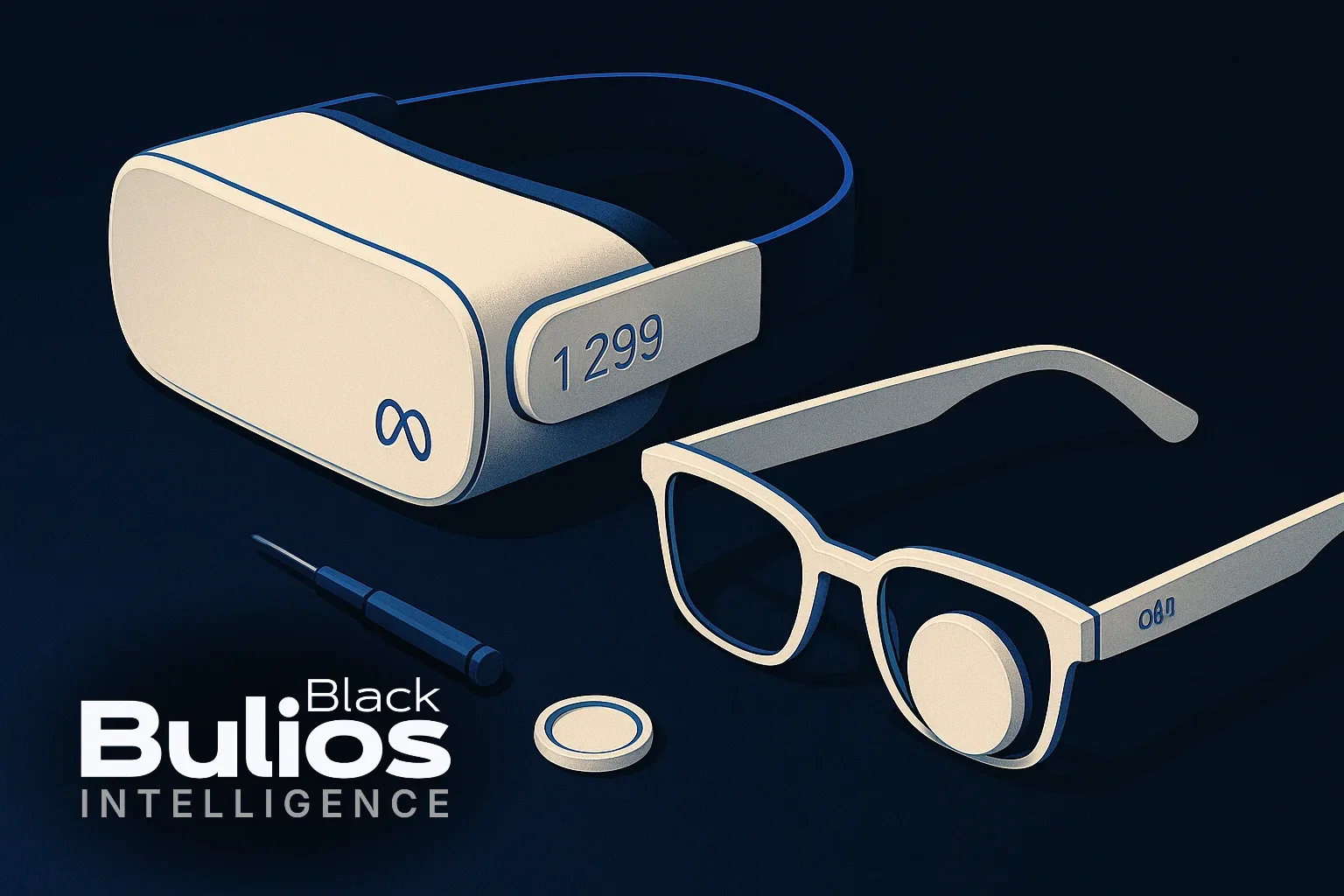
On Wednesday, September 23, Meta unveiled a compact VR headset in the style of glasses for $1,299, Ray-Ban Meta Audio smart glasses without a camera for $349, and the Muse Charm pocket device built around its own Muse AI model.
More important than the individual products is the claim framing them: the company says its headset line is moving toward profitability. After years of heavy losses in hardware and the metaverse, this is the most concrete signal that Meta has stopped buying market share at any cost and started building wearables as standard consumer electronics - with price tiers, margins, and seasonality. This changes the nature of a cost item, not just the product portfolio.
Why the $1,299 price is a technical, not marketing, figure
The headset is priced below and smaller than the Apple Vision Pro, which launched at $3,499. Meta is offering the category for under 40% of the reference device's price. Pricing in this class is not a discount campaign - it is a function of how expensive the displays, optics, and compute chip are, and how much of the computation can be offloaded outside the device.
The key to shrinking is optics. Classic VR lenses require several centimeters between the display and the eye; pancake optics bend the light multiple times between layers and fold the path into a smaller depth. The device slims down and approaches the shape of glasses, but you pay with efficiency - some light is lost, which requires brighter and more expensive displays.
The second lever is division of labor. The more AI computation runs on the phone or in the data center, the smaller the chip and battery needed in the headset - and the lower the material cost. Muse Charm is a logical continuation: a standalone pocket device for AI on the go that needs no display or optics, the two most expensive components of the category.
Camera-free glasses as a product answer to regulation
Ray-Ban Meta Audio at $349 keeps microphones and speakers but has no camera. They are available in Clubmaster and Burbank styles in 23 color and lens combinations, with pre-orders and sales starting October 13. The declared goal is to ease privacy concerns associated with a camera in the frames.
Removing the camera solves more than image. The camera is what makes glasses a device that captures the surroundings - thus subject to interest from European privacy regulators and the rules of schools, hospitals, or cinemas. A camera-free variant opens channels where the camera version is hard to sell and lowers the entry price to the ecosystem.
For Meta, it is also a test of how much of the glasses' value is carried by the AI assistant itself. If a customer pays $349 for voice, microphones, and an assistant without any visual input, it confirms that the core element of the category is software - and hardware becomes a distribution channel, not the goal.
How this rewrites the loss-making division thesis
$META was valued for years with Reality Labs as a permanent tax on advertising cash flow. If the hardware line indeed swings to profitability, part of that discount disappears - and the debate shifts from how much the division burns to how fast the installed base of devices grows.
Sentiment is already adjusting: KeyBanc raised its price target to $900 from $780 with an Overweight rating and pointed to growing interest in the Meta Muse assistant as evidence of improving sentiment toward consumer AI. It raised its 2027 revenue forecast to $313.8 billion, growth of 23%.
Pressure shifts to $AAPL. Vision Pro defined the category from the top with a $3,499 price; a $1,299 device in the shape of glasses defines volume. Apple won't lose revenue in the order of a percentage of the whole, but it loses the ability to shape the category - and in wearables, where the assistant ecosystem decides, that is an expensive loss.
In a horizon of months, a single number matters: margins and sales volumes of the headset line, which will show whether the path to profitability is a trend or a one-off effect of cheaper components. Also watch how much of the $349 price remains with Meta after partner EssilorLuxottica's share - the camera-free glasses have the tightest margin space.
Note on scope: the analysis is based on Meta's announcement of September 23 and available analyst materials. A detailed breakdown of Reality Labs results for the current quarter has not been published, so the hardware profitability claim remains a company statement until results, not audited data.
Microsoft unified Copilot: the end of the personal chatbot battle, a bet on businesses
On Friday, September 25, Microsoft unveiled a redesigned Copilot app that combines chat, coding, and long-running agents into one interface. It was shown to enterprise and technology managers on Wednesday at an event in Seattle. By merging the consumer and work versions, it leaves the personal AI assistant market to OpenAI, Google, and Meta.