


5 boring companies that have been printing money for years

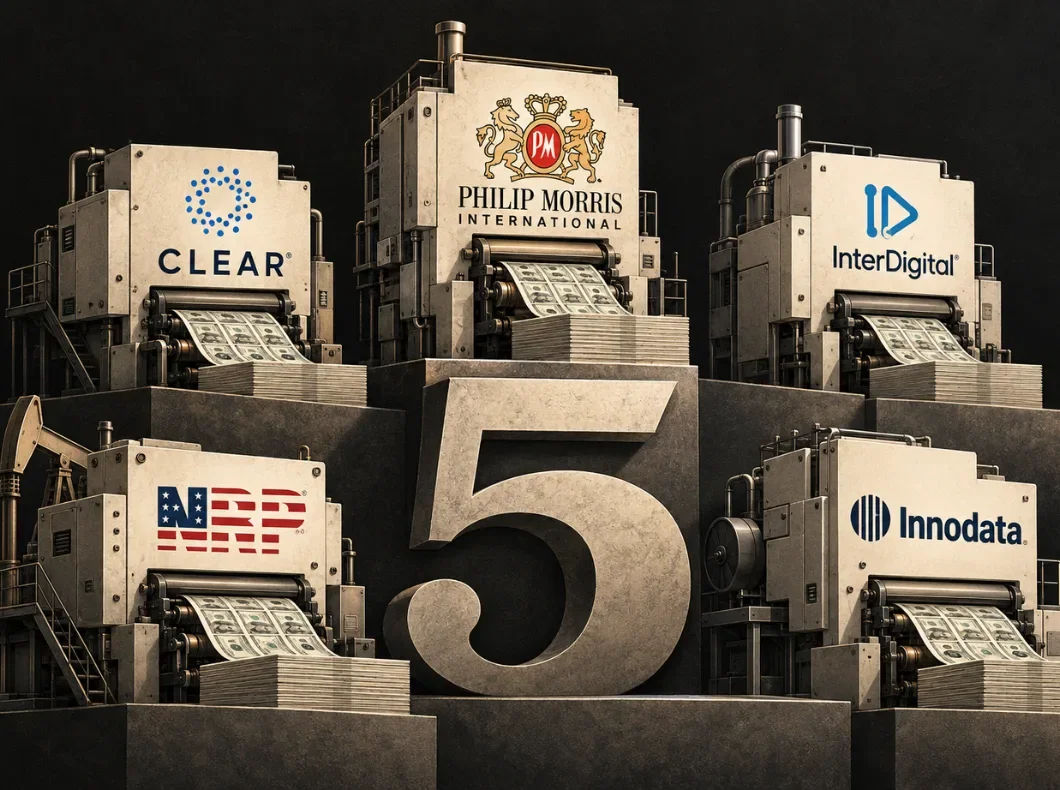
Tobacco, airport lines, patents on mobile standards, coal deposits, and data for artificial intelligence. Five businesses from industries that have almost nothing to do with each other share the ability to turn a large portion of revenue into cash. But the mechanism by which they do so is fundamentally different for each, as are the risks and the price the market demands for this quality today.
Key points
Why cash matters: Revenue growth does not yet say how much money a business actually creates for shareholders. What matters is free cash flow, the cash left after paying for operations and investments. It is from this that dividends, share buybacks, and debt repayments are paid.
Common denominator: All five companies need very little capital to operate and grow. Capital expenditures at these companies make up low single-digit percentages of revenue, so most operating cash flow remains free.
Different paths to cash: Each company earns money differently. One through pricing power, another through subscriptions paid in advance, a third through legal protection of its inventions, a fourth through land ownership, and a fifth through the operating leverage of a service.
Numbers must be read in context: At some companies current cash flow is overstated by the timing of payments from customers and partners. Adjusted metrics can also differ significantly from accounting figures.
Price for quality: Valuations range from a significant premium to multiples that reflect doubts about the long-term future of the business. For each company a different assumption applies that an investor must believe for today's price to make sense.
Value is created beyond the headlines
Over the last three years market attention focused on chipmakers, data center operators, and companies promising to monetize artificial intelligence. But rapid revenue growth alone does not say how much cash a business actually creates for shareholders. What matters is how much capital a company must invest in growth, how predictable its income is, and how strong its bargaining position is with customers. A large part of real value is therefore created in businesses that are only marginally discussed on investment forums.
The five companies in this selection come from industries that have almost nothing to do with each other. One sells nicotine, another sells time saved at the airport, a third rents the right to use its inventions, a fourth collects fees for raw materials extracted by other companies, and a fifth supplies data and human expertise to developers of AI models. What they have in common is that their operating cash flow significantly exceeds the capital needed to maintain and develop the business.
Looking through the lens of cash flow has a clear logic. Accounting profit is affected by depreciation, one-off items, revaluation of investments, and timing of revenue. Free cash flow, i.e. operating cash flow after deducting capital expenditures, shows how much money remains for dividends, share buybacks, debt repayment, or acquisitions. Even here, numbers must be read in context. At two of the five companies current cash flow is overstated by the timing of payments from customers and partners, and the text explicitly warns about this for the relevant companies.