


Dividends around 10% without energy and real estate. Five American companies worth watching

On the US stock exchange, a number of stocks trade with dividend yields around 10%, whose results do not depend on the price of oil, natural gas, or office building rents. Five of them, with yields roughly 9 to 13%, earn interest on more than $40 billion they have lent mostly to private American companies. To maintain their favorable tax status, they must distribute most of their taxable income to shareholders, so the high payout is part of the very structure of these companies.
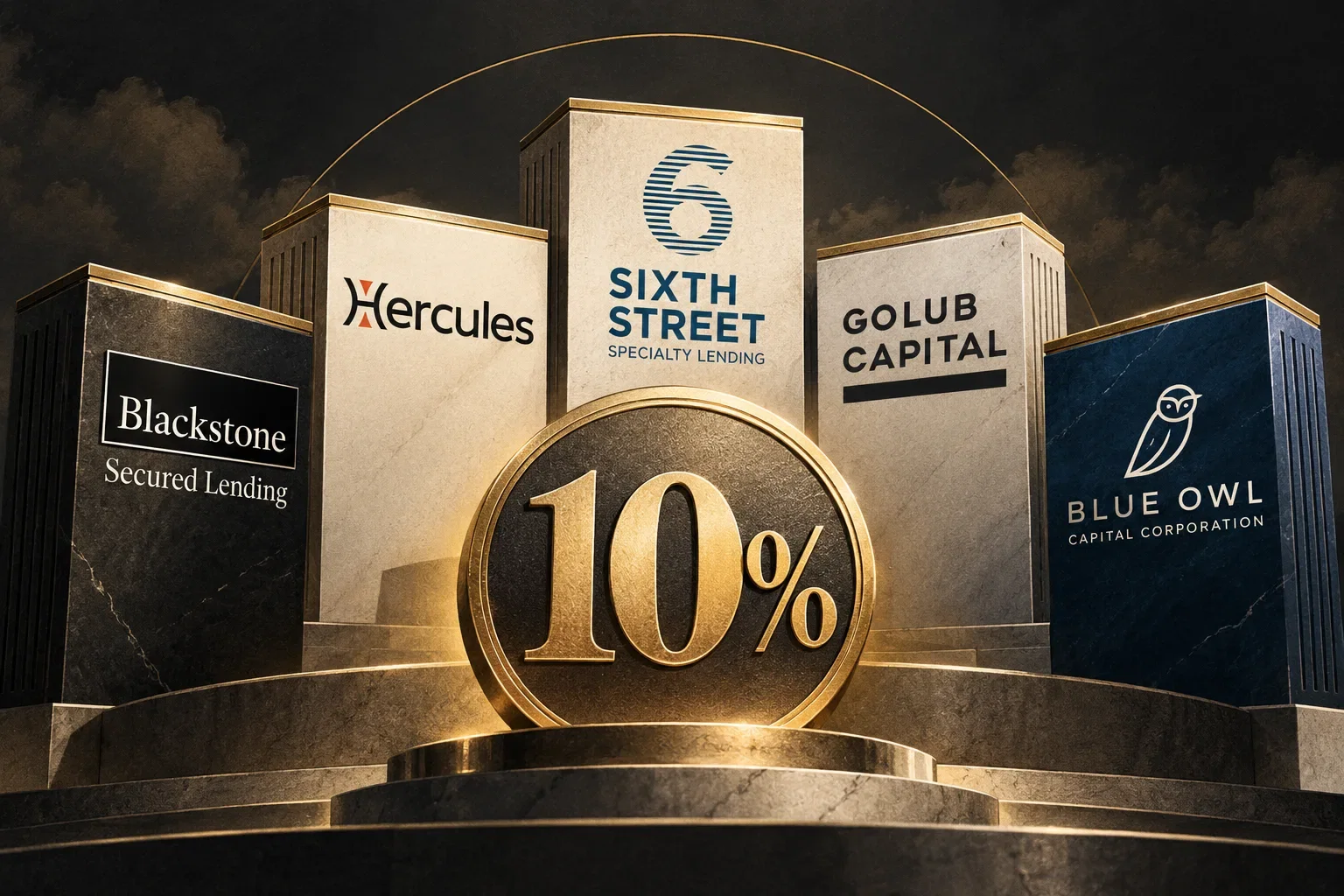
Key points
Investors pay 38% more for Hercules shares than the value of its net assets, and thus receive 9.5% from the dividend. The company distributes over 13% of its asset value to shareholders.
Blackstone Secured Lending offers the highest yield of the five, 12.8%. However, in August its management itself announced a transition to a lower dividend because earnings no longer covered the payout.
Blue Owl trades at 74% of its asset value, so a buyer receives 11.8% from the dividend. The company cut its base payout by a sixth this year.
Golub covers its dividend from earnings, yet its asset value has fallen nearly 5% since last September. The shareholder has thus lost part of the paid yield on the portfolio price.
In September, instead of further cuts, the Fed raised rates to 3.75–4.00%. Hercules may benefit the most because its loans have floating rates, while almost 87% of its own debt carries fixed rates.
A high yield here is not a sign of undervaluation nor a guarantee of payout. How much a shareholder ultimately receives is determined by the loan portfolio yield, losses on borrowers who stopped repaying, and the level of rates to which the vast majority of loans are tied. The highest yield of the five mainly reflects market fear that the payout will soon decline. The opposite case is a company for which investors pay almost 40% more than the value of its net assets.
We are talking about Blackstone Secured Lending $BXSL, Hercules Capital $HTGC, Sixth Street Specialty Lending $TSLX, Golub Capital BDC $GBDCand Blue Owl Capital Corporation $OBDC. All five are business development companies (BDCs), American investment firms that by law finance mostly small and medium-sized private companies. At first glance they look similar. But each lends to a different type of borrower, sets its dividend policy differently, and shareholders bear different risks.
Where does a dividend of around 10% come from when the company owns no pipeline or office building?
These companies' borrowers are typically mid-sized private firms with annual operating profits in the tens to hundreds of millions of dollars, often owned by private equity funds. They are too small or too indebted to issue public bonds, and banks are providing loans of such size and risk less and less. Therefore, they pay more for fast and tailored financing than large corporations.
The loan price consists of two components: the floating base rate SOFR and a fixed spread above it. Blue Owl Capital Corporation reported an average spread of 5.6 percentage points and a yield on performing loans of 9.9% at the end of June. Of its $15 billion portfolio, 78.8% consists of senior secured loans and 96% of debt investments bear floating rates, according to the company. Senior secured means that if the borrower goes bankrupt, the lender has priority claim on its assets and gets paid first.
The loan yield alone, however, is not enough for a dividend of around 10% of the share price, because BDCs pay interest on their own debts, fees to the external manager, and operating costs. The difference is made up by leverage. Rules allow borrowing up to $2 for every dollar of equity; the companies in our group stay roughly between 1.0 and 1.3 times. In a simplified illustrative calculation, the equation looks like this: for $100 of equity, there are about $220 of loans, which at a yield of around 10% bring $22 per year. After subtracting about $7 of interest on $120 of debt and $4–5 of fees and costs, about $10 remains, i.e., around 10% of net asset value.
The company distributes almost all of this income. BDCs that have chosen special tax status must pay at least 90% of taxable income to shareholders and do not pay income tax themselves. Unlike a regular corporation, they do not retain profits for growth, so when they want to expand their portfolio, they must issue new shares or borrow more.
Taxation is also different. Most BDC payouts consist of interest, and companies can label them as so-called interest-related dividends, which under US tax rules are exempt from withholding tax for foreign investors. US withholding can thus be lower than the usual 15%, but it depends on the specific broker. Companies often publish the breakdown of payouts only after the end of the year, and some brokers withhold 15% and refund the overpayment later. However, this does not exempt a Czech investor from tax: foreign dividends are taxed at 15% in the tax return with a credit for tax paid in the US. All stated dividend yields are therefore gross.
This implies a different risk profile than traditional dividend stocks. A consumer goods maker can raise the dividend as sales grow. A lender at best gets back the lent amount with agreed interest, no more. If the borrower goes bankrupt, the loss is reflected in the net asset value (NAV), and earnings are lower from a smaller base. The yield is thus capped from above, while losses have no such limit. Moreover, behind a REIT or pipeline payout lies a building or pipeline with a lifespan of decades. Behind a BDC payout lie hundreds of loans with maturities of a few years, which are continuously repaid and the money must be lent again, often under different conditions.
This roughly 10% is not a yield from growth of a consumer brand. It is a share of the loan book yield.