


Fantastic results, yet the stock is falling. What is the market concerned about with Micron?
The numbers at first glance look almost flawless, yet the stock is down about 2% after the results. The market isn't just focused on how the company is doing today, but mainly on how long the current memory boom can last. And the development of memory demand will tell us a lot about whether the AI investment cycle remains strong or is starting to slow down.
This company makes DRAM, NAND, and especially HBM memory, without which today's AI servers practically cannot function. If companies were to start slowing down the construction of AI infrastructure, we should gradually see it in memory demand.
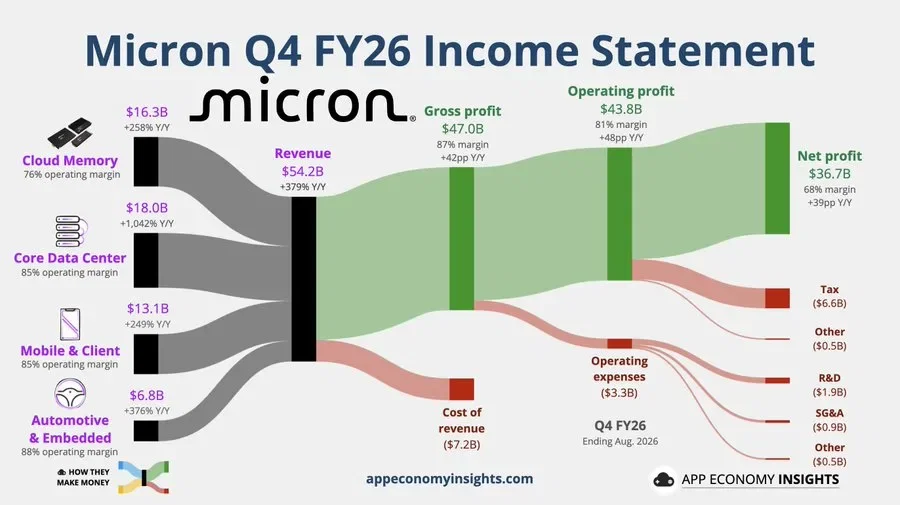
So far, we're seeing the opposite. Micron achieved revenue of $54.2 billion last quarter, a year-over-year increase of about 379%. Adjusted earnings per share were $33.42 and gross margin was 87%, compared to around 46% a year ago. Free cash flow for a single quarter reached $33.2 billion, and the company expects revenue of approximately $61.5 billion for the next quarter.
One big catch I see
A large part of the growth today is not driven by higher volume of memory sold, but by its price.
DRAM revenue increased 27% quarter-over-quarter, with shipment volume up only in the mid-single digits and prices up nearly 20%. For NAND, revenue rose 42%, volume about 10%, but prices about 30%. One thing, however, is starting to change - the pace of growth is no longer as extreme. Revenue in the previous quarter grew 74% quarter-over-quarter, now 31%, and the outlook for next quarter implies about 13% (but that doesn't mean the trend is reversing yet).
The memory business has historically always been very cyclical. Shortage → prices spike → manufacturers add capacity → supply catches up with demand → prices and margins drop sharply. So with Micron, it's not enough to just look at the record quarter, but mainly at the development of demand and supply.
Demand is holding up so far
However, it should be added that the over 75% of production for 2027 does not include only these long-term agreements, but also other customer commitments. The company also has 26 long-term customer agreements that, according to its estimate, cover more than 35% of revenue until 2030. Some already extend to 2031. Customers have additionally provided commitments of $32 billion, mostly in the form of cash prepayments.
That is no longer just a company saying "demand looks good." Customers are actually securing capacity years in advance. Even these contracts, however, do not completely eliminate the cyclicality of the business. Moreover, the more than 75% of production for 2027 that Micron has already committed does not consist only of these long-term agreements - there are also orders from other customers.
Demand is not equally strong everywhere. In mobile and PCs, shipment volume declined quarter-over-quarter, while the strongest pressure on capacity today comes from data centers.
Supply is not just Micron
Micron's new supply will not come overnight. The first new fab in Idaho is expected to start production in mid-2027, the second only at the end of 2028. New NAND capacity in Singapore is expected in the second half of 2028, and larger production from New York only from 2030. However, in the memory cycle, the entire industry must be watched. Samsung and SK Hynix are also expanding capacity, so the decisive factor will not be just what Micron builds, but whether total memory supply starts growing faster than demand.
What does this tell me about the entire AI cycle?
Demand for AI infrastructure so far does not show significant slowing. And it's not just about HBM for GPUs. Micron's Core Data Center segment already made $18 billion in revenue in the quarter, and data center SSD drives reached almost $10 billion, more than 10 times compared to last year. So AI is increasing the need for memory across the entire data center, not just directly at the GPU.
For companies tied to the construction of AI infrastructure, this is still a positive signal in my opinion. For Micron itself, however, the decisive factor will be how demand development meets new supply in the coming years. If demand continues at a similar pace, high prices and margins may last much longer than in previous memory cycles. But if demand slows just as new supply begins to increase, prices could turn very quickly.
Therefore, I will be watching mainly at Micron:
- DRAM and NAND prices and also shipment volumes,
- further contracts for 2028,
- hyperscaler investments in data centers,
- demand development in mobile and PCs,
- and the pace at which new production capacity begins to increase across the industry
So from Micron's results, I don't conclude that the AI investment cycle has peaked. Demand from data centers remains strong, even though in memory itself we are already seeing a slowdown in price growth.


