


Insurance against an Oracle crash is more expensive today than ever before in the company's history. Its rating is just one notch above junk bonds. What this means and why you should care.
Oracle is borrowing like never before
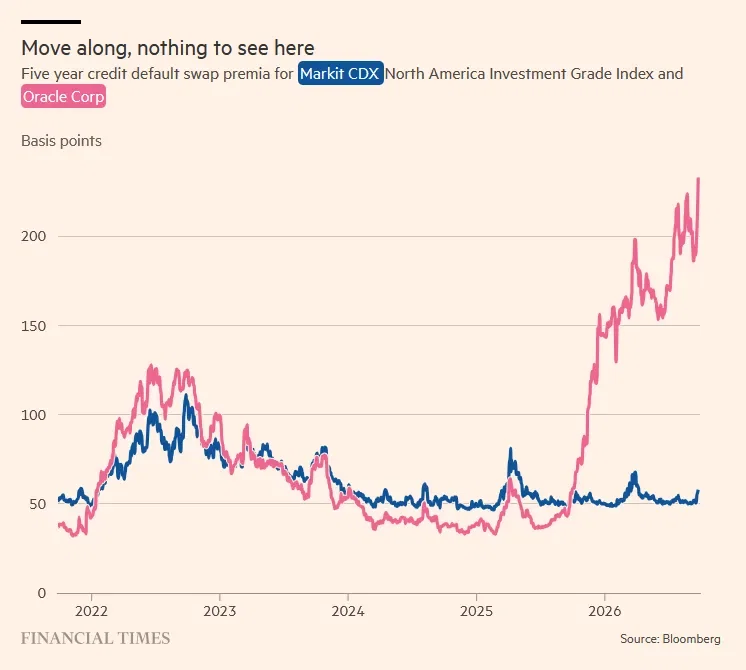
I've been watching this for a few weeks and the numbers speak clearly: credit default swaps (CDS) on Oracle $ORCL have shot up to an all-time high. For comparison: just a year ago Oracle's spreads were essentially at the level of healthy investment-grade companies. Today they're somewhere completely different and the chart shows it brutally: a sharp, almost vertical rise over recent months, while the rest of the market (the investment-grade bond index) remains calm.
The company's rating is now just one notch above junk bonds: that is, above "trash", where investors only venture with awareness of high risk and demand higher yields in return. In other words: the debt market is starting to price Oracle as if it were much riskier than the stock market sees it, since the shares are still holding a decent price.
Why this is happening
Oracle has borrowed up to its ears to build giant AI data centers, primarily for OpenAI, but also for other major players. This bet is extremely capital-intensive: you build server halls, buy chips for billions, pay for energy, and all of that before it generates a single crown back. Oracle has essentially committed to megalomaniacal contracts that it must finance with debt, because it doesn't have the cash on hand.
Barclays bank already warned earlier that without further financing inflows Oracle could run out of cash as soon as this November.
What happens if the rating falls further
If rating agencies downgrade Oracle by another notch, it will fall straight into junk territory. Estimates say that would knock $120 billion of bonds out of key investment indices. And this is the part that ordinary investors often underestimate: many funds have a mandate to hold only investment-grade bonds. When a company falls into junk, these funds have no choice but to sell the bonds, regardless of whether they believe in the business or not. Forced selling can further push bond prices down and worsen the risk, so it can become a self-fulfilling spiral.
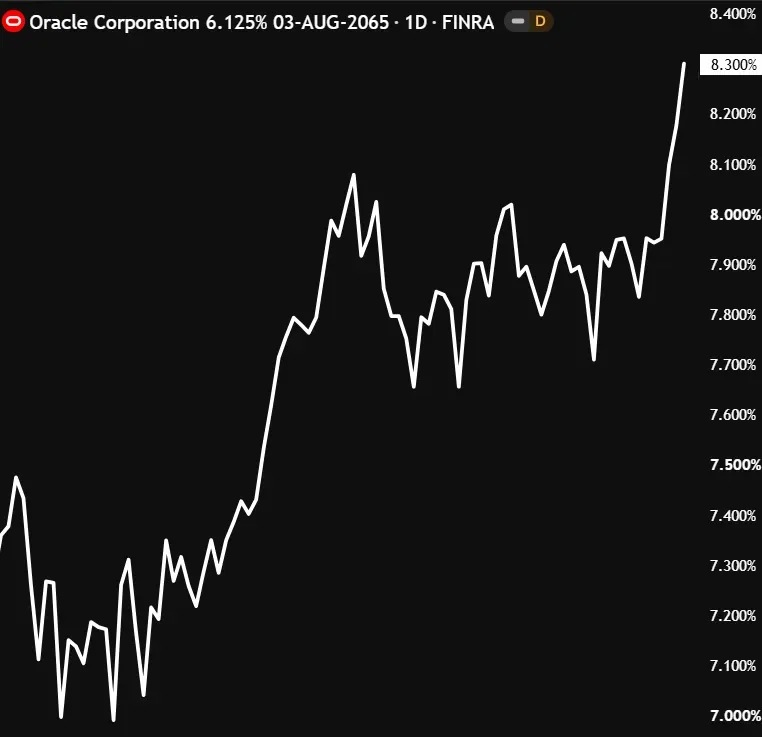
This is exactly the type of risk that is often overlooked in the AI euphoria. The market rewards companies for "being in AI", and the stock price reflects that enthusiasm. But the capital intensity of the whole bet is being addressed with debt, and the debt market is much more cold-blooded than the stock market. It doesn't play on the story, it plays on the ability to repay. Oracle is certainly not the only one financing the future with debt built on the assumption that demand for AI infrastructure will last for years ahead and contracts won't be cancelled.
What to do if you have Oracle in your portfolio?
If you have Oracle in your portfolio, watch rating agency decisions and CDS spread developments more than quarterly results; the risk will show up there first. And one thing generally holds true: the AI boom doesn't mean that every company pouring billions into it is automatically a safe bet.
