


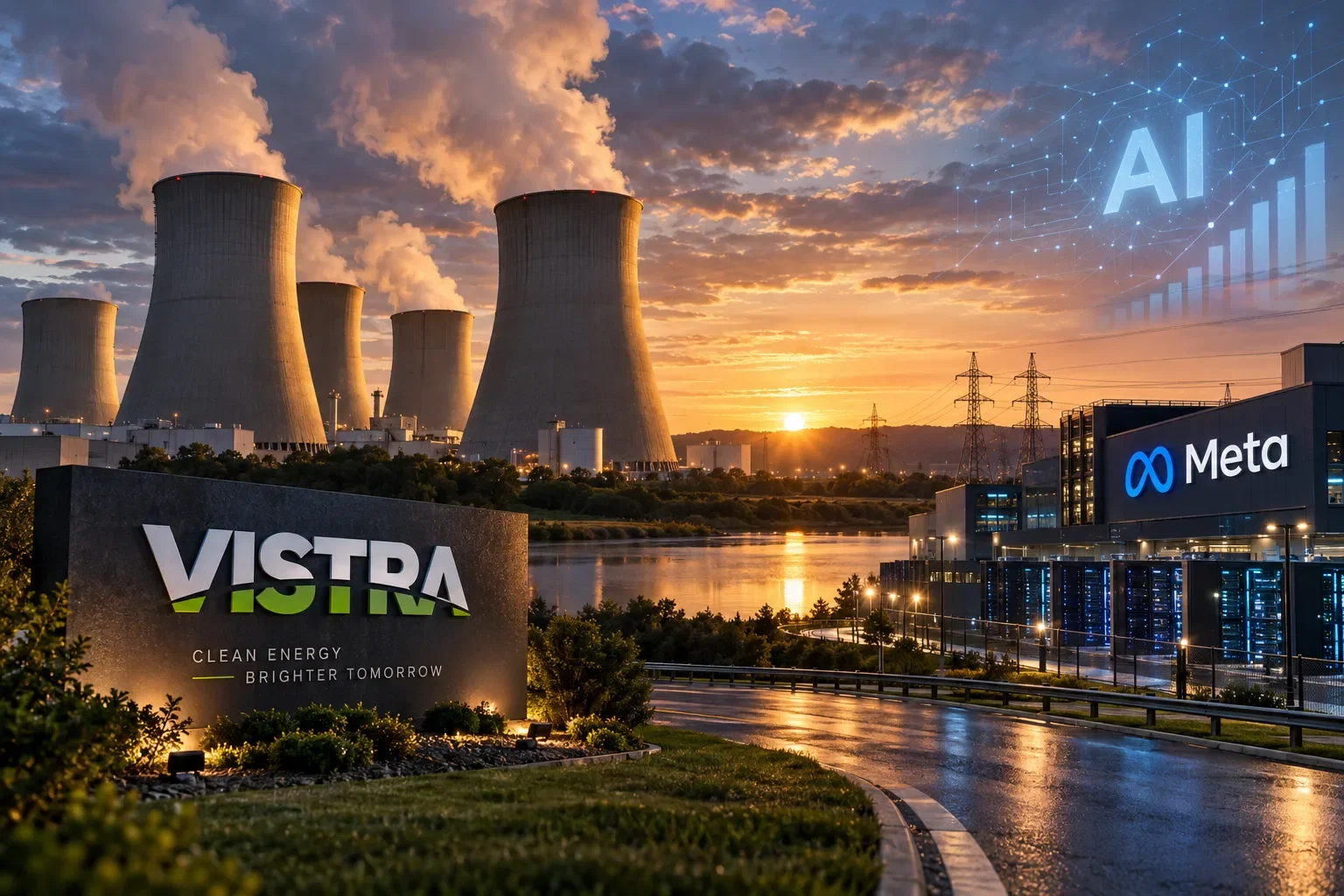
⚛️ $VST – the market still gives me an opportunity to keep building my position.
I started buying Vistra on May 13, 2026. Today it makes up approximately 3.7% of my portfolio, my average purchase price is $147.40, and at a price around $140 I am about 5% in the red.
But for me, that doesn't mean the investment isn't going according to plan. In long-term investing, I don't judge the correctness of a decision by what the price does over a few months. What matters much more is whether the investment thesis on which I bought the company is playing out.
And with Vistra, that's exactly what's happening so far.
When people talk about AI, most attention goes to Nvidia, semiconductors, the cloud, and data centers. But the more computing power we build, the more electricity we need. AI infrastructure won't work without stable energy sources capable of delivering power 24 hours a day.
That was one of the reasons Vistra caught my attention.
Vistra owns and operates six nuclear reactors at four plants. According to the company's annual report, that's 6,448 MW of clean nuclear capacity, about 15% of its total generation capacity.
An important part of my thesis was also the deal with Meta, which Vistra announced back in January 2026, before my first purchase.
These are 20-year contracts. Meta contracted 2,176 MW of nuclear energy and capacity from the existing output of the Perry and Davis-Besse plants. Another 433 MW is to come from uprating the Perry, Davis-Besse, and Beaver Valley plants.
That's 2,609 MW in total.
Deliveries under the agreements are set to begin in late 2026, with the additional capacity to be phased in through 2034, when the full 2,609 MW should be available.
For me, the key point is simple: a big tech company is securing nuclear power for 20 years and at the same time supporting investments to increase the output of existing nuclear plants.
And now another piece of news has arrived that fits this thesis.
Reuters reported on October 3 that the U.S. government plans to provide Vistra with approximately $4.2 billion in the form of a loan to increase the output of its nuclear plants. According to a Reuters source, the financing is intended to support uprates at at least three of Vistra's four nuclear sites.
Here it's important to distinguish fact from what has yet to be confirmed.
Vistra hasn't received this money yet. Reuters reports on the planned loan and says its formal announcement is expected on Monday. So today I won't write that Vistra "received $4.2 billion." That's not a confirmed fact yet.
But if the financing is definitively confirmed, it will be another step that fits what I'm watching with Vistra: the growing value of existing nuclear assets at a time when the U.S. needs more stable electricity.
Reuters also notes that U.S. electricity demand is growing again after a long period of stagnation. One of the main drivers is energy-hungry data centers for AI, alongside electrification and other new sources of consumption.
And that, for me, is the essence of the whole story.
I don't want exposure to AI only through chipmakers. AI needs the whole infrastructure – semiconductors, data centers, networks, and ultimately a huge amount of electricity.
Vistra gives me exposure to exactly that part of the chain.
It's also interesting that other big investors have noticed the company. Thiel Macro LLC, Peter Thiel's investment firm, reported 372,755 shares of VST worth about $59.1 million in its 13F filing for June 30, 2026.
And then there's Paul Pelosi. In January 2025, he bought 50 call options on Vistra with a $50 strike and expiration on January 16, 2026. The official disclosure listed the transaction value between $500,001 and $1,000,000. In January 2026, he exercised these options and acquired 5,000 shares of VST at the $50 exercise price.
But this information isn't the reason I own Vistra. The fact that a well-known investor owns the stock isn't an investment thesis. It's just interesting context.
For me, the fundamentals are decisive.
And so I don't view today's roughly -5% as a problem. If the fundamentals deteriorated or my original thesis no longer held, I would have to reassess the position. But that's not happening yet.
On the contrary, the long-term deal with Meta was one of the arguments I already knew when buying, and the planned federal financing is new information that could further support the thesis.
As long as the fundamentals are developing in the right direction and the market allows me to buy below my average price, I don't see it as a reason for nervousness. I see it as room to keep gradually building the position.
And maybe this will be one of the most interesting investment themes of the coming years.
With AI, everyone asks who will make the best chip.
I also look at the second question:
Who will generate the electricity that powers all those chips, servers, and data centers? ⚡
Sources: Vistra Investor Relations, SEC, U.S. House of Representatives, and Reuters. Data verified as of October 4, 2026.
The value of investments can go down as well as up and you may lose capital. Past performance is not a guarantee of future results.


