


Wells Fargo challenges AppLovin's key growth story
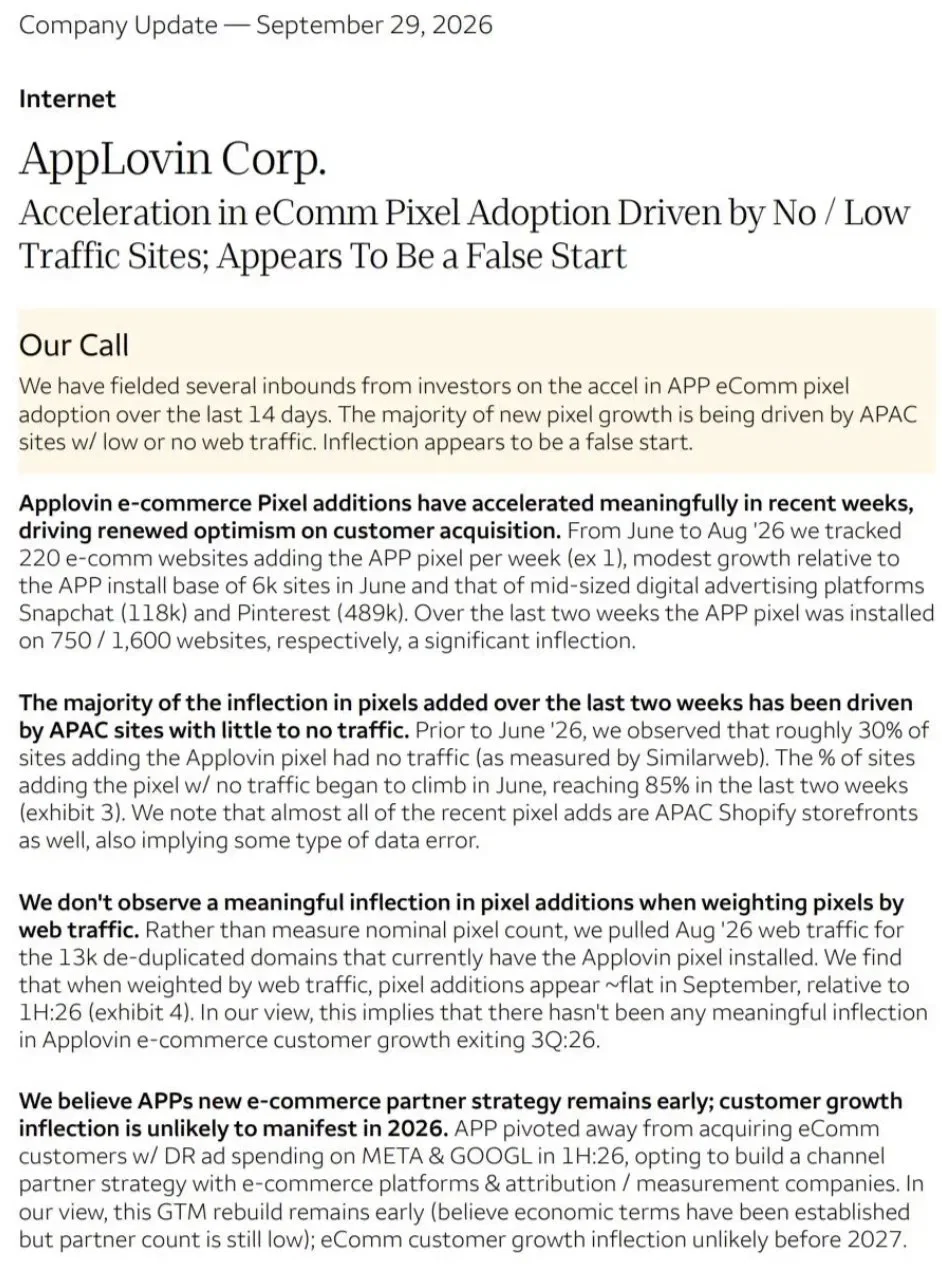
According to recent reports, Wells Fargo claims in its report that the acceleration of Pixel e-commerce adoption at $APP is largely an illusion. Between June and August the bank tracked the addition of 220 new websites with Pixel per week. In the last two weeks the pace jumped to 750-1,600 new websites per week, which at first glance looks like a major acceleration.
But according to Wells Fargo, almost all of these new websites are APAC Shopify e-shops with zero or negligible traffic. The share of websites without traffic jumped from 30% (before June) to 85% (last two weeks). When growth is weighted by actual traffic, no acceleration is visible - adoption is practically flat. The bank therefore labeled the apparent boom a "false start" and wrote that real revenue in the e-commerce segment is more likely in 2027, not this year. It kept its rating and target price at Equal Weight/325 USD.
What this means for shareholders
Pixel adoption has been one of the few publicly trackable signals in recent months by which investors estimated how quickly AppLovin's new strategy is working - selling ads to e-shops through partnerships with platforms instead of buying ads directly on Meta $META and Google $GOOG. If Wells Fargo's reading is correct, the market may have confused the growing number of websites with real business that isn't behind it. That's a problem mainly for those who saw in the stock a rapid diversification from gaming ads to the broader e-commerce market - that argument now is cracking.
It's important to separate facts from interpretation: this is one bank's opinion, not a verified methodology confirmed by an independent party. AppLovin has not publicly commented, and Similarweb's real traffic numbers are not a perfect tool - it may underestimate traffic for smaller e-shops. At the same time, it comes at a time when the stock faces other issues: the lawsuit with Unity (AppLovin failed to get a preliminary injunction) and growing class-action lawsuits in the US.
How it moved the shares
The market reaction was noticeable but not catastrophic. The stock fell 4.5% on individual days after the report's release and repeatedly hit new annual lows. Competitors in the ad-tech sector (such as $TTD, $MGNI) stayed practically flat during the same period, showing that this is a repricing specific to $APP, not a broader sector sell-off. For the whole year 2026 the stock is down about 56%, so the report hit a name that was already under heavy pressure - and therefore every new doubt about the growth narrative moves the price more than it would for a stable company.