


These 5 companies profit from AI, but not from chips

When someone says AI investment, most people think of Nvidia and its GPUs. But around every AI cluster, a chain of suppliers emerges without which a data center would not function. Someone has to connect thousands of chips, provide enormous amounts of electricity, remove the generated heat, and deliver servers. The AI boom is thus not built only on chips, but on the entire infrastructure around them.
Key points
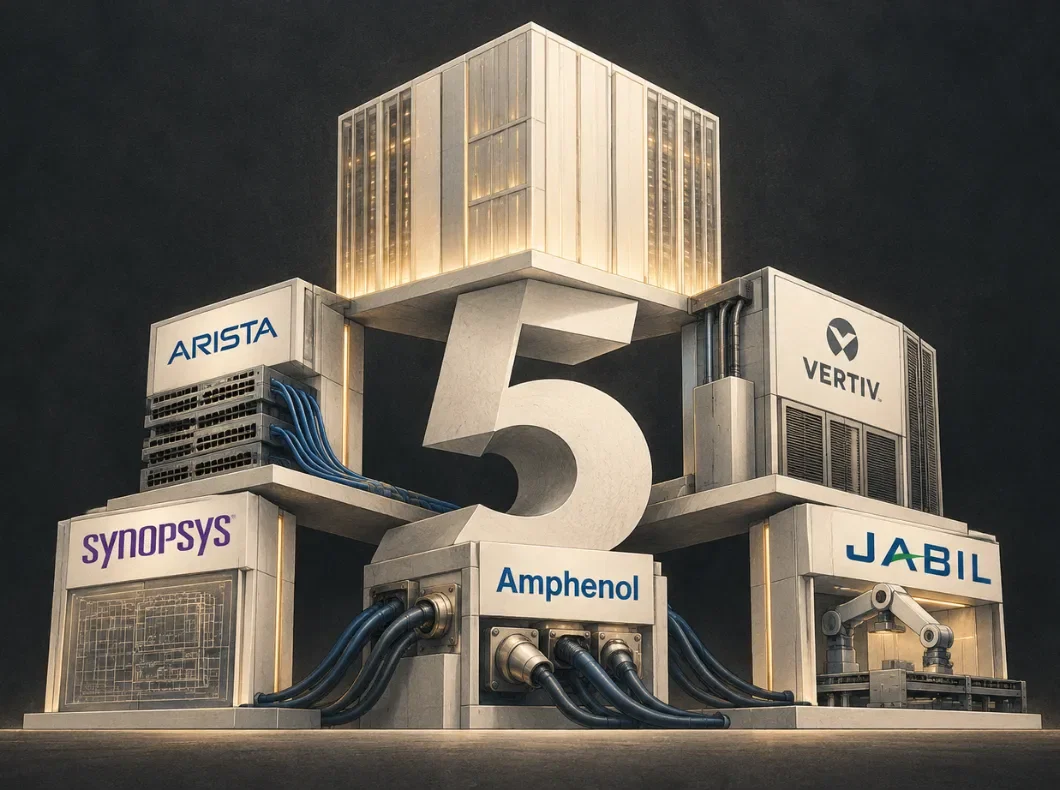
A more important question than who makes the fastest chip is the economics of the rest of the chain, that is, where exactly in the process of building AI infrastructure profit is generated and how sustainable that profit is. Five selected companies each sit in a different part of this chain: Arista Networks $ANET in the networking layer, Vertiv $VRT in power and cooling, Synopsys $SNPS in chip design, Amphenol $APH in connectivity, and Jabil $JBL in manufacturing. None of them makes an AI chip. Yet all of them profit from its growth, only in very different ways and with very different business quality.
AI infrastructure stack in a nutshell
Before we dive into individual companies, it is useful to divide the whole chain into layers. Every new AI cluster, whether built by Microsoft $MSFT, Meta $META, or a smaller cloud player, needs roughly the same: a high-speed network between servers, enough power and cooling for tens of kilowatts per rack, millions of connectors and cable assemblies, sophisticated software for designing the chips themselves, and finally physical manufacturing and assembly of servers.
Company | Part of AI infrastructure | What it sells | How AI increases demand |
|---|---|---|---|
Arista Networks | Networking layer | Ethernet switches, EOS network software | GPU clusters need extremely fast and reliable interconnects between thousands of chips |
Vertiv | Power and cooling | UPS systems, liquid cooling, power management | More powerful AI chips consume more energy and generate more heat per rack |
Synopsys | Chip design | EDA software for chip design and verification | The complexity of AI chips exponentially increases demands on design tools |
Amphenol | Connectivity | Connectors, cable assemblies, optical interconnects | More GPUs per server means more data and power connections |
Jabil | Manufacturing | Contract manufacturing of servers and data center infrastructure | Hyperscalers need external manufacturing capacity for rapid scaling |
This is not to say that these companies are some inferior alternative to investing in Nvidia. Each has a different sensitivity to AI capex, a different moat, and a different valuation, and that is exactly why they deserve a separate analysis.