


📊 Weekly view: what happened in the markets and what I'm watching now
Hello, investors.
Last week brought strong TSMC revenue, a weaker PepsiCo outlook, and pressure on European banks. The Fed minutes reminded us that cheaper money is not a given.
🏦 Fed: the next move remains open Minutes released on October 7 confirmed unanimous support for the September 25-basis-point hike to the 3.75% to 4.00% range. Most Fed officials considered another hike by year-end likely appropriate. However, the decision will depend on new inflation and economic data. Higher rates make financing more expensive. That's why I also watch debt levels and cash generation.
🤖 TSMC: revenue is in, earnings and guidance still to come $TSM released September revenue on October 8, up 54.6% year-over-year. Why before the quarterly results? The Taiwan Stock Exchange requires listed companies to report revenue monthly, by the 10th of the following month. Adding July, August, and September, we already know third-quarter revenue: about NT$1.49 trillion, or around US$46.7 billion. TSMC will report full results on October 15. Then we'll also learn about earnings, margins, and management's outlook. However, chip demand does not yet guarantee returns on AI projects for their operators.
🥤 PepsiCo: higher revenue, weaker earnings outlook $PEP has already reported full results. Quarterly revenue rose 5.6% to about US$25.27 billion. Excluding currency, acquisitions, and divestitures, revenue rose 3.1%. Adjusted earnings per share excluding currency effects, however, rose only 1.5%. The company lowered its full-year growth outlook for this metric to 1% to 2%. Previously, it expected a result at the lower end of the 4% to 6% range. North American beverage volume fell 2%. The group's adjusted operating margin declined by 0.35 percentage points. So even for a well-known brand, I watch costs and margins, not just sales. 🇪🇺 Banks: higher rates are not an automatic advantage European banks faced rising bond yields and concerns about French public finances. On Thursday, the banking sector lost about 2%. Higher rates can help banks if interest income grows faster than deposit costs and other funding. At the same time, they can make it harder for clients to repay. Fee income depends on client activity, not directly on rates. That's why I watch net interest income, deposit costs and stability, credit losses, and management's outlook. I'm considering increasing my bank sector exposure, but I'll form a clearer picture only after earnings season.
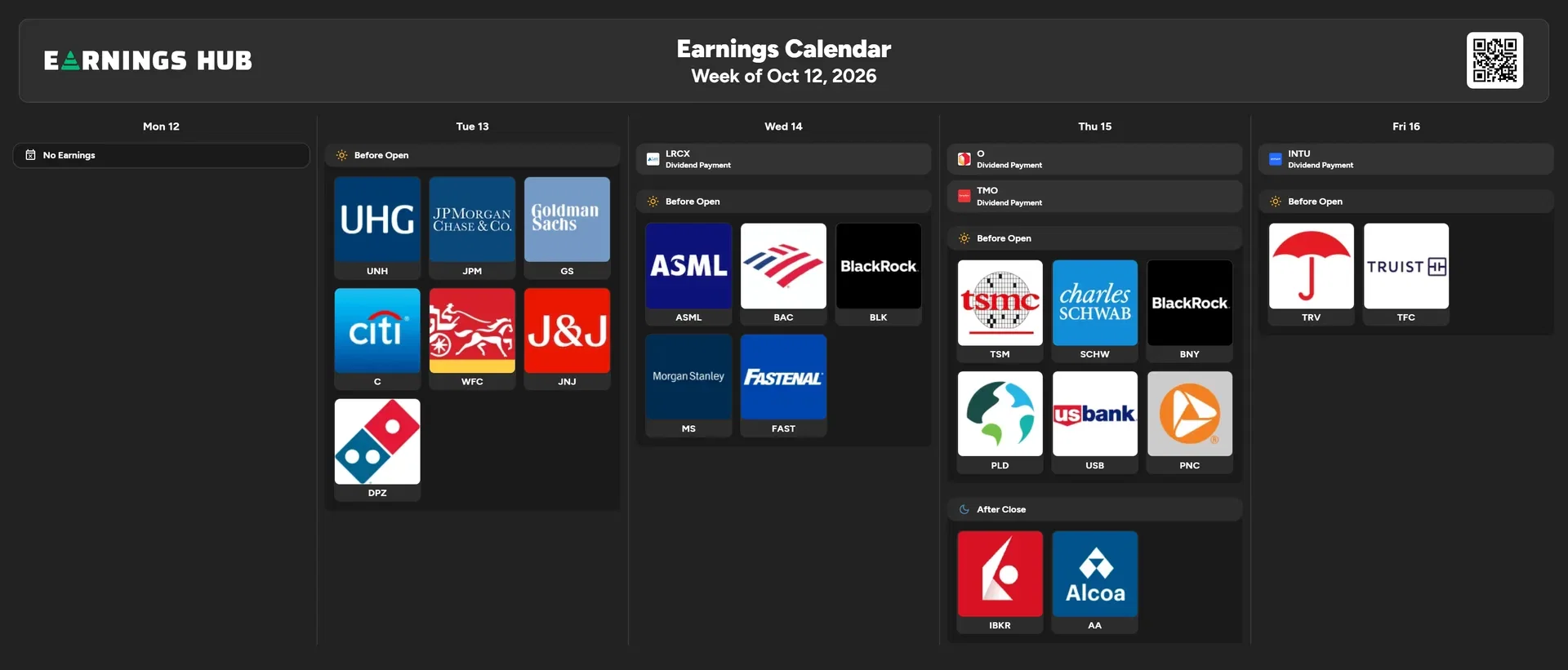
📅 What I'm watching October 12–16
Tuesday, October 13: • JPMorgan $JPM, Goldman Sachs $GS, Citigroup $C, and Wells Fargo $WFC. • I'll compare interest income, credit losses, and outlooks. For Goldman Sachs, also investment banking.
Wednesday, October 14: • Bank of America $BAC, BlackRock $BLK, and ASML $ASML. I hold these companies in my portfolio. • For Bank of America, I watch interest income and deposits. For BlackRock, client inflows and fee income. For ASML, bookings and outlook. • US September CPI inflation at 2:30 pm our time.
Thursday, October 15: • TSMC $TSM full results and US PPI producer prices. • I watch TSMC for chip demand trends and the impact of its outlook on tech sector sentiment.
🎯 What am I doing with my portfolio now? I've already made my recent purchases. Now I don't plan any more. I'm waiting for results before the next monthly buying date. At the end of the month, I split deposits between the more stable part of the portfolio and cryptocurrencies. Since I already have a large exposure to technology and semiconductors, I want to direct further purchases more toward companies whose business is not so closely tied to AI. Results, risks, and price will decide. At my next planned purchase, I'll add to gold $PPFB.DE if it stays below €4,000 per ounce. I plan gradual DCA purchases. I view gold as a protective component of the portfolio.
₿ Crypto: the rally came sooner than I expected I want to regularly add to the crypto portion until March 2027. Originally, I expected a deeper drop in $BTC below $60,000. My target buy level was around $52,000, and I didn't rule out a decline to $40,000. However, BTC bounced from the $60,000 area and the rally came sooner than I expected. I see the current development as a possible earlier return to the growth phase of the cycle and will adjust my buying intensity accordingly. If the price rises sharply, I'll allocate a smaller portion of my regular deposit to crypto than I originally planned. If another drop below $60,000 comes, I'll increase the allocation and buy more heavily, especially BTC and $ETH.
I'll allocate a smaller portion to other crypto assets where I see growth potential. If no significant drop comes, I'll continue regular purchases on schedule. The halving cycle is part of my strategy, and I plan gradual selling when, in my assessment, the cycle is peaking.
I am an investor, not a trader. I stick to the plan.
This post expresses my personal view and is not investment advice. Link to the article on Etoro: https://etoro.tw/4yfrg0u Show less Translate