


Diamonds aren't forever. At least not their price...💎📉
I was just looking at the diamond market and it's quite a ride, literally. The market as a whole has fallen by more than half (51%) over the last 5 years.
It's a longer analysis, so grab a tea, but it's worth it!
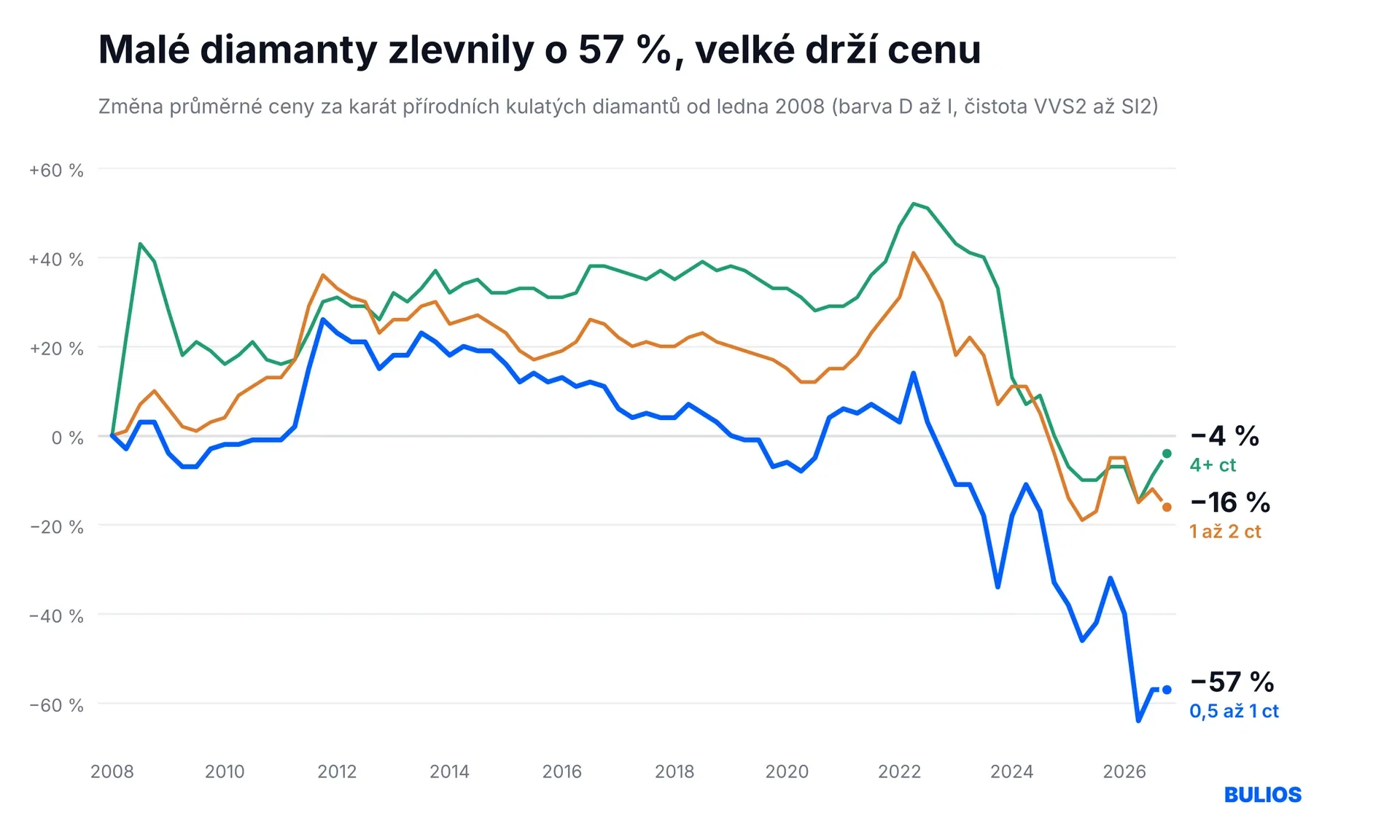
We all know this market is artificially created and diamonds aren't actually as "rare" as they seem. A few of the biggest companies have such control over the market that they release diamonds whenever they want. But now it looks like their business is collapsing📉
In 2021, an average one-carat natural diamond cost $8,007, today it's $3,898, a 51% drop.
The Diamond Standard Index, which tracks so-called investment diamonds, fell to an all-time low of 2,490 points in early August.
If you actively follow the diamond market, you're probably not surprised. According to IDEX index analysis, natural diamonds fell 11.5% between March 2025 and March 2026, and since June 2025 the market hasn't seen a single month of growth. The decline was also driven by a weaker economy and rising precious metals prices, which dampen demand for luxury jewelry.
If you think diamonds are only traditionally mined from the ground⛏️, you're also mistaken.
In the first half of 2026, lab-grown diamonds accounted for 51% of newly priced engagement rings, compared to just 6% in 2019.
The price difference is huge. The median natural engagement ring cost $12,961 in 2025, while a lab-grown one cost $4,557.
Per carat, natural stones sold for $8,428, lab-grown for $2,057, so about 75% cheaper. At Brilliant Earth $BRLT you can get a lab-grown stone with internally flawless clarity and excellent cut for as little as $450.
Production is controlled by Asia🌏
China now produces over 60% of synthetic diamonds, and exports of lab-grown stones through the Shanghai Diamond Exchange grew 65.3% year-over-year in the first half.
De Beers...first let me tell you what it is, so we're all on the same page:
De Beers is the most famous diamond company in the world. It mines diamonds, sorts them, and sells them, and for decades it practically controlled the entire global market.
It was founded in 1888 in South Africa by Cecil Rhodes. For most of the 20th century, it controlled an estimated 80 to 90% of the world's rough diamond trade.
It operated as a cartel: it bought up production from other miners and released it to the market only in quantities that kept prices high. That's why diamonds seemed like a rare asset for so long, even though they're not really as rare as I mentioned at the beginning.
It's also the author of the famous slogan "A Diamond Is Forever" from 1947. That campaign essentially created the tradition of the diamond engagement ring as we know it today, mainly in the US.
Today it mines mainly in Botswana, where it has a joint venture with the local government, as well as in Namibia, South Africa, and Canada. Since 2012, 85% is owned by mining giant Anglo American, with the remaining 15% held by Botswana. It's not publicly traded, so you can't buy its shares.
And now we continue...
The estimated value of De Beers has fallen from $12.75 billion in 2011 to just $2.3 billion. Owner Anglo American has already written off $2.9 billion in 2024 and another $2.3 billion in 2025.
According to Bloomberg, Anglo American is negotiating with a consortium led by former De Beers CEO Gareth Penny, which would pay about $1 billion for the 85% stake, including $750 million upfront.
De Beers itself reported an underlying EBITDA loss of $113 million in the first half of 2026.
Petra Diamonds immediately closed its Finsch mine in South Africa after the price collapse. The realized price there fell to $47 per carat in April and May.
Canada lost 2 of its 3 diamond mines in the Northwest Territories, and the world's largest producer Alrosa was in the red for the entire first half of 2026. De Beers itself cut production by 12% in 2025.
First signs of a possible bottom
Rapaport (an American firm that serves as the main price reference in the diamond trade) reports that its one-carat stone index was stable in August for the first time after 13 months of decline, and smaller stone sizes even rose.
Analysts point out that mining cuts could lead to shortages in 2027 and 2028, and are already creating a floor under rough diamond prices. Larger and higher-quality stones are now holding their value much better than commercial goods.
Retailers are doing great right now. Signet $SIG, the largest jewelry company in the US, increased same-store sales by 2.2% in Q2, the average selling price rose about 6%, and operating profit soared to $87.5 million from just $2.8 million a year earlier. The company raised its full-year revenue outlook to $6.7 to 6.9 billion.
Today it looks like the diamond market is splitting in two.
- Cheap commercial stones are being replaced by lab-grown ones.
- Rare large stones may stay in stores thanks to limited mining.
And the one profiting from all of it is whoever sells the ring to the customer, regardless of where the stone comes from.
Would you buy a natural diamond today, or is a lab-grown stone an equal choice for you?