
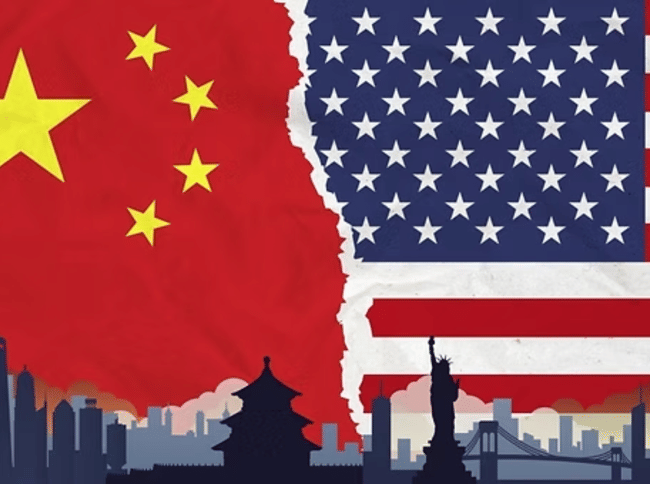
Tensions between the United States and China have become a key factor in recent years, changing the strategy of global companies. Threats of new tariffs, export restrictions and technology sanctions are forcing businesses to reassess their dependence on the two largest economies. According to recent data, more than half of large corporations are actively seeking alternative markets for production and sales. This trend, often referred to as "friend-shoring" or "near-shoring", is shifting capital and production towards Southeast Asia, India, Latin America or Central Europe.
The technology sector is at the forefront of this transformation. Chipmakers like TSMC $TSM or Intel $INTC are investing billions of dollars in new factories in the US and Europe to avoid over-concentration in China and Taiwan. The US is supporting this trend with generous subsidies under the CHIPS Act, which is boosting US construction and engineering companies such as Applied Materials $AMAT or Lam Research $LRCX. But relocation doesn't come cheap - it means higher capital costs, which puts pressure on semiconductor industry margins in the short term.
The consumer goods sector follows a similar logic. Apparel and footwear manufacturers such as Nike $NKE or Adidas $ADDDF are gradually shifting some production from China to Vietnam, Indonesia or India. These regions are becoming new industrial hubs and can also benefit the supplier firms there. Investors thus have the opportunity to monitor the growth of local markets while considering whether diversification will actually reduce risks in the event of a further escalation of geopolitical tensions.
The impact is also evident in logistics and transportation. The change in the direction of global freight flows is increasing demand for the services of companies such as Maersk, FedEx $FDX and UPS $UPS. They can win new contracts and higher shipping volumes even as they have to adapt to more complex routes and increasing competition. In parallel, the Middle East and Africa are also coming into play as newly emerging trade hubs.
From an investor perspective, it is crucial that the move away from dependence on China and the US is not a short-term measure but a long-term strategic direction. Regions with political stability and lower labour costs can be winners, but also companies that can flexibly invest in new capacities. For portfolios, this means opportunity not only in the US tech giants, who are securing domestic production, but also in developing markets that are becoming new industrial hubs. Conversely, the risk remains higher price volatility and a possible slowdown in the growth of companies that cannot adapt quickly enough to change.
What does this mean for investors?
For investors, the current transformation of supply chains is a double-edged sword. On the one hand, it creates new growth opportunities as new industrial hubs are established and capacity expands in countries that benefit from this trend. These include in particular India, Vietnam, Indonesia and Mexico, which are profiling themselves as new manufacturing bases. Firms that can flexibly relocate operations and invest in diversification can gain a strategic advantage and strengthen their position in the global market. This applies to players in the technology sector such as TSMC, Intel or Samsungas well as for logistics giants FedEx a Maersk.
On the other hand, this process is associated with higher costs, lower efficiency and, in some cases, pressure on margins, which can weigh on companies' results in the short term. This is particularly important for investors seeking stability and dividend yields, as these companies may experience temporary turbulence. A strategy to take advantage of this trend may be to diversify portfolios towards emerging markets and infrastructure projects that directly benefit from capital inflows. The key for investors will therefore be to distinguish between companies that are merely surviving the changes and those that can translate them into a source of growth and higher returns.