
Alphabet’s acquisition of Intersect is not about sustainability optics or marginal efficiency gains. It is a recognition that the next bottleneck in artificial intelligence is no longer compute alone, but the ability to secure reliable, scalable power. As AI workloads grow exponentially, electricity is turning into a strategic constraint rather than a utility input.
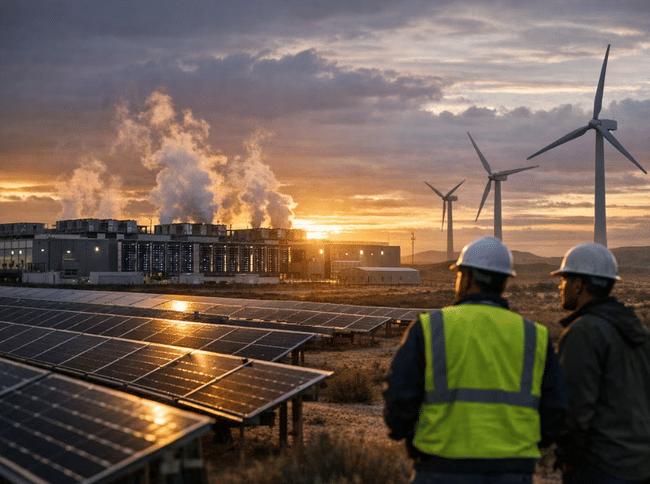
By internalizing energy development, Alphabet reduces its exposure to grid delays, regulatory friction, and volatile pricing. More importantly, it gains control over project timelines—something increasingly critical as AI infrastructure races ahead of public utilities. This move places Alphabet closer to the logic of an infrastructure operator than a pure technology company.
Who is Intersect and what makes $GOOG so valuableto Alphabet
Intersect is not an electricity generator in the classical sense, nor is it a utility that operates a distribution network. It is a company that specializes in the design and construction of power projects for large industrial customers, particularly data centers. Its main task is to find suitable sites, secure permits, prepare technical solutions and then build power sources and storage facilities capable of delivering stable power in large volumes.
Crucially, Intersect often builds its projects close to the point of consumption. As a result, electricity does not have to flow through congested transmission grids, which are one of the main obstacles to further data centre construction in the US today. It is this model that makes Intersect a company that is extremely attractive to technology giants.
Why Alphabet is buying Intersect now
Alphabet has been getting to a point in recent years where having high-end chips and proprietary software is no longer enough. The development of artificial intelligence means a huge increase in electricity consumption, and without the certainty that it will be available in sufficient quantities and at the right time, a new data center cannot be launched at all.
With the acquisition of Intersect, Alphabet secures greater control over this critical input. It gains access to projects that are already under development or under construction and can better match the pace of computing capacity growth with energy availability. This isn't about trying to capitalize on the energy business, but about removing one of the major risks that could slow AI growth significantly.
From a management perspective, this is a defensive but very rational move. It reduces Alphabet's reliance on state-owned grids, lengthy permitting processes, and the uncertainty that exists today around future transmission capacity.
How does the acquisition fit into the long-term strategy?
Google has long been one of the largest data centre operators in the world, and the development of artificial intelligence reinforces this trend. Training large models and running cloud services requires a stable and continuous supply of power, which places new demands on infrastructure.
Intersect will remain a formally separate company, but its projects will be closely tied to Google's needs. Typical examples are projects where battery storage is being built alongside data centres. These help to smooth out fluctuations in power consumption and increase operational reliability, which is crucial for AI systems.
In this way, Alphabet is gradually moving from simply buying electricity to actively building its own energy infrastructure. This is a change that may become standard for most large technology companies in the years to come.
Impact on the technology sector as a whole
This acquisition clearly shows that the next phase of AI development will not only be limited by technology, but also by physical infrastructure. Electricity, permits and the availability of suitable sites are becoming factors that may determine where and how quickly new AI projects will emerge.
It is likely that other tech giants will follow suit. Companies that can secure stable energy sources will gain a competitive advantage. Others may face limits that cannot be solved by investing in chips or software alone.
What to take away from the acquisition from an investor's perspective
The purchase of Intersect is not a transaction that will have an immediate impact on the bottom line. It is a long-term investment in stability and predictability of future growth. In doing so, Alphabet is taking higher capital expenditures today to reduce risks in the future.
For investors, it's a signal that the company is counting on AI to remain a key pillar of its business for years to come. It also shows that Alphabet is willing to tackle problems that aren't visible on the financial statements but may determine its ability to grow in the long run.
If the trend continues, energy may become as much a strategic asset as data or computing power. By taking this step, Alphabet ensures that it will not be dependent on circumstances beyond its control in this area.