
When former president Donald Trump began imposing broad tariffs on Chinese imports and other goods, the goal was often framed as protecting U.S. manufacturers. In practice, these levies have become a major structural factor influencing how mega tech companies operate, invest, and plan for the future. Recent market history shows that tariff policy even when paused or reduced reshapes supply chains, investment priorities, and investor sentiment in the technology sector.
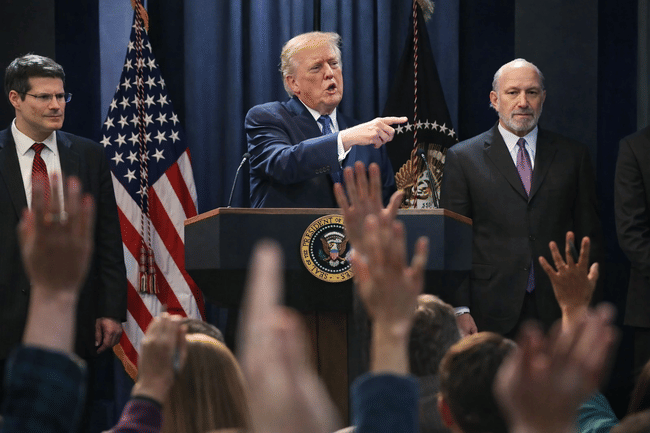
Court Ruling on Trump Tariffs Briefly Boosts Tech Stocks
U.S. Supreme Court’s decision earlier this year to block large parts of Trump’s tariff schedule briefly lifted stock prices of digital advertising and cloud companies like $GOOGL and $META , demonstrating how closely markets track trade policy risk and legal rulings.
Apple’s China exposure makes cost structures more sensitive
Few tech firms illustrate tariff vulnerability better than $AAPL. The company’s iPhone assembly and many of its components are manufactured through a sprawling Chinese and East Asian supply chain. Tariffs on certain imported components or finished devices or potential future levies can squeeze margins, force price increases, or accelerate supply chain shifts.
Apple has already responded to trade pressure by expanding manufacturing in India and Southeast Asia as part of its “China+1” strategy, reducing some concentration risk (India Briefing on Apple’s supplier expansions. Yet full diversification takes time, and partial tariff reinstatements or spillovers can still lead to near-term cost pressures and inventory decisions that affect earnings.
Nvidia and semiconductor frictions: a particularly tight knot
For semiconductor companies like Nvidia a bellwether of the AI boom tariffs intersect with export controls and geopolitics in a way that goes beyond duties on physical goods. China imposes tariff and non-tariff barriers on U.S. chip imports, and Washington has restricted the export of advanced chips and chip-making equipment to China. Nvidia’s flagship AI GPUs, for example, have been at the center of U.S. export controls aimed at limiting access to high-performance computing for certain Chinese entities (explained in depth by Reuters coverage on chip export rules. Such export barriers a sibling to tariff policy can reduce addressable markets for Nvidia’s most lucrative products while increasing geopolitical supply chain risk.
If Trump-era tariff measures return or expand including on intermediate semiconductor products Nvidia could see input costs rise (for chips assembled outside the U.S.) or face even tighter market segmentation. Either scenario influences growth expectations baked into the company’s premium valuation.
Intel’s ‘national champion’ potential benefits, but competition still looms
Some U.S. tech firms may benefit from tariff-induced reshoring incentives particularly those supported by policy initiatives like the CHIPS Act. Intel, which has invested heavily in domestic semiconductor fabrication facilities, could be viewed as a strategic beneficiary when tariffs make imported chips more expensive and incentivize onshore production.
Reports on Intel’s $5 billion collaboration with Nvidia on chip capacity signal how tariff and export control environments could reframe the competitive landscape, pushing companies toward domestic partnerships instead of cross-border supply chains (analysis of semiconductor funding moves.
However, Intel still faces competitors like Taiwan Semiconductor Manufacturing Company ($TSM). If tariff pressures drive chip fabrication back into the U.S., the capital intensity of building global-scale fabs means that policy incentives alone can’t guarantee market success. Multi-national partners and investment flows will continue to shape sector competition.
Amazon and Google: software giants not immune to hardware friction
Mega tech companies that are primarily software and services oriented such as $AMZN and $GOOGL are often seen as more resilient to trade friction because their products are less reliant on imported physical goods.
Yet even these giants depend on costly datacenter hardware, networking gear, and AI accelerators. If tariffs push up the cost of imported server components or networking switches, companies like Amazon Web Services and Google Cloud could face higher infrastructure costs. Some of these might be passed onto customers, but margin compression is a real possibility in price-competitive cloud markets.
Moreover, tariff-driven hardware cost pressures on downstream customers can reduce overall technology spending, dampening demand for cloud, advertising, and enterprise services. Reuters technology reporting has highlighted how broad tariffs and trade uncertainty have historically affected tech equipment markets and investor sentiment.
Qualcomm and network equipment — tariff ripple effects
Qualcomm’s business supplying chips for mobile devices, IoT, and automotive illustrates how tariffs can affect component makers embedded deep inside long value chains. Tariffs on intermediate goods can increase the landed cost of $QCOM chips in consumer devices assembled abroad. While some tariff exclusions have helped, the continued possibility of reinstated duties or expanded tariff lists keeps planning difficult for companies that design globally but manufacture abroad.
Industry trade groups have repeatedly called for greater stability in tariff policy because unpredictability even without active duties harms long-term capital investment and inventory decisions.
Investors price in policy risk
Tariff risk is now a standard input in macro and sector models used by institutional investors. Policy uncertainty contributes to higher discount rates, wider implied volatility, and risk-off repricing in earnings multiples for companies with high exposure to cross-border costs.
History provides vivid examples. Broad tariff escalations in 2018 – 2019 once triggered significant sell-offs in U.S. equities, particularly tech and consumer electronics. When tariff rounds paused or exclusions were granted, markets rallied sharply illustrating how policy expectations alone drive substantial sentiment swings (historical tariff market reaction overview.
Long term structural shifts: China+1 and supply chain diversification
Trump’s tariff regime along with export controls and geopolitical tension accelerated the China+1 strategy in tech supply chains, where companies build additional manufacturing capacity outside China, often in Southeast Asia, Mexico, or India.
This trend isn’t merely about avoiding duties; it’s about strategic risk mitigation. Apple’s diversification into India and Vietnam, semiconductor assembly moves to Malaysia and Thailand, and even Amazon and Google supply chain adjustments all reflect a new era of multi-pole manufacturing footprints that reduce concentration risk and political exposure (China+1 supply chain strategy overview).
Such structural reconfiguration can improve resilience over the long term but also entails near-term capital expenditure and coordination costs. These are fundamental shifts, not quick fixes and they will continue to influence competitive dynamics long after any single tariff round ends.
Tariff uncertainty as a permanent investment risk factor
Even as courts strike down specific tariff provisions, and as some duties are scaled back or negotiated away, the underlying lesson for investors and companies is clear: trade policy and geopolitics are now core strategic risk factors for mega tech.
Tariffs can influence:
Operating margins through cost increases or forced supplier shifts.
Capital allocation decisions as firms weigh reshoring costs.
Valuation multiples via sentiment and risk premium adjustments.
Competitive positioning across hardware, software, and semiconductors.
Investor psychology through episodic volatility tied to policy shifts.
For diversified portfolios, exposure to these risk channels means that tariff policy is no longer a remote macro variable it’s a feature that directly influences earnings forecasts, supply chain decisions, and strategic planning across the world’s largest tech companies.