
Novo Nordisk shares fell sharply after the company shared study results suggesting its next-generation obesity candidate, CagriSema, did not beat Eli Lilly’s Zepbound in a direct comparison. In obesity drugs, the market cares about two practical things: how much weight patients lose and whether people can stay on the treatment long enough. When a head-to-head result looks weaker, investors quickly adjust what they expect for future sales and pricing power.
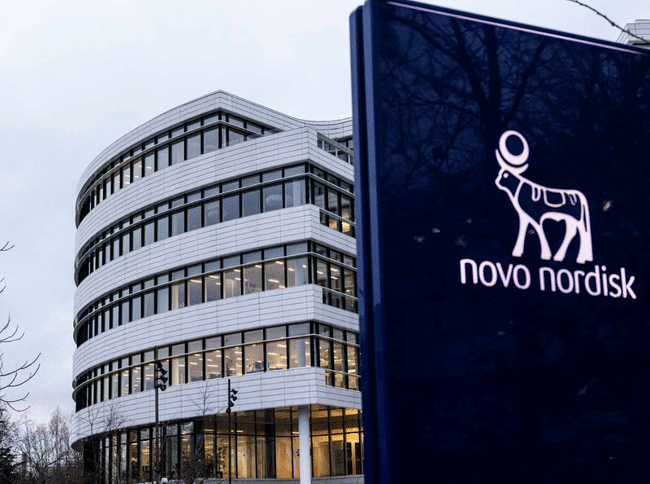
The bigger issue is the story Novo has been selling. Wegovy made the company a leader, but investors were looking for proof that the next wave would keep Novo ahead as Lilly gains momentum. CagriSema was supposed to be one of the clearest pieces of evidence. When the competitor looks better in a key study, the market treats it as a signal about the future line-up, not just one disappointing data point.
What the study showed and why the difference is painful even without the "catastrophic" numbers
$NVO described in its official announcement that when evaluated "under ideal conditions" (when all patients adhere to treatment), CagriSema achieved a 23.0% weight loss after 84 weeks, while tirzepatide achieved a 25.5% weight loss. In the second evaluation, which takes more account of reality (including the fact that some people do not complete the treatment or do not follow it exactly), CagriSema came out at 20.2% and tirzepatide at 23.6%.
On paper, this may not look like a gap. It's just that in practice, it's a difference that can make the difference in what doctors will prefer and what care payers will be willing to reimburse without undue restrictions. Moreover, the market for obesity drugs is rapidly professionalizing: gradually, there is less forgiveness for "second-best" products unless they have a clear advantage elsewhere - perhaps in tolerance, dosing, availability, or price. And a number of analysts are now saying that as it stands, it's hard to find a reason why a patient would get CagriSem instead of tirzepathide if both are on the market.
Another important detail that has investors worried is the reputational moment: some analysts mention that it's unusual to hear management essentially admit that a competitor came out better in a study Novo sponsored and designed. To the market, it's a signal that while the company may push CagriSema to approval, the commercial story will be tougher - and that will be recalculated in the valuation faster than the regulatory decision itself.
Why the stock's reaction is so extreme: it's a valuation built on an "obesity option"
This slump isn't just about one study, it's about how Novo has been priced in recent years. Reuters describes how, after Monday's sell-off, the stock erased the gains of the era when Wegovy made Novo an investment star, and the title has fallen to levels where it last was before the "Wegovy era." From the market's perspective, this means one thing: investors have taken a haircut because they're not sure Novo can maintain the same momentum in the next product cycle.
When a company is priced as a clear market winner, "just" slightly worse data is enough and valuations can collapse quickly. That's because the market isn't just deciding whether CagriSema will pass approval, but whether it will be able to take share from competitors - and whether Novo can once again dictate terms in a segment where huge money is rolling in and where volumes, production capacity, reimbursement and marketing pressure will decide the next few years.
That's why the question of strategy comes to the fore: if Novo doesn't have the most effective next-generation product, it will have to fight harder with other tools - price, availability, combinations, form of delivery - while trying to piece together further growth outside of a direct battle with Lilly "on strength".
What this means for the $LLYfight and why the acquisition plan is starting to be addressed
After this data, analysts are much more confident in saying that Zepbound is now the clear leader and Lilly has room to continue to gain share in the coming years. J.P. Morgan, for example, expects a longer "runway" for Zepbound's share growth beyond 2026, and several banking houses agree that it will be hard for Novo to erode Lilly's market position unless it has a clearer advantage.
The second part of the story is psychological: investors will start putting more pressure on management to show it has a Plan B. And here comes the topic of acquisitions. Jefferies mentions that investor attention may shift to how Novo will handle its financial strength, with estimates suggesting the potential to spend as much as $35 billion this year. An important detail is that some investors would prefer to buy beyond obesity and diabetes to "buy time" for the company and reduce dependence on one battleground.
This is not an academic debate. If the market for obesity drugs were to gradually move towards maximum efficacy (and for that matter availability and reimbursement) being the primary deciding factor, the second strongest player may be pushed into price concessions in the long run. And in such a scenario, even a very good product may become "commercially weaker" because it will be harder to sell or sell at a smaller margin.
Risks and what to watch next
The biggest risk is that CagriSema, while approvable, will enter the market with a "weaker than leader" label. This is exactly the situation where commercial success breaks down to whether the product either has a clear advantage in tolerance or can make a case for itself on price and availability. Barclays, for example, admits that CagriSema may be approved, but warns that winning users will be difficult against a more efficient established competitor, and Novo is then left with few arguments other than price.
At the same time, it remains to be seen how Novo communicates the next steps in its clinical programme: the firm is already hinting that it wants to keep looking at the "full potential" of CagriSema and explore higher doses. The market will want to see whether the gap to tirzepatide can realistically be made up - and more importantly, whether it can be done without compromising tolerability.
One last thing: whether an acquisition strategy will really take off and how quickly. If investors believe Novo can find other growth pillars, some of the damage to confidence may be healed. But if weeks go by with no clear moves, while Lilly continues to push the lead, the stock may remain vulnerable to every other clinical number.