
The self-driving arm of Amazon, Zoox, is expanding its robotaxi testing to Dallas and Phoenix while opening a new Fusion Center in Scottsdale, Arizona, to coordinate fleet operations and remote driving. With this move, Zoox now operates in 10 metro markets - joining Las Vegas, San Francisco, Seattle, Austin, Miami, Los Angeles, Atlanta, and Washington, D.C. as it races to match Waymo’s lead and Tesla’s production-driven autonomy.
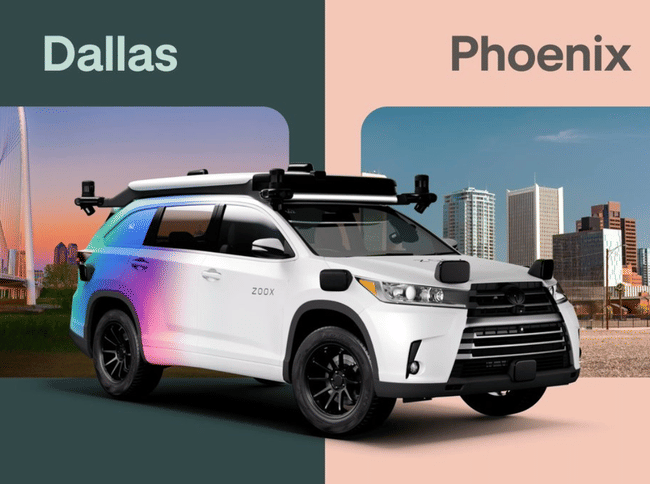
In Texas and Arizona, Zoox plans to deploy a limited fleet of SUVs for mapping before advancing to supervised autonomous runs. The new facilities are expected to add hundreds of jobs and test how its vehicles perform under the region’s heat, dust, and wide highways - stress conditions that push sensors and AI systems to their limits.
Zoox between Waymo and Tesla
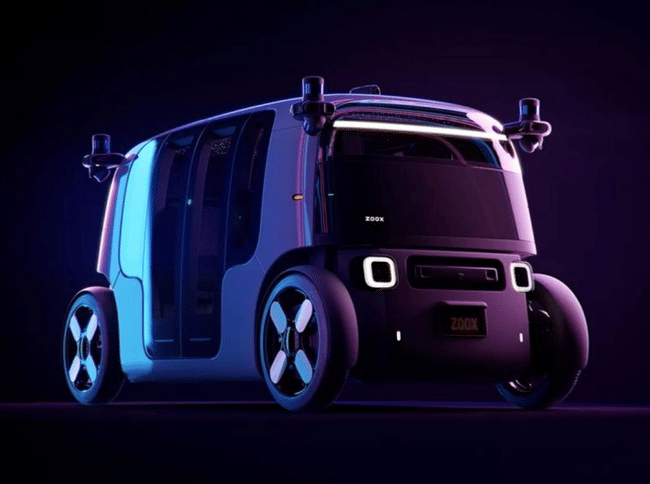
The robotaxi market today is formally led by Waymo, which has commercial operations in major cities and records millions of rides per year, while Tesla $TSLA is building on its production capacity and Full Self-Driving software as a path to a robotaxi fleet from existing cars. Zoox, on the other hand, is betting from the start on a robotaxi designed "from the ground up", without steering wheel and pedals, with a cabin for four passengers sitting facing each other.
From an investor's perspective, the difference in business model is important. Waymo is already charging fares in some cities, Tesla is monetizing Autopilot and Full Self-Driving software packages, while Zoox is so far providing free rides in Las Vegas and San Francisco as part of pilot programs and preparation for future charging. Zoox executives talk about commercial operation on a larger scale being a matter of a few years before the service is financially viable - the current phase is primarily about validating technology, processes and safety. That said, Amazon is still funding a long development cycle at Zoox, with high investment and limited immediate returns.
Why Dallas and Phoenix: a technical and political test
The choice of Phoenix and Dallas is not random. Phoenix is one of Waymo's core markets and has become a practical laboratory for autonomous taxis in a less complicated urban environment with a relatively favorable regulatory approach. Dallas offers a different type of traffic: sprawling city, high speeds, freeways, suburbs, but without the extreme traffic density and hilly terrain of San Francisco.
For Zoox, the combination of San Francisco + Las Vegas + Phoenix + Dallas is an opportunity to cover a variety of use scenarios: dense urban environments with complicated intersections and cyclists, tourist traffic around the Strip, and the sprawling Sun Belt city with long routes and freeways.
From a technical perspective, it is about validating the robustness of the sensor suite (lidar, radar, cameras), thermal battery management, and trajectory planning algorithms in conditions that differ significantly from coastal California. From a regulatory perspective, it is important that the trials are taking place in jurisdictions perceived as more open to experimentation with autonomous driving, which may expedite data acquisition and permitting for broader operations.
Fusion Center: what robotaxi operation looks like in practice
The new Fusion Center in Scottsdale will serve as a fleet control center where data from the vehicles converges and where operators provide what is known as remote guidance, or remote guidance in situations that the autonomous system cannot resolve with sufficient certainty. Zoox already operates similar centers in the Bay Area and Las Vegas, and the new Arizona location is the third hub with this type of infrastructure.
The concept of teleguidance is key to scaling robotaxi: the car is in fully autonomous mode the vast majority of the time, but in a small fraction of situations (such as an uncharacteristic road closure or police intervention), it hands the decision to an operator who remotely suggests a solution. This reduces the requirements for "perfect" autonomy in every conceivable situation, but also creates demands on personnel, data infrastructure and operational processes that are not common in conventional transport services.
Investors in Amazon should see the Fusion Center as part of the fixed cost base of the future robotaxi business. Such centers are expensive to build and operate, but at higher fleet and ridership densities, their costs are spread over more miles - a typical operating leverage model: either volume is achieved or costs remain disproportionately high.
Safety and Washington: a forum that can change the rules
The expansion of Zoox's activities comes shortly before a national forum on autonomous vehicle safety, hosted by the US agency NHTSA and featuring the heads of Waymo, Zoox and Aurora. President Donald Trump' s administration is looking for ways to speed up the deployment of robotaxis, but is also facing pressure over safety incidents and public concerns.
The regulatory framework is a binary risk for robotaxi:
If NHTSA and individual states create clear, predictable rules for testing and commercial operation, fleets can expand relatively quickly
if there is a sharp tightening after a major accident or political pressure, it could halt expansions for a time, including fresh projects in Dallas and Phoenix
For Amazon, this means that the timing of the return on investment for Zoox is not just a function of technology and demand, but also the regulatory cycle in Washington. The presence of Zoox CEO Aicha Evans alongside leaders from Waymo and Aurora suggests the unit wants to be right there in the rule-making that will set the pace and terms of robotaxi deployment in the coming years.
Risks and potential impacts
In the short term, the main risk is operational execution: entering two new cities, building depots and a Fusion Center, hiring hundreds of employees and expanding the fleet in parallel adds significantly to the complexity where delays or technical issues can easily arise. Any incident - from a minor accident to a major traffic incident - can trigger a media and political reaction that translates into more stringent testing conditions.
In the medium term, the economics of the model are one of the key issues. Zoox must demonstrate that it can transition from free pilot runs to a fully paid-for operation with sufficient vehicle occupancy and utilization to budget the high capital expenditure on vehicles, depots and the Fusion Center for sufficient miles. At the same time, Waymo's competition and Tesla's ambitions put pressure on both price per ride and service availability; a purely premium robotaxi service could prove too narrow a segment.
In the long term, the binary risk is whether robotaxis become a mass part of urban transport or remain limited to a few pockets of the city and special routes. If the wider public or regulators prove unwilling to accept autonomy on a large scale, Zoox would remain a technology project with limited business rather than a full-fledged transport infrastructure.
What to watch next
In the coming months, the pace of fleet expansion in Dallas and Phoenix will be key: how many cars are actually on the streets, how quickly they transition from manual mapping to autonomous mode, and whether Zoox reports major incidents or, conversely, "boring" traffic without problems. It will also be important to see if and when Zoox switches from free to paid rides in Las Vegas and San Francisco, and what the reaction of competitors, especially Waymo and Tesla, will be in the same or similar locations. From a regulatory perspective, the outcome of the NHTSA forum will be crucial, specifically whether there will be proposals for new federal standards for autonomous vehicles or pilot programs in selected states.