
Elon Musk says Tesla’s Terafab project, an in house factory for artificial intelligence chips, will officially launch within seven days. The move is a response to a simple constraint: even with aggressive supply agreements at TSMC and Samsung for the fifth generation AI5 chip, Tesla does not see enough capacity to cover future needs for Full Self Driving, robotaxis, Optimus robots and AI data centers. Musk has argued since last year that Tesla will “probably have to build a gigantic chip fab” to hit its autonomy ambitions, and Terafab is the first concrete step toward that goal.
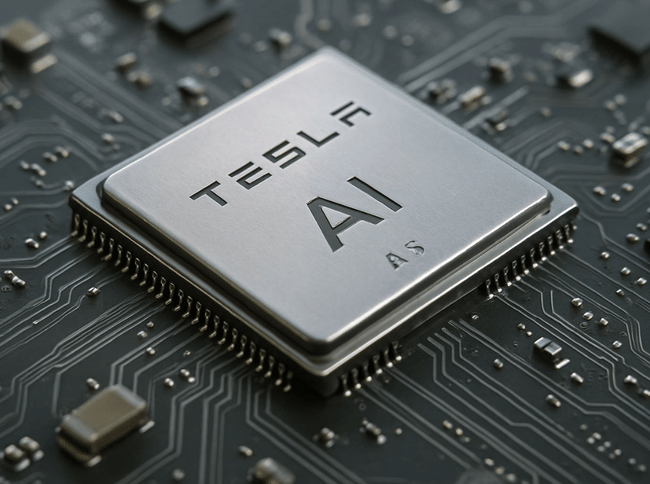
For investors, Terafab marks a sharp turn from a fabless model into deeper vertical integration, closer to an integrated device manufacturer in a field dominated by specialists like TSMC. Bringing part of AI5 production under Tesla’s roof could reduce supplier risk and give more control over a core technology, but it also adds a new layer of capital intensity and execution risk, with estimates of tens of billions of dollars required to build a 2 nanometer capable facility and the challenge of ramping a world class fab on top of an already ambitious EV and robotics roadmap.
What we know about Terafab and AI5 today
The official information so far suggests a few certain things. Terafab is supposed to be a project aimed at making AI chips for Tesla $TSLA, Musk describes it as a "gigafactory, only much bigger", and the project's launch is expected to come within a week of the announcement. Tesla hasn't commented on the details - where the fab will stand, what process it will use, the specific investment volume and timeline.
The fifth-generation AI5 chip, according to earlier reports, is designed to be a significant leap over current HW4 hardware, with an emphasis not only on raw computing power, but also on memory and efficiency for the functionality of modern AI models. Musk has previously confirmed that AI5 will be produced simultaneously by both TSMC and Samsung to reduce Tesla's reliance on a single foundry and ensure a "surplus of AI5 chips" for both cars and data centers. This makes it all the more clear that Terafab will not be the sole source of chips from the start, but rather a complement to external capacity.
Musk has also mentioned the possibility of working with Intel $INTC in the past and has talked about the value of having serious discussions with Intel. However, there is no confirmed contract yet and everything remains at the level of speculation.
Why Tesla is pushing for its own chipset
From Musk's perspective, the key driver is a lack of capacity at suppliers. He said last year that even if he takes the best-case scenario of supply from TSMC $TSM and Samsung $SSNLF, "it's still not enough" given the projected volumes for cars, robotaxi fleets and Optimus robots.
The main reasons why Terafab makes sense from Tesla's perspective:
Control over a key input - AI chips are as strategic to Tesla today as batteries.
Long-term demand - if Tesla is to really roll out robotaxis and physical AI in a big way, it will need millions of chips a year, not just for cars, but for data centers.
geopolitics and supply risk - diversifying beyond a pure Asian foundry model may be a hedge against tensions around Taiwan or other supply shocks.
On the other hand, building your own chip fab means entering an industry where barriers to entry are extremely high: technically, financially and organisationally. Even established players like Intel have struggled to catch up with TSMC, despite decades of know-how.
The impact on Tesla's business model
If Terafab succeeds, Tesla would move from the role of a buyer to an integrated player in the AI chip chain. This would have several implications:
Some of Foundry's margin would remain within Tesla.
The company would gain more flexibility in how quickly it scales Robotaxi, FSD and Optimus.
it could eventually offer its own chips or manufacturing capacity to third parties (this is purely hypothetical for now, but model-possible).
But in the short term, it will mainly be a source of cost and CAPEX. Tesla is already planning to significantly increase capex due to the transition from a pure EV story to "physical AI". The addition of a giant chip plant will further inflate this bill and may deepen the period of negative free cash flow that some analysts are already talking about for 2026.
Crucially for investors, this increases the sensitivity of Tesla's story to execution. It's not enough to just deliver cars and software, it adds another critical layer - high-end chip manufacturing - in which there is world-class competition and where mistakes are very expensive.
The risks
Short-term risks:
Project ambiguity - Tesla doesn't comment on details, so panels on how much Terafab will cost, where it will be, and what process it will use are still guesses. The vagueness may increase nervousness in the market.
Investment overlap - simultaneously running investments in robotaxi, Optimus, capacity expansion at existing plants and now Terafab. This may exacerbate the perception of cash flow risk.
Medium-term risks:
Technology slippage - approaching the technology level of TSMC and Samsung is extremely challenging. If Terafab falls one or two process generations behind, it may limit its usefulness for the most advanced AI chips.
Cost - in-house fabs can have higher unit costs than outsourcing to high-end foundries, especially in the early years.
Long-term risk:
Either Terafab will become a functional part of Tesla's vertically integrated AI platform and support its lead in autonomy.
or it turns into a capital-intensive experiment that can't keep up with the foundry market leaders and remains permanently dependent on TSMC and Samsung while investors bear the cost of building it.
What to watch next
From an investor perspective, the following triggers will be key:
First specific information about Terafab' s location, technology and budget - whether it is a full-fledged leading-edge project or more of a complementary capacity.
How Tesla will align the timing of Terafab with the start of AI5 mass production at TSMC and Samsung - whether the fab will be a follow-on or just complementary to the supply already running.
How the new CAPEX will play out in free cash flow projections and whether Tesla will communicate a clear ROI framework.
what role Terafab will get in the Tesla AI Day / Investor Day communications - as a side project or as one of the pillars of the physical AI strategy.