
Since fighting with Iran erupted at the end of February, US equities have been shaken out of their complacency: the S&P 500 is down about 5,4%, logging its worst bout of volatility since 2022, with Thursday’s 1,7% drop pulling the index to a seven month low as eight of eleven sectors closed in the red and the Nasdaq 100 slid 2,4% under pressure from Nvidia, Meta and other mega caps. Energy and defence have been the only real winners in this phase, with oil up sharply, US crude nearly 50% higher, energy stocks gaining more than 18% in March and defence names adding close to 15% on the back of a fresh 45 billion dollar supplemental spending package from Congress.
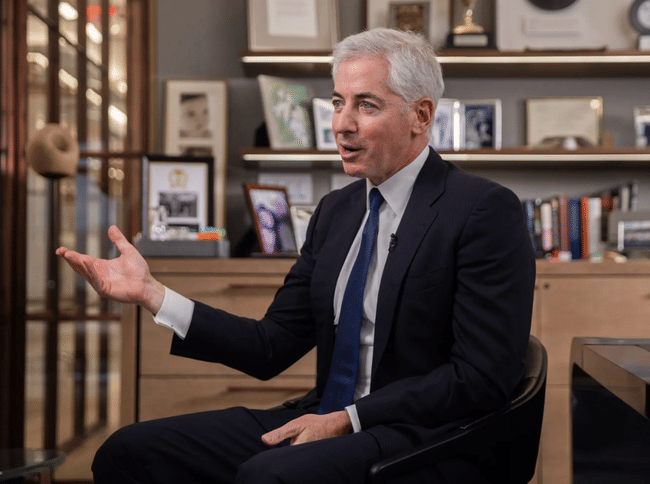
Bill Ackman is reading the same tape very differently. In a letter to investors he describes the current turmoil as an advantage, not a hurdle, arguing that macro driven selling is allowing his fund to buy leading US companies at what he views as attractive valuations, even as the S&P 500 still trades around 20,6 times forward earnings, down from roughly 22 times at the start of the year but above its long term average. With prediction markets putting the odds of a US recession by the end of 2026 at just under 30% and the top ten S&P names expected to grow earnings by more than 20% annually over the next two years, he believes today’s multiples on global giants in tech, healthcare and consumer platforms are not only defensible but, in some cases, starting to look outright cheap.
The S&P 500 is down 5.4% since the conflict began
The S&P 500 $^GSPC has fallen 5.4% since the war with Iran began on February 28 . Thursday's 1.7% drop was then the worst since January, dragging the index to its lowest closing level since September, with eight of 11 sectors ending in the red.
The technology-focused Nasdaq 100 fell 2.4%, led by big names such as Nvidia Corp $NVDA and Meta Platforms Inc $META. The S&P 500 hit a seven-month low, while the Dow Jones fell 1.73%.
Energy stocks rose 18% for the month
The conflict with Iran has significantly restructured US equity markets. The energy sector rose 18.2% during March - Exxon Mobil $XOM gained 16.4%, Chevron $CVX 14.8%, ConocoPhillips $COP 21.3% and Pioneer Natural Resources 19.7%.
Defense stocks gained 14.7%, with RTX $RTX (formerly Raytheon) up 22.1%, Lockheed Martin $LMT up 19.4%, Northrop Grumman $NOC up 17.2% and L3Harris $LHX up 15.8%. Meanwhile, Congress approved $45 billion in emergency defense spending in March.
West Texas Intermediate (WTI) crude is up nearly 50%, while Brent crude futures, the international benchmark, are even higher.
Ackman: Chaos is an advantage, not a hindrance
In a letter to investors, Ackman explicitly called chaos "an advantage, not a hindrance." He argued that stock market disruption helps his fund buy high-quality companies at bargain prices because of macroeconomic events that may not affect their long-term intrinsic value.
Bettors at prediction market Polymarket put the probability of a recession in the US by the end of 2026 at around 29%, with Ackman reportedly able to amass the $10bn he needs to find bargain buys in his current position.
He believes current valuations are justified
According to Motley Fool analysis, the S&P 500 is now trading at about 20.6 times aggregate estimates of future earnings. That's still well above its long-term average, but well below the 22 times earnings at which it traded at the beginning of the year.
Ackman points out that the 10 largest companies in the S&P 500 are expected to grow earnings per share by more than 20% on average over the next two years. As a result, their higher-than-average valuations are justified. In fact, some of them look like bargain buys at today's prices.
The top "10" S&P 500 stocks by weight
Rank | Company | Ticker | Note |
|---|---|---|---|
1 | Nvidia | Megacap AI/chips | |
2 | Apple | iPhone, HW/SW ecosystem | |
3 | Microsoft | Cloud, software, AI | |
4 | Amazon.com | E-commerce, AWS cloud | |
5 | Alphabet | Google, YouTube, AI, both classes in aggregate | |
6 | Broadcom | Chips, networking, SW acquisitions | |
7 | Tesla | EV, energy, software | |
8 | Meta Platforms | Facebook, Instagram, WhatsApp, AI | |
9 | Berkshire Hathaway | Conglomerate, insurance companies, equity portfolio | |
10 | Eli Lilly | Healthcare |
These advantages include "their global size, dominant market position, access to low-cost capital, and leadership in artificial intelligence and related technologies." Ackman concludes, "The market's P/E multiple is justified and can remain sustainably higher than historical averages."
History points to a rapid recovery after geopolitical shocks
Strategists at Carson Group compiled a list of 40 major geopolitical and historical events over the past 85 years and calculated the S&P 500's returns in the months ahead. On average, the S&P 500 lost 0.9% in the first month afterward, but rose 3.4% in the six months following the event.
The average weekly decline in the Standard & Poor's 500 Index after the initial geopolitical shock is 1.09%, according to a Stock Trader's Almanac analysis of 17 incidents since 1939. Twelve months after each crisis, the S&P has posted an average gain of 2.92%.