
Ferrari last week made a move that many premium brands have not ventured into in an era of cooling demand for electric cars. In Rome, it officially unveiled its first all-electric model, the Luce - a four-door, five-seat GT costing around 550,000 euros, with more than 1,000 horsepower, a 122 kWh battery and a range of around 530 kilometres. Deliveries are scheduled to begin in the fourth quarter of 2026, and the car immediately became one of the most expensive production electric cars in the world.
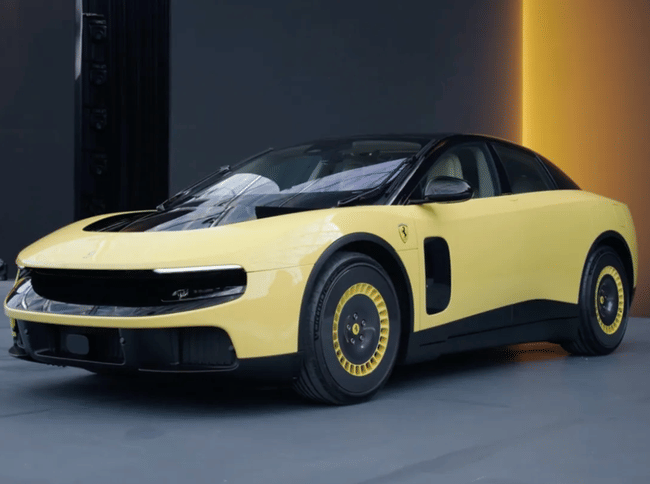
While Porsche, Lamborghini and other manufacturers have rather put the brakes on their EV plans in recent months, Ferrari has chosen the opposite direction. The Luce is meant to be a technological showcase, proof that pure electric power can handle the company's dynamics while delivering something that Ferrari's internal combustion car never could - five full-size seats and a giant trunk.
Why Ferrari is betting on EVs now
Ferrari $RACE entered the pure EV era at a moment when much of the luxury market was retreating. Ford $F announced write-downs and losses totaling nearly $20 billion related to EV programs and model cancellations, and along with General Motors $GM and Honda $HMC scaled back investment plans. Lamborghini, meanwhile, canceled its planned all-electric Lanzador, saying demand in the target segment was "near zero" and the brand was shifting back to plug-in hybrids. Porsche $P911.DE has cut back on its own battery projects in 2025 and slowed electrification targets.
Ferrari itself has softened its original target of having up to 40% of sales in its pure-electric portfolio by the end of the decade - it's now talking more like 20%. Still, it decided to launch the Luce and build a story of generational technological change around it. According to boss Benedetto Vigna, the model is the result of five years of work and is intended to be proof that "the best Ferrari for a particular segment may not necessarily be electric".
Technology: four engines, over 1,000 hp and a 122 kWh battery
https://www.youtube.com/embed/Gf2TI6tfWA0?rel=1The Ferrari Luce is the first five-seater model in the brand's history and the first production EV with the cavallino rampante logo. Basic specifications:
four synchronous electric motors - one for each wheel - with a combined output of around 830 kW, or over 1,100 hp.
0-100 km/h acceleration in 2.5 seconds, 0-200 km/h in about 6.8 seconds, top speed over 310 km/h
122 kWh battery (NMC cells from SK On) with a claimed range of over 530 km according to WLTP
800V architecture with fast charging up to 350 kW
weight of around 2260 kg, centre of gravity reduced by 95 mm compared to the Purosangue SUV and torsional rigidity increased by around 35% thanks to the integration of the battery into the floor
Performance is therefore more in line with a hypercar than a "family" car. Ferrari has sought to exploit the four-motor layout to the full - including independent torque vectoring at each wheel - while grappling with the physics of a two-tonne car through optimised weight distribution, a low centre of gravity and an active chassis.
An interesting detail is the "synthetic sound": engineers use accelerometers on the rear axle to sense vibrations from the transmission and engine components, which the VCU then filters and amplifies like an electric guitar to create a mechanically faithful sonic signature of the powertrain both inside and outside the cabin.
A strategic bet on ultra-luxury families
Luce is targeting customers who want to use the Ferrari as an "everyday" car while having more than half a million euros in the bank.
Five full-size seats and a large trunk open up a new type of use for the brand - family travel, longer routes and everyday operation
a range of over 500 km and fast DC charging solves some of the practical concerns
the all-electric platform made it possible to make better use of space and offer comfort that would have been difficult to achieve with a front-engined internal combustion engine and conventional gearbox
But at the same time, Ferrari doesn't want to sacrifice exclusivity. Production is to be limited and target the brand's existing clientele - Vigna and product marketing boss Emanuele Carando have been open about the fact that customer reaction will be "very mixed" and some traditional fans will hate the car. That's also why the automaker is talking about the Luce as a long-term project, intended to bring more than 60 new patents and serve as a technological foundation for future models, not a mass-market bestseller.
Ferrari results and analysts' view on RACE stock
On the numbers side, Ferrari entered the Luce launch from a position of strength. The company beat Wall Street expectations in the first quarter of 2026:
Adjusted earnings per share reached 2.33 euros (about $2.72)
Sales of 1.85 billion euros meant year-on-year growth of just over 3% compared to 1.79 billion a year ago
The automaker confirmed its outlook for 2026, including net revenues of around €7.5 billion and adjusted operating profit of at least €2.22 billion
Shares of Ferrari (RACE) were trading around $347 apiece, which, with a market capitalization of about $86 billion, corresponded to a P/E of about 33 and a dividend yield of about 1.2%. According to Wall Street data, the company still had a bullish consensus: the median 12-month target price was around $475, with a range of about $406 to $572 depending on individual houses.
Vigna repeatedly emphasizes three pillars: exclusivity (limited supply), brand appeal and disciplined production. The electric strategy is to be based on this - no mass-produced EVs, but expensive, technically exceptional pieces with high margins.
Gamble in a time of electrical uncertainty
When a brand that defined the idea of a "roaring" internal combustion supercar launches a five-seat all-electric sedan and claims that electric propulsion was a necessary condition for the creation of such a car, it sends a strong signal to the entire industry.
Ferrari argues that:
a five-seat sedan with more than 1,000 horsepower, individually controlled motors at each wheel, active suspension and rear steering would be virtually impossible to build with an internal combustion engine in such a combination of power, handling and space
electric drive is not only 'sufficient' but in some segments can be better than an internal combustion solution in terms of dynamics and control
At the same time, he recognises that it is a risk: Carando has openly admitted that part of the customer base will love the Luce and part will hate it. At a time when competitors are backing away from EVs and writing billions of dollars of write-offs, it's a bet against the tide - but that's what Ferrari has done often in the past, and its influence on car culture has always been significantly greater than the sheer volume of sales.