
Boeing is returning to China after nearly a decade of a virtual trade drought, not only symbolically but also in numbers. During Donald Trump's summit in Beijing in May, the company announced China's initial commitment to buy 200 planes, which CEO Kelly Ortberg said would be just the "first part" of a much larger package. Against the backdrop of a years-long ban on new orders and a supply freeze, it is the largest Chinese purchase in Boeing's history and a key step toward rebuilding the second-most important market for commercial aircraft.
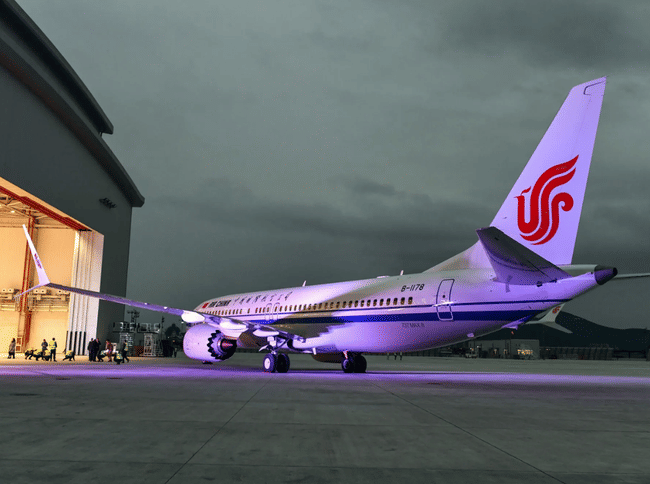
The deal is not just business news, but also a political signal. Ortberg accompanied President Trump to China along with the heads of other US technology and industrial firms including Tim Cook, Elon Musk and Jensen Huang. By his own admission, an order this large is "100 percent dependent" on the course of US-China negotiations. This means that Boeing is more dependent on the Washington-Beijing political axis in the short term than a long-term investor would ideally like.
What exactly was agreed: 200 aircraft as a down payment on a larger package
Formally, Boeing $BA confirmed China's initial commitment for 200 aircraft, saying it expects additional orders to follow this "initial series." Ortberg speaks of a "very successful trip to China" and that the main goal was to reopen the Chinese market for orders - not to negotiate a complete megapackage right away.
The market initially speculated an even larger number, so the initial volume of 200 units may look less overwhelming on paper. But more important is the quality of the signal: Beijing is finally letting Boeing back in the game after years of official bans. Given the size of the Chinese market and the average prices of narrow- and wide-body machines, we're already talking tens of billions of dollars in book-to-bill value for these 200 units, with an eye on multiplying that volume in the years ahead.
For production, this means that Boeing can start planning Chinese slots back into the existing backlog. It already has over 6,800 aircraft on order, including more than 4,300 737 MAXs, with a total value of around $600 billion. Thus, new Chinese commitments could account for a significant portion of assembly line utilization over the next decade, especially if the broader package of 500+ narrow-body and 100 wide-body machines under consideration can be completed.
Politics in the cockpit: Trump's role and dependence on geopolitics
Ortberg's words about not expecting "any big short-term orders from China" without the administration's active involvement are a good indication of how deeply entrenched the trade embargo was. When Donald Trump returned to the White House in January 2025, a new tariff war kicked off, to which Beijing responded with an outright ban on Chinese carriers ordering Boeing aircraft - and even taking delivery of previously ordered units.
Only a ceasefire in the trade war late last year opened the way for a resumption of "normal" activity with Chinese customers. The current deal is thus not an isolated commercial event, but part of a broader political package. For Boeing, the impact is twofold:
In the short term, it is a huge positive - without this reset, the company would continue to lose ground to Airbus and its domestic COMAC;
in the long term, it increases the political risk - any deterioration in relations could quickly close the Chinese door again.
Ortberg was personally present at the Beijing talks alongside the heads of GE Aerospace and others when Trump announced the framework agreement, in which Beijing promises to buy hundreds of jets and engines from U.S. manufacturers, essentially confirming that without "big politics" Boeing would have had a hard time getting into China on this scale.
The end of a decade-long fast: why China is critical for Boeing
Since the two 737 MAX 8 crashes in 2018-2019, Boeing's position in China has been gradually dismantled by a combination of safety concerns, regulatory delays and a trade war. While deliveries of some types have resumed in recent years, a large new order from China hasn't come in nearly a decade.
In the meantime, Beijing has been buying massively from Airbus and pushing the development of a domestic manufacturer, COMAC (ARJ21, C919), to be a strategic alternative to Western manufacturers. For Boeing, traditionally the largest US exporter by dollar value, this meant not only a loss of market share but also a reputational blow. China is one of the fastest growing aviation markets, and if it were to be "written off" in the long term, Boeing would have to cut capacity or rely on other regions to fully replace the missing demand.
The current agreement thus breaks a roughly 10-year horizon in which Chinese airlines have not placed a large order with Boeing. The political truce and the resumption of the ability to realistically deliver new machines to China puts the company back in the game for tens of percent of global demand for narrow-body aircraft. Without this market, Boeing's long-term investment story would be significantly weaker.
What might come next: from 200 units to 600+ aircraft?
According to Bloomberg, Fox Business and Aerotime, China is considering a much larger package: up to 500 737 MAXs and about 100 wide-body jets. If this framework actually comes to fruition, it would be one of the largest orders in commercial aviation history - and a contract that could fundamentally change Boeing's revenue and utilization trajectory for the next decade.
Analyst Richard Safran of Seaport Global Securities estimates that such a summit sale could mean an additional five 737 MAXs per month in the production schedule. For the 737 family, that represents a very noticeable increase in monthly revenue and a better spread of fixed costs. At the same time, however, it should be perceived that:
Boeing will only be able to realistically deliver higher volumes from this new package in a year or two
the current capacity and supply chain is already running at high speed and the company is still facing pressure on quality and controls after previous scandals
In other words, the potential mega-contract from China is a structural story, not an immediate boost to results in the coming year. In the short term, it mainly adds confidence to the backlog and reassurance that Boeing will have someone to produce for once production capacity continues to stabilize and increase.
What's in it for Boeing
Several key points can be drawn from the combination of facts:
China is not lost - on the contrary, after years of stagnation, there is room for new large orders. This reduces the risk of a long-term market share decline in favour of Airbus and COMAC.
Political risk remains high - the current success is strongly linked to the Trump administration and the current "truce" in the trade war. Any new escalation could quickly change the playing field again.
Backlog is getting better - a higher proportion of Chinese customers and major airlines increases revenue visibility over years to decades.
Manufacturing and supply chain will be under pressure - to realistically monetize new Chinese contracts, Boeing must simultaneously manage increasing production rates, addressing quality issues and regulatory confidence.
Overall, the Chinese contract is significantly positive strategic news for Boeing: after years of defensiveness and crisis, the company is getting back to a growth market that can fill its order books for a long time.