
When Chipotle Mexican Grill $CMG announced a stock split at an unprecedented ratio of 50:1 in June 2024, it was intended as a gesture of goodwill toward small investors. At the time, a single share cost over $3,000, making it a virtually unaffordable piece of paper for the average retail investor. After the split, the price settled at a more affordable roughly $66, and the logic was clear: the more investors who could afford the stock, the more interest would grow.
But the market has a sense of humor all its own. The split occurred almost exactly at the peak. Since then, the stock has fallen by 53% and is currently trading around $33. Market capitalization has fallen to roughly $45.8 billion (just over 950 billion crowns). Over the past 52 weeks, the price has ranged between $28 and $58, so today’s value is closer to the yearly low than the high.
What actually went wrong? A stock split in and of itself means nothing; it’s purely a cosmetic move. The problem lies in the business itself.
When the Magic of Growing Revenue Fades
For years, Chipotle was a textbook example of a growth stock. Revenue grew at a double-digit rate, people stood in line for burrito bowls, and every new location churned out profits. In the second quarter of 2024—at the time of the stock split—revenue grew 18% year-over-year, and comparable sales (a key metric in the restaurant industry that measures the performance of locations open for more than a year) grew 11%.
Then came the turnaround. American consumers began to exercise greater caution, and belt-tightening took its toll even on the seemingly resilient fast-casual segment. For the full year 2025, revenue grew by only 5%, and comparable sales actually fell by 1.7%. For a company that had been trading at a premium valuation precisely because of its growth, this is a serious problem.
It’s worth noting that this slowdown wasn’t specific to Chipotle alone. It was a broader phenomenon across the entire U.S. dining industry, as customers shifted to cheaper options or simply began eating at home more often.
Margins Under Pressure: More Expensive Beef, Higher Labor Costs
The second problem is even more tangible. When sales slow and costs rise, margins find themselves in a vise. And that is exactly what is happening to Chipotle.
The restaurant-level operating margin has been falling in a stair-step pattern:
26.7% in 2024
25.4% in 2025
23.7% in the first quarter of 2026
This decline is driven by a combination of higher rent, higher wages, and rising ingredient prices, particularly for beef. The company further exacerbated the situation by lowering prices on certain items to maintain foot traffic. The result? People are still going to restaurants, but every burrito sold yields a smaller profit.
This is clearly reflected in the profit figures. In the first-quarter 2026 results, net income fell to $302.8 million, or 23 cents per share, from $386.6 million (28 cents) a year earlier. Adjusted earnings per share fell 17% year-over-year. The decline was driven by a higher effective tax rate, wage inflation, and the aforementioned beef costs.
"The first quarter exceeded our expectations. We advanced our 'Recipe for Growth' strategy and made tangible progress across operations, digital, menu innovation, people, and store development."
Scott Boatwright, CEO of Chipotle
The Departure of a Star CEO, Who Was Sidelined by Starbucks
The third factor is psychological, but all the more powerful for it. At the end of August 2024, longtime CEO Brian Niccol left the company to take the helm at Starbucks $SBUX in September. And he was no ordinary manager.
Under Niccol’s leadership between 2018 and the third quarter of 2024, Chipotle more than doubled its revenue and doubled its operating margin. From the end of 2014 through the third quarter of 2024 , the stock returned 567% to investors . It’s no coincidence that Starbucks chose him as the savior for its own turnaround; he was one of the most respected operators in the industry.
A change at the top always brings uncertainty, and the market doesn’t like uncertainty. New CEO Scott Boatwright must now prove that he can lead the company just as well as his predecessor. So far, it’s not clear-cut, though the initial signs aren’t bad.
Drive-thru windows and the dream of 7,000 locations
Whatever the short-term picture may be, one argument remains in the bulls’ favor: Chipotle still has plenty of room to grow in terms of the number of restaurants. In December 2025, the company opened its 4,000th location in Manhattan, Kansas, putting it roughly halfway toward its long-term goal of 7,000 restaurants in the U.S. and Canada.
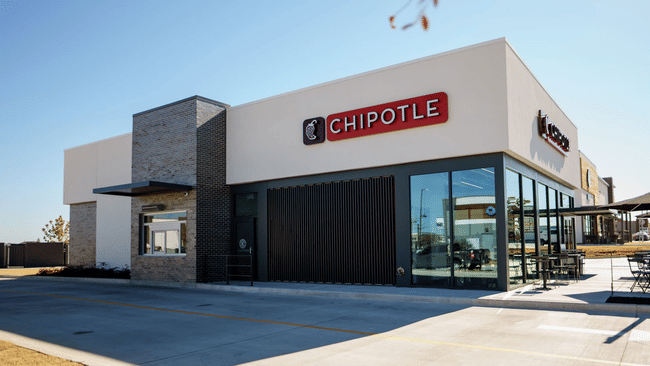
For 2026, management plans to open 350 to 370 new locations and aims for 8 to 10% annual growth in the number of locations going forward. So-called “Chipotlanes”—drive-thru windows for picking up digital orders from the car—play a key role. More than 80% of new restaurants will have them, and according to the company, these locations consistently outperform traditional stores in both performance and speed of service.
Its expansion beyond U.S. borders is also noteworthy. Chipotle currently operates around 115 locations outside the U.S. and is preparing to enter new markets: through partners, it plans to open its first restaurants in Mexico, South Korea, and Singapore by 2026. The international business is still a drop in the bucket, but it adds a new dimension to the story of long-term growth.
Here we see the contradiction that defines the stock. In the short term, the company is struggling with margins and cautious consumers, but in the long term, it is still on track to more than double the number of locations. For investors, the question is which of these two periods is currently influencing the price.
Is the stock cheap, or is it cheap for a good reason?
It’s interesting to see where Chipotle stands in terms of valuation. Following the decline, the stock is trading at a price-to-earnings (P/E) ratio of around 30, which is one of the lowest figures in recent years. For a company that has been accustomed to a P/E ratio well above 50 for years, this represents a significant revaluation.
Optimists argue that the brand’s quality hasn’t changed and that this is a temporary cyclical fluctuation. The latest figures partly support their view: Revenue in the first quarter of 2026 rose by 7.4% to $3.1 billion, and comparable sales returned to positive territory with a 0.5% increase, exceeding analysts’ expectations, who had anticipated a slight decline.
Skeptics, on the other hand, point out that until margins rebound and profits grow, the stock will have no reason to rise. The key driver will be the trend in food prices. If inflation in raw materials begins to ease, margins could recover quickly, and with them, sentiment surrounding the stock.
Chipotle thus presents the classic dilemma of a fallen growth stock today. The brand remains strong, and the lines outside its locations haven’t disappeared, but the narrative of continuous growth—on which its premium valuation was based—has begun to crack. Whether this is a temporary pause or the end of an era will become clear with the next quarterly results—and, above all, whether the new CEO can pick up where his predecessor left off.