


Salesforce jumped 23%, Agentforce growing over 240%. Is a real turnaround starting?

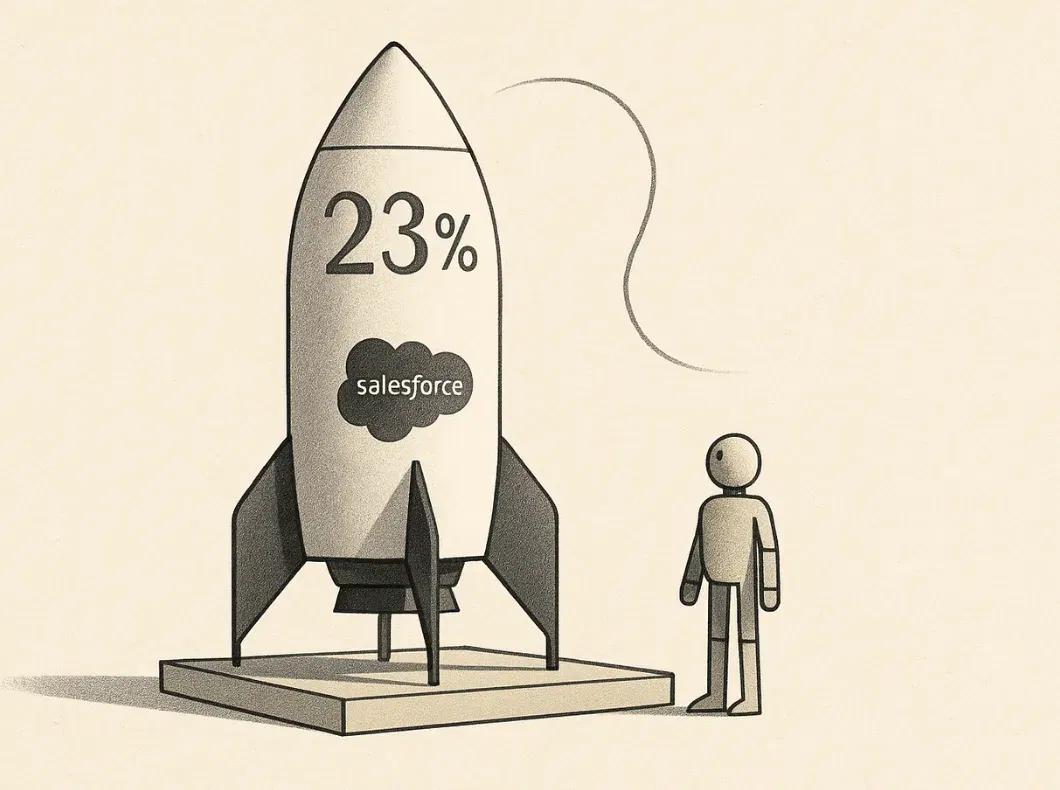
Salesforce $CRM stock gained 22.58% in a single session on August 27, 2026, closing at $252.05, its strongest day since 2020 and the second-largest one-day jump since going public in 2004. The trigger was quarterly results, a raised full-year outlook, and an expanded partnership with Anthropic. Ironically, the very technology for which the market had been punishing Salesforce and the entire software sector for months now sent the stock soaring.
Key points
Paradox at the core. The same technology that had been dragging Salesforce down for months sent the stock up 22.58% in a single day.
Agentforce is growing, but the company as a whole is slow. The AI business is adding over 240%, but total revenue is only up 11%, and after excluding the Informatica acquisition, the organic pace is around 6 to 7%.
Headline numbers are polished. Growth was boosted by the acquisition, and the doubled EPS largely comes from revaluing the stake in Anthropic, not from operations.
A new way Salesforce makes money. Charging for work done instead of per user is both an opportunity and a risk, because it could cannibalize classic licenses and change margins.
Debt-funded buyback and the valuation question. The company borrowed for the first time to fund a $25 billion buyback, and at $257.54 the stock lies between cautious and optimistic analysts' targets.
A day later, the stock added another 1.57% and closed at $256.00. The rally erased a substantial part of this year's decline, though the stock still sits roughly 6% below its high from the turn of the year. The question for an investor holding or considering it now sounds different than before the results. It is no longer about whether AI will destroy Salesforce, but whether it is just beginning to accelerate the whole company, or has only changed market sentiment.
Up a fifth in one day: why the market repriced Salesforce
Software stocks went through their worst period in years, and Salesforce was among the hardest hit. In early June, the stock was down more than 33% year-to-date and fell to an annual low around $146. Even in mid-August, just before results, it traded around $205. The sell-off was driven by a specific fear: that generative AI and autonomous agents would reduce the value of traditional software paid per user. The market even got a name for this fear: SaaS-pocalypse.
The logic of that fear was not stupid. Salesforce's classic model is based on the number of users who pay license fees. If companies replace some people with AI agents, paid licenses will decline along with revenue. Investors were not selling irrationally; they were betting on a scenario in which AI undermines the very core of the business.
The second-quarter fiscal 2027 results first significantly challenged that bet. Agentforce, Salesforce's AI agent platform, began appearing directly in the numbers, not just in management presentations. And the market, which had long punished the company because of AI, repriced it by a fifth in one day because of that same AI.
Not +240%, but +14%: which number really measures a turnaround
At first glance, the results were not revolutionary. Second-quarter revenue reached $11.3 billion, up 11% year-over-year. Subscription and support, the core recurring revenue, added 12% to $10.8 billion. Non-GAAP operating margin remained solid at 34.1%. A decent quarter for a large, mature software company, not numbers that alone justify a one-day 20% jump.
The revolution was hidden in another part of the income statement. Agentforce, the AI agent product line, achieved an annual recurring volume (ARR) of over $1.5 billion according to the company, up more than 240% year-over-year. In the quarter alone, agents performed 3.2 billion so-called agentic work units, i.e., completed tasks, 97% more than the previous quarter. Bookings of Agentforce premium packages more than doubled versus the prior quarter.