


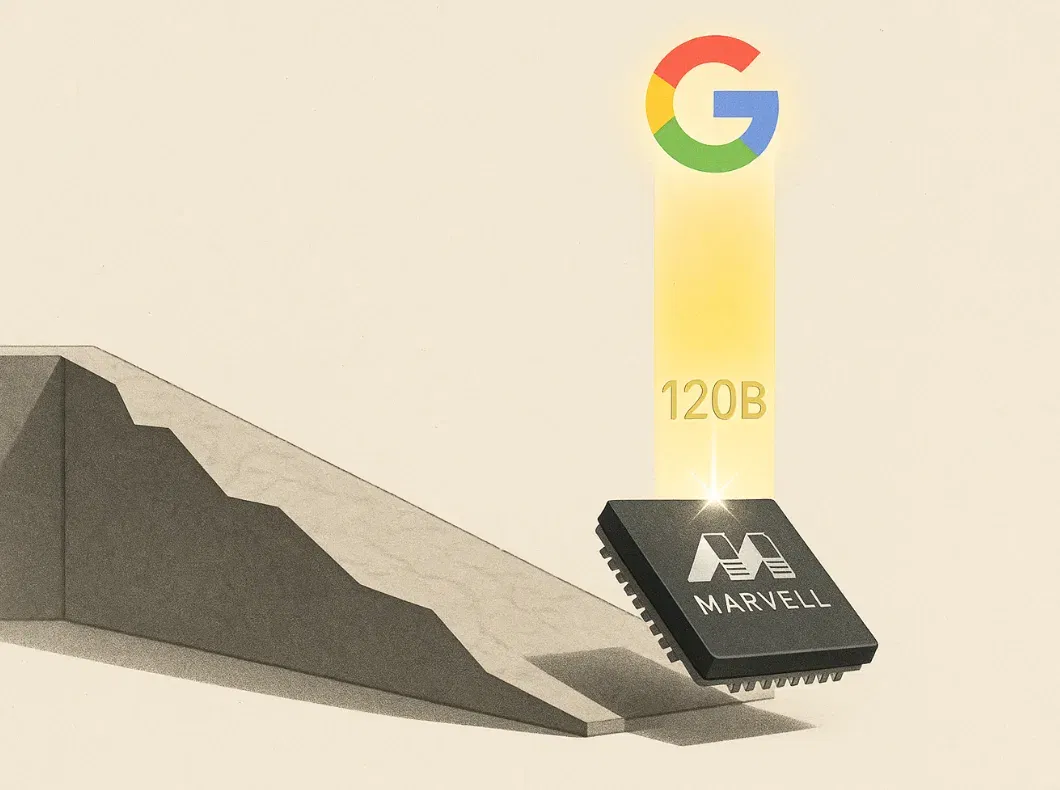
Google could bring Marvell up to 120 billion. Is the stock drop an opportunity?

Marvell Technology $MRVL at the end of August reported a quarter that would have sparked celebrations at most chip companies. Revenue of $2.739 billion, up 37% year over year, the data center segment accelerated growth to 46%, and management again raised its outlook, now to roughly $18 billion for fiscal 2028. On top of that, a fresh deal with Google $GOOGL, whose theoretical ceiling reaches as high as $120 billion in revenue. And yet the stock fell about 10% the day after results to $217. So the market didn't punish weak numbers. The problem was rather a combination of high expectations, a slower ramp of revenue from Google, and pressure from the custom business on gross margin.
Key points
The contradiction that runs through the whole article: a record quarter, a third raised outlook, and a deal with a $120 billion ceiling, yet minus 10% in a day. Why the market punished strong numbers becomes clear in the first third.
$120 billion is not an order: it's the upper bound of a warrant, not backlog or contracted revenue. How much of it is a realistic trajectory and how much a theoretical ceiling will be hinted at by the pace of the first tranches.
When, not if: the biggest financial effect of Google lies beyond FY2028. What exactly the company promised by then and what it pushed further out changes the entire reading of the drop.
The price of that deal: dilution, thinner margins of the custom business, and growing customer concentration. The real economic cost of dilution is different from what the number of new shares suggests.
Cheaper doesn't mean cheap: after a rise of about 180%, the drop is a return from an extreme, not a discount. Whether it was a reset or the start of multiple compression will be decided by a single date, and it's closer than it seems.
What the Google warrant really is and why $120 billion is not an order
The basis of the deal that Marvell announced on August 19 and signed as early as July 29 is not a classic order. Google received a warrant to purchase up to 58.97 million shares of Marvell at a fixed price of $206.58 per share, which at the exercise price corresponds to roughly $12.2 billion and about 6 to 7% of the company based on the current share count outstanding.
Most of the warrant does not unlock all at once. Of the total 58.97 million shares, roughly 1.36 million are time-based and vest during the first year. The remaining portion unlocks in 240 tranches based on Google's purchases, always after every $500 million of revenue from selected custom products. That gives exactly that $120 billion ceiling. Unlocking runs from the third quarter of fiscal 2027, and Google has until August 2033 to exercise.
What counts toward those revenues is narrower than the headline suggests. It's not one chip, but an entire ecosystem of silicon around Google-designed TPUs: AI accelerators for inference, storage controllers, network and memory controllers, and so-called near-memory compute. This circle is called XPU-attach, i.e., components that surround the main computing chip and handle how quickly data reaches it. The deal is not announced as a replacement for Broadcom in the design of the main TPU. Under the published terms, Marvell is primarily getting access to the broader ecosystem of custom chips attached to TPUs.