


Adobe down 60% from its all-time high. Can AI save the stock's decline?

The stock has lost 60% of its value in less than two years, even though the company itself continues to grow. Revenue is rising at a double-digit pace, operating margins are holding around 45% on a non-GAAP basis, and the company generates nearly $10 billion in free cash flow annually. Yet its traded value has fallen from $688 per share in November 2021 to around $266 currently, below twelve times earnings for the last four quarters.
Key points
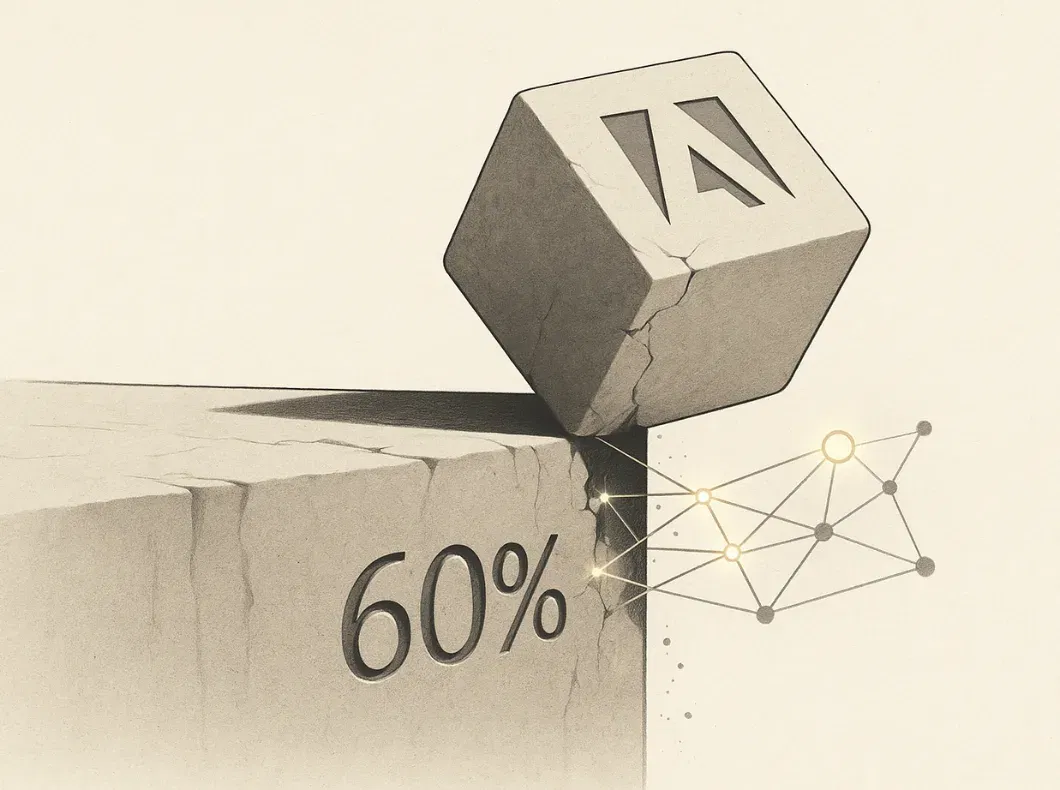
A 60% drop from its all-time high. The stock fell from $688 to around $266 currently, even though revenue and earnings continue to grow at a double-digit pace.
Forward P/E of only around 10x. Against a five-year average of around 30x, this is the deepest discount among comparable software companies like Autodesk or Salesforce.
AI-first ARR tripled to over $500 million. Relative to total ARR of $27.1 billion, it still represents only about two percent; AI monetization is growing rapidly from a very small base.
Three leadership departures in half a year. The CEO, CFO, and president of the creative division all left between March and September 2026, deepening uncertainty just as competitive pressure is peaking.
FCF yield of 9.3% with double-digit revenue growth. The combination of cheap valuation and healthy cash flow suggests the market has priced in a scenario closer to the bear case than to the numbers so far.
In such a situation, the market usually prices one of two things. Either a company whose business model is falling apart, or a company hit by short-term fear disproportionate to the real impact on its financials. At Adobe, both interpretations are possible at once. Generative AI can create an image, video, or document in seconds—exactly what the company has charged a monthly subscription for for years. Yet Adobe has beaten analyst earnings estimates for five consecutive quarters and in June 2026 raised its full-year outlook.
The key test remains whether third-quarter results confirm or refute the slowdown from the first quarter. Until then, both interpretations—structural problem and overblown sentiment reaction—are supported by a comparable amount of data.
Why the market stopped believing in Adobe
Valuation in ruins, results fine
The decline in Adobe stock is not a one-off event but a gradual process:
Period | Stock price change |
|---|---|
2024 | approximately -25% |
2025 | approximately -21% |
2026 (year-to-date) | approximately -18 to -20% |
Cumulative from peak (November 2021) | approximately -60% |
Forward P/E, i.e., the ratio of stock price to expected earnings for the next twelve months, has fallen to around ten times, according to data, even though the company's five-year average is around thirty times. A similar drop hit the entire software sector, but at Adobe it is the most pronounced among comparably sized companies.
But this decline does not correspond to the development of fundamentals. Adobe increased revenue by 11% and net income by 28% for fiscal 2025. Yet after second-quarter fiscal 2026 results, when the company again beat revenue and earnings estimates, the stock fell more than 6% in a single day. The market in this case reacted not to what Adobe earned, but to what it signaled about the future—specifically, the slowing pace of new net additions to recurring revenue (Net New ARR) in the Digital Media segment.
Leadership in disarray as an accelerator of distrust
In 2026, a series of personnel upheavals added to AI concerns:
March 2026: longtime CEO Shantanu Narayen announced he would step down from operational leadership of the company.
June 2026: CFO Dan Durn left for Marvell Technology, having resigned from that company's board the day before the announcement.
September 3, 2026: Adobe confirmed that Anil Chakravarthy would become the new CEO effective December 1, 2026, while Narayen moves to executive chairman.
September 4, 2026: David Wadhwani, president of the creative and productivity division, which generates roughly three-quarters of total revenue and was one of the main CEO candidates, announced his own departure.
Three high-level departures within half a year, concurrent with the open question of AI disruption, are a signal investors usually penalize regardless of current financial results. On top of that, in March 2026 came the settlement of a consumer lawsuit with the U.S. Department of Justice for $150 million, according to the DOJ over hidden early termination fees for subscriptions. Financially marginal against ten billion in cash flow, but reputationally adds another layer of distrust toward a company also facing a separate lawsuit over data used for AI model training.
Is AI a threat or an opportunity for Adobe?
The answer varies by portfolio segment, so it's appropriate to break the analysis down by product line rather than making a general claim about 'creative software being threatened':
Product line | YoY growth | AI threat level | Main defensive advantage |
|---|---|---|---|
Creative Cloud (Photoshop, Illustrator, Premiere Pro) | 10% | High | Depth of professional tools, integration into corporate processes |
Acrobat / Document Cloud | 17-18% | Low | PDF format network effect, corporate approval processes |
Digital Experience (marketing, Semrush) | 8-9% | Lowest | Long enterprise contracts, complex integrations |
Photoshop, Illustrator, Premiere Pro: the most exposed core
Canva with more than 260 million monthly active users and its acquisition of Affinity, or generative models like Midjourney and Sora, lower the barrier to entry for visual content creation. For the casual user who needed Photoshop only for minor edits, a cheaper and simpler alternative now exists. Adobe is responding with the Express product and integrating Firefly directly into flagship applications, trying to keep users within the Creative Cloud ecosystem. The competitive advantage that AI cannot easily erase lies in the depth of professional features, in layer and mask control at the pixel level, and in integration with enterprise processes—exactly the areas where professional users still need the control that purely generative tools do not offer.
Acrobat and Document Cloud: paradoxically the most stable segment
The document segment, including Acrobat, e-signing, and AI Assistant, has grown faster than the creative division in recent years. The PDF format and corporate approval workflows create a network effect that is difficult for competitors to replicate. Here AI works primarily as an accelerator, not a threat, because AI Assistant speeds up summarization and search within documents, and companies pay extra for that feature without it replacing Acrobat itself.
Digital Experience: least threatened but slowest growing
Customers of the marketing and analytics division around Adobe Experience Platform and the recently acquired Semrush are large enterprises with long contract cycles, which don't switch vendors because of a marketing trend. The risk of AI disruption is lowest here because it's enterprise infrastructure, not a creative tool with an obvious consumer alternative.
Firefly and the monetization question
The decisive factor is whether Adobe can earn more from AI than AI threatens from its existing revenue. Second-quarter fiscal 2026 numbers give a partial answer:
AI-first ARR (recurring revenue from purely standalone AI products) tripled year over year and exceeded $500 million.
Firefly ARR (revenue directly from the Firefly app, credit packs, and enterprise licenses) is around $300 million and growing by half quarter over quarter.
Against total company ARR of $27.1 billion, AI-first ARR alone still represents only about two percent.
A broader metric, so-called AI-influenced ARR, exceeded five billion dollars according to Narayen's statement from autumn 2025. But this metric includes all subscriptions where the user used any AI feature—including a customer paying the same subscription as last year who just clicked once on a generative tool inside Photoshop. The difference between AI-first ARR as truly new, incremental revenue and AI-influenced ARR as existing subscription with an added AI feature is crucial for understanding how much of the communicated growth is real monetization and how much is marketing spin on existing revenue.