


Wegovy worked in children too. Why are Novo Nordisk shares still falling?

Novo Nordisk treats 70% more people with obesity than a year ago, dominates the weight-loss pill market, and has now succeeded even in six-year-olds. Yet it expects revenue to decline and the market values it like a company in decline. Where is the mistake?
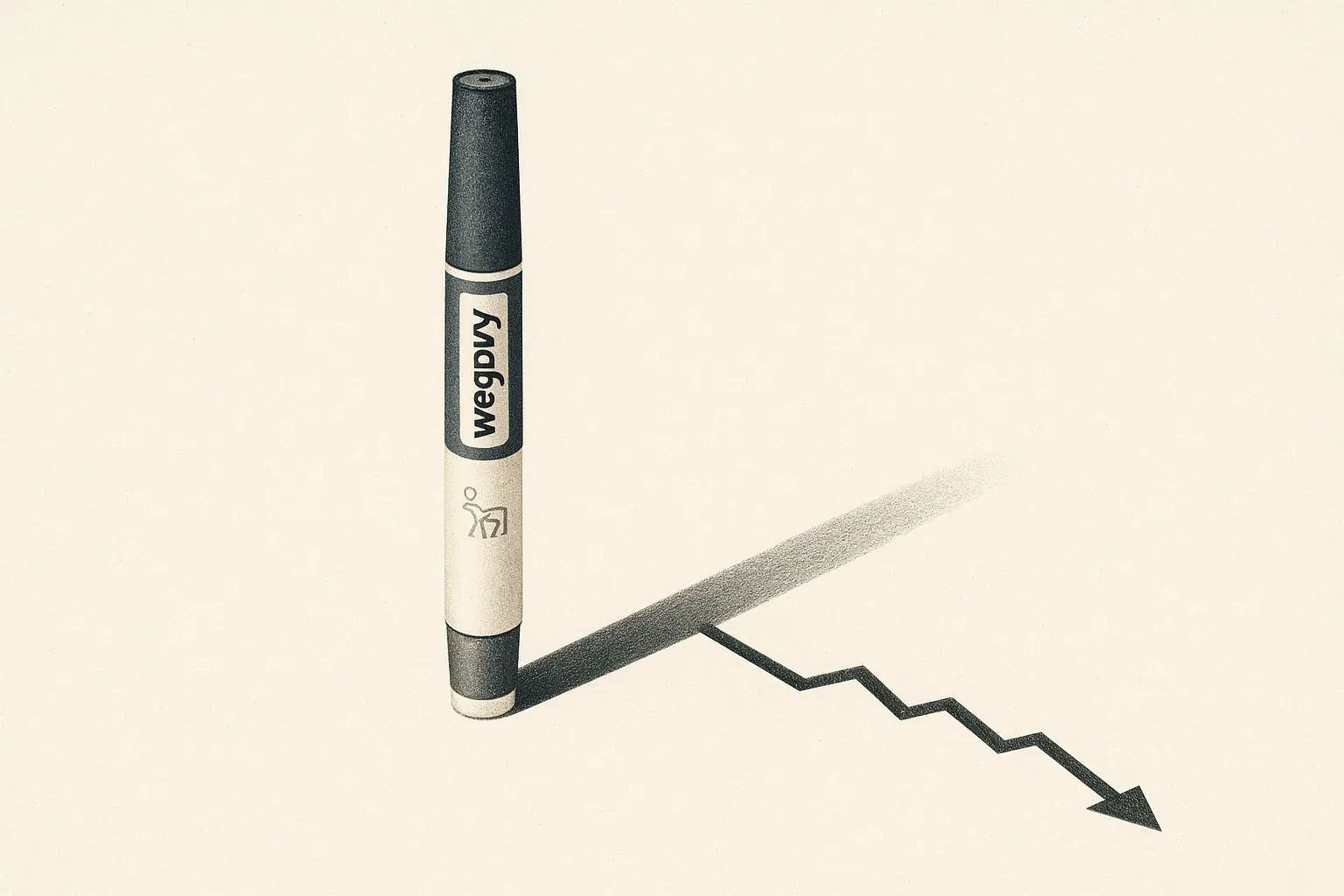
Key points
Novo Nordisk treats 70% more people with obesity than a year ago, yet expects its revenue to fall this year
In a study of children aged six and up, 40.4% dropped below the obesity threshold, while in the placebo group not a single child did
For the leader of the weight-loss boom, the market pays a P/E of around 11, while the pharmaceutical average is over 22
In injectables, Novo is losing to Eli Lilly 40:60, but in pills it holds about 80% of the new market—and the market doesn't care
Three risks are already in the share price, two more apparently are not, and one of them has a date after 2031
Two pieces of news on one day, and the market picked the worse one
On Monday, September 7, Novo Nordisk $NVO released results that doctors had been waiting years for. In the STEP Young study, 165 children aged 6 to 12, over 85% of whom had severe obesity, received semaglutide—the active ingredient in Wegovy—for 68 weeks. According to the company's press release, 40.4% of them dropped below the obesity threshold. In the placebo group, not a single child achieved that.
On the same day, however, Novo announced that it was halting two studies, HERMES and ATHENA, of the heart drug ziltivekimab because an independent committee concluded they had no chance of success. And the market chose the worse of the two pieces of news. After a morning plunge, the Copenhagen-listed share ended Monday roughly flat, and on Tuesday it fell to around DKK 296. It is now nearly 30% below its 52-week high of DKK 410, and more than 70% below its summer 2024 peak above DKK 1,000. New York-listed ADRs closed around $45 on Tuesday.
Today the market values the whole company at roughly $200 billion—about CZK 4.2 trillion—and prices its earnings at a P/E of around 11. The pharmaceutical sector average is over 22. That's how you value a company running out of steam, not the leader of the decade's biggest pharmaceutical boom. The pediatric data is just the latest example of the paradox that has puzzled investors in Novo Nordisk for a year now.