


Orders of $664 billion, cloud +121%. Oracle has certain growth, return not so much

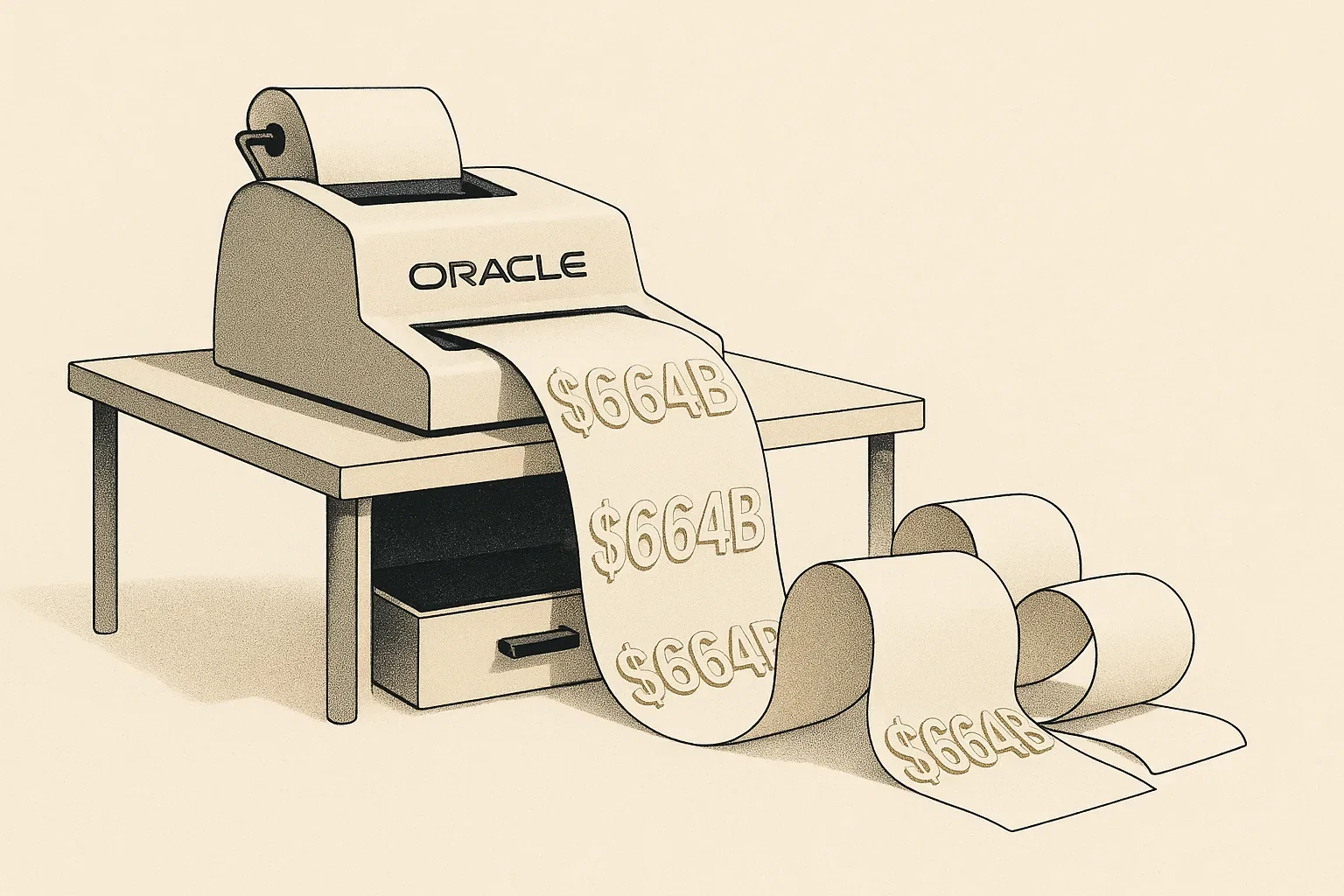
Oracle $ORCL closed the quarter ending August 31 with signed and not yet recognized orders of $664 billion. Over those three months it poured $28.5 billion into data centers and free cash flow ended at -$5.4 billion. The previous quarter could be read as backlog growing much faster than anything on the income statement; the first quarter of fiscal 2027 changed that: revenue rose 30% to $19.3 billion, cloud revenue 62%, and cloud infrastructure 121% to $7.4 billion. The company also raised its full-year non-GAAP earnings per share guidance to $8.10.
Key points
Oracle has signed orders of $664 billion, more than seven times this year's expected revenue. But the backlog signed last quarter will, according to management, turn into revenue no earlier than fiscal 2028.
Operating margin rose from 29% to 35%, while cloud delivery costs jumped 77%. The difference was offset by cuts in marketing and development, and the company is now laying off for the second time in a few weeks.
In a single quarter Oracle invested $28.5 billion and free cash flow ended at -$5.4 billion, the fifth negative quarter in a row. Depreciation more than doubled over the year.
The stock trades at 17.3 times expected earnings, lower than most large tech companies. But the price includes $125.34 billion of debt and net debt higher than total equity.
Last September the stock peaked at $329.50 and signed orders were worth $455 billion. Today backlog is almost half higher and the stock is at $140.35.
The market did not appreciate it; the stock has weakened since results on September 10 and closed on September 15 at $140.35, about 57% below last September's high. Oracle has demand signed for years ahead and at the same time pays for it today with negative cash, shareholder dilution, and depreciation that doubled over the year.
$664 billion in orders is not $664 billion in revenue
Remaining performance obligations is the sum of contracted performance not yet recognized in revenue: signed and undelivered orders, deferred revenue, and billed but not yet paid invoices. Oracle had $209 billion more in this item at the end of August than a year ago and $26 billion more than at the end of May.
The gap between backlog and revenue is unusually large for Oracle. Full-year guidance assumes revenue of at least $90 billion, so contracted performance equals more than seven times this year's expected turnover (own calculation from guidance and RPO). No comparable software company has such visibility.
But the pace of additions has slowed significantly. In the last quarter of fiscal 2026 backlog rose by $85 billion, in the first quarter of FY2027 only by $26 billion. Year-over-year RPO growth thus fell from 363% to about 46%. That alone does not mean weakening demand, because last year's base was exceptionally low, but it shows that another jump in orders is less likely today than a year ago.
Three things cannot be read from the contracted volume.
When it will turn into revenue. Oracle recognizes revenue when it delivers capacity and starts providing the service. Management said on the earnings call that backlog signed in the first quarter will not translate into capital expenditures or revenue before fiscal 2028.
At what margin. RPO is a dollar value, not a margin. How much of each dollar remains after GPU, energy, and depreciation costs, the contracted amount does not reveal.
Who pays for hardware. In large AI contracts the customer either prepays for GPUs or buys them itself and delivers them to Oracle. In June the company quantified the volume of such customer-financed hardware at $75 billion.
The last point has changed the nature of the entire backlog over the past year. Of more than $30 billion of new AI contracts signed in the first quarter, the vast majority have the same structure, according to management, and the company therefore confirmed that it is not increasing its capital raising plan.
But there is another side. If the customer buys GPUs itself, Oracle cannot charge for their acquisition and part of the contract value stays with the customer. The company has not quantified this anywhere; it is the logic of the contracts, not a disclosed figure. Therefore, the volume of contracted performance and the profit that ultimately emerges from it do not grow at the same pace.
Backlog started turning into revenue. Gross margin paid for it
The argument that signed orders are just numbers on paper no longer holds after this quarter. Cloud infrastructure for the first time overtook the entire software segment and became Oracle's largest revenue item.
Segment | Revenue (USD million) | YoY |
|---|---|---|
Cloud total | 11,607 | +62% |
of which cloud infrastructure | 7,388 | +121% |
of which cloud applications | 4,219 | +10% |
Software | 5,550 | -3% |
Services | 1,414 | +5% |
Hardware | 774 | +15% |
Total revenue | 19,345 | +30% |
Note: Quarter ending August 31, 2026, source Oracle.