Nuclear power is back. Constellation could be one of the biggest AI boom winners

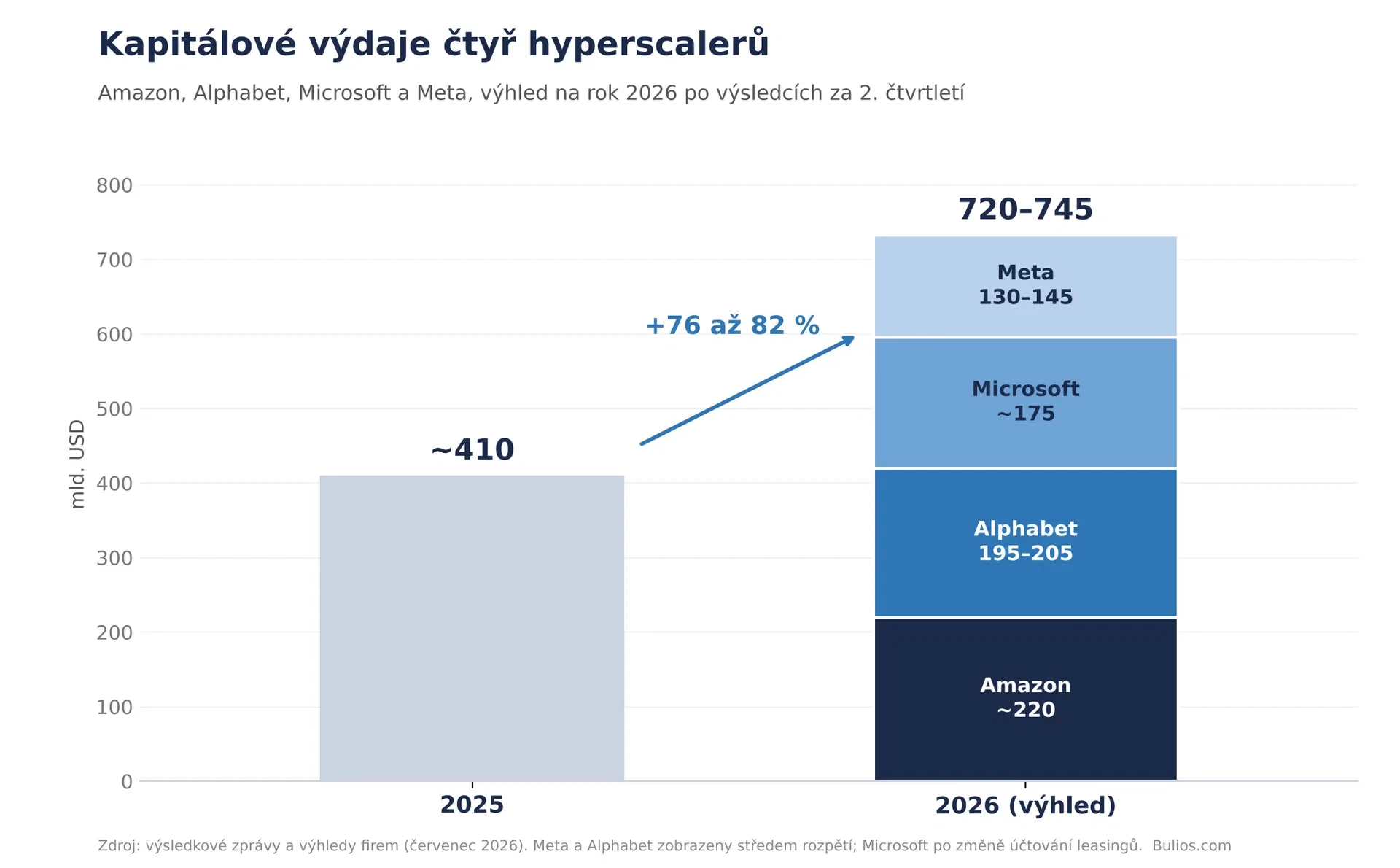
The four largest tech companies will spend over $700 billion on data centers and computing infrastructure this year. But every new data center needs electricity that flows 24 hours a day, and there is a shortage of it in the US market. The owner of the largest nuclear fleet in the US is therefore signing twenty-year contracts with Amazon, Microsoft, and Meta. The stock has lost roughly 35% from last year's high.
Key points
The stock has lost roughly 32% from last year's high, even though management has twice confirmed or raised guidance this year
Amazon signed a twenty-year deal for 690 MW from the Calvert Cliffs plant; Google is reportedly next in line according to Bloomberg
The largest nuclear fleet in the US has 22 GW, but only 30% of its emission-free output is contracted
At the management's plan, the stock trades at only 13 times 2029 earnings
The Three Mile Island restart in 2027 and the FERC decision on PJM rules will show whether the market's doubts are justified
Investors usually look for AI boom winners among chipmakers, server makers, and cooling system manufacturers. But computing capacity is useless without electricity, and in the US it is becoming a bottleneck of the entire chain. The mechanism is straightforward: hyperscaler capital expenditures lead to building more data centers, which increases electricity consumption, and the grid runs short of reliable capacity. Tech companies are therefore starting to sign long-term contracts directly with power producers, raising the value of existing assets that can generate around the clock and without emissions. At the end of this chain stands Constellation Energy $CEG. However, the stock has fallen sharply from last year's high, so the question is not only the strength of the story, but also how much of it the market has stopped pricing in.
Amazon and Calvert Cliffs: what the contract reveals
Deal parameters
On September 30, 2026, Constellation and Amazon $AMZN announced a twenty-year agreement covering the Calvert Cliffs nuclear plant in Maryland. Figures from the official press release:
The deal enables investments exceeding $3 billion in the entire plant, which currently has a capacity of 1,790 MW.
A power uprate will add approximately 190 MW of new emission-free capacity, expected to come online between 2030 and 2032.
The twenty-year contract covers a total of 690 MW, including the 190 MW uprate.
The parties also entered into a related retail supply agreement for Amazon's operations within the PJM market, which spans 13 states.
What matters is what the contract does not include. Electricity from Calvert Cliffs will not physically flow directly to Amazon's $AMZN data centers, but will continue to be delivered into the regional PJM grid. Amazon is thus not buying a cable from the reactor, but a financial commitment to offtake and pay for a specific volume of emission-free generation for twenty years. For Constellation, this commitment has another function: the two reactors from 1975 and 1976 would, under current licenses, have to shut down in 2034 and 2036. The Amazon contract provides the revenue certainty needed to apply for another twenty-year license extension.
Why Amazon doesn't just buy solar and wind
Amazon is one of the world's largest corporate buyers of renewable energy. But a data center for training and running AI models draws power nearly flat around the clock all year. A solar farm generates only during daylight, and wind depends on weather, so their annual output matches the data center's consumption profile only partially. The gap must be covered by the grid, where gas and coal dominate at night and in calm weather. A company that wants to claim emission-free operation hour by hour, not just in an annual total, needs a source with steady output. A nuclear plant with a capacity factor above 90% offers exactly that.
The second reason is reliability. A power outage in an AI cluster means interrupted computations and idle GPUs worth billions of dollars. Batteries can smooth fluctuations for hours, not days. Nuclear is thus the only large source that meets all three requirements for hyperscalers:
continuous operation
zero direct emissions
hundreds of megawatts at a single site.
What the deal says about the economics of US energy
The Calvert Cliffs contract is not used to get Amazon cheaper electricity. It serves to finance new capacity and extend the life of a source that would otherwise retire in the next decade. The tech company thus takes on the role previously filled by regulated utilities or state incentives: it provides long-term price certainty without which the investment would not pay off. For the generator, this changes the economics of a nuclear plant from a commodity business, whose price fluctuates with weather and gas prices, to an infrastructure asset with a twenty-year contract with an investment-grade offtaker.
Alphabet $GOOG may soon join Amazon. According to a Bloomberg report from October 6, 2026, Google is nearing a multi-year agreement with Constellation worth at least $1 billion. Neither company has confirmed it yet, and the volume and location are unknown.
AI and electricity: from chip to grid
Power density and a new consumption profile
A classic server rack in a data center used to draw roughly 10 to 15 kW. A rack with an NVIDIA $NVDA GB200 NVL72 system, which connects 72 GPUs, runs around 120 kW. The same floor space thus creates several times higher electrical and thermal load, requiring liquid cooling and stronger grid connections. Training a large model runs for weeks to months at nearly full power, and inference—serving user queries—creates continuous load. AI data center consumption therefore has no pronounced daily peak and valley, but resembles industrial operations.
Hyperscaler capital expenditures
After second-quarter 2026 results, Amazon (approximately $220 billion), Alphabet ($195–205 billion), Meta $META ($130–145 billion), and Microsoft $MSFT (approximately $175 billion after a change in lease accounting) plan combined capital expenditures this year of roughly $720–745 billion. In 2025 it was about $410 billion. A large share of this goes to chips and buildings, but every gigawatt of computing capacity requires a gigawatt of supply from the grid.